Articles | Volume 37, issue 2
https://doi.org/10.5194/ejm-37-143-2025
© Author(s) 2025. This work is distributed under
the Creative Commons Attribution 4.0 License.
the Creative Commons Attribution 4.0 License.
https://doi.org/10.5194/ejm-37-143-2025
© Author(s) 2025. This work is distributed under
the Creative Commons Attribution 4.0 License.
the Creative Commons Attribution 4.0 License.
Letter
| 
07 Mar 2025
Letter |
| 07 Mar 2025
| 07 Mar 2025
Fe3+∕ΣFe variation in lawsonite and epidote in subducted oceanic crust

Department of Earth and Environmental Sciences, University of Minnesota, Minneapolis, MN 55455, USA
Max Wilke
Institut fũr Geowissenschaften, Universität Potsdam, 14476 Potsdam-Golm, Germany
Sara E. Hanel
Department of Earth and Environmental Sciences, University of Minnesota, Minneapolis, MN 55455, USA
Florian Heidelbach
Bayerisches Geoinstitut, Universität Bayreuth, 95440 Bayreuth, Germany
Olivier Mathon
European Synchrotron Radiation Facility, Grenoble, 38000, France
Angelika D. Rosa
European Synchrotron Radiation Facility, Grenoble, 38000, France
Related authors
Katherine F. Fornash, Charles Petty, Erkan Toraman, Gültekin Topuz, and Donna L. Whitney
Eur. J. Mineral., 38, 567–574, https://doi.org/10.5194/ejm-38-567-2026, https://doi.org/10.5194/ejm-38-567-2026, 2026
Short summary
Short summary
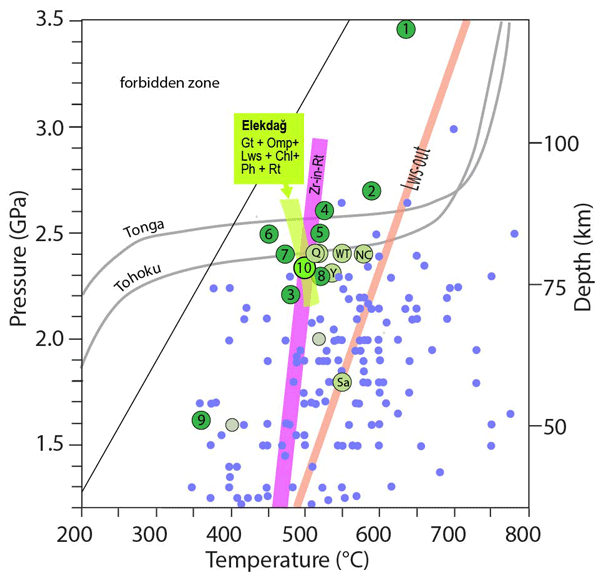
Lawsonite eclogites, which are a type of metamorphic rock, are important but rare archives of the conditions and processes in modern subduction zones. This report describes a 10th lawsonite eclogite locality (Elekdağ, Central Pontides, Türkiye). Mineral and bulk-rock compositions indicate P–T conditions of ~500°C, ~2.3 GPa, which are higher than the previously determined pressure conditions for the area but are similar to conditions recorded by other lawsonite eclogites.
Katherine F. Fornash, Charles Petty, Erkan Toraman, Gültekin Topuz, and Donna L. Whitney
Eur. J. Mineral., 38, 567–574, https://doi.org/10.5194/ejm-38-567-2026, https://doi.org/10.5194/ejm-38-567-2026, 2026
Short summary
Short summary
Lawsonite eclogites, which are a type of metamorphic rock, are important but rare archives of the conditions and processes in modern subduction zones. This report describes a 10th lawsonite eclogite locality (Elekdağ, Central Pontides, Türkiye). Mineral and bulk-rock compositions indicate P–T conditions of ~500°C, ~2.3 GPa, which are higher than the previously determined pressure conditions for the area but are similar to conditions recorded by other lawsonite eclogites.
Jakob Rauscher, Michael Fechtelkord, Sandro Jahn, Julie A.-S. Michaud, Draupadi Mothan, Melanie J. Sieber, Robert B. Trumbull, Franziska D. H. Wilke, Max Wilke, and Bernd Wunder
Eur. J. Mineral., 38, 383–396, https://doi.org/10.5194/ejm-38-383-2026, https://doi.org/10.5194/ejm-38-383-2026, 2026
Short summary
Short summary
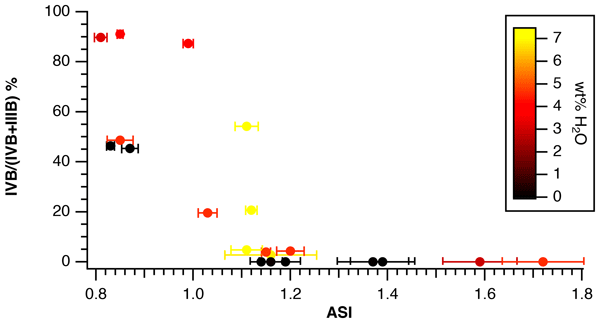
Boron and its isotopes, 11B and 10B, can track magmatic–hydrothermal processes, but this requires knowing how the isotopes fractionate between melt and fluid, which depends on B coordination. This is known for aqueous fluids but not for silicate melts. We determined B coordination by nuclear magnetic resonance in granitic glass with variable water content and alkali–alumina ratios. The results provide a way to estimate B coordination and melt–fluid fractionation for variable melt compositions.
Danielle S. Souza, Daniel Frost, Florian Heidelbach, and Marcel Thielmann
EGUsphere, https://doi.org/10.5194/egusphere-2026-3264, https://doi.org/10.5194/egusphere-2026-3264, 2026
Short summary
Short summary
We performed high-pressure experiments to test antigorite dehydration under different stress conditions and whether this can cause it to fracture. The experiments were carried out at pressures and temperatures like those where intermediate-depth earthquakes occur. We observed more dehydration when the rock is actively deformed but fractures only develop at very fast deformation rates. This suggests intermediate-depth earthquakes arise from multiple interacting processes rather than single cause.

Manuela Borchert, Maria A. Kokh, Marion Louvel, Elena F. Bazarkina, Anselm Loges, Edmund Welter, Denis Testemale, Rami Al Abed, Stephan Klemme, and Max Wilke
Eur. J. Mineral., 37, 111–130, https://doi.org/10.5194/ejm-37-111-2025, https://doi.org/10.5194/ejm-37-111-2025, 2025
Short summary
Short summary
Tungsten (W) concentrations in fluids in equilibrium with crystalline tungsten oxide are used to improve constraints of thermodynamic parameters for W solubility. W species in the hydrothermal fluids are further characterized by X-ray spectroscopy. Improved thermodynamic properties for a set of W fluid species are provided that cover a wide range of fluid compositions, necessary for understanding and describing the complex processes of W enrichment and mineralization in hydrothermal systems.
Nobuyoshi Miyajima, Danielle Silva Souza, and Florian Heidelbach
Eur. J. Mineral., 36, 709–719, https://doi.org/10.5194/ejm-36-709-2024, https://doi.org/10.5194/ejm-36-709-2024, 2024
Short summary
Short summary
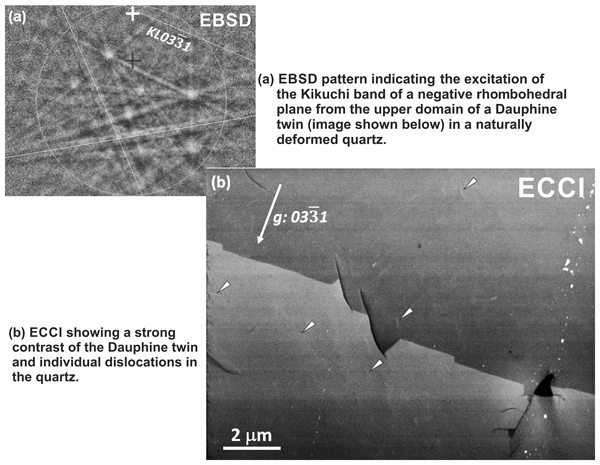
Dauphiné twin (DT) domains in a deformed quartz were visualized for the first time by using orientation-optimized electron channelling contrast imaging under Bragg conditions of the rhombohedral planes. The different contrast of a pair of DT domains in the backscattered electron images originates not from a misorientation between the two domains but from different diffraction intensities between positive and negative rhombohedral planes in quartz.
Roman Botcharnikov, Max Wilke, Jan Garrevoet, Maxim Portnyagin, Kevin Klimm, Stephan Buhre, Stepan Krasheninnikov, Renat Almeev, Severine Moune, and Gerald Falkenberg
Eur. J. Mineral., 36, 195–208, https://doi.org/10.5194/ejm-36-195-2024, https://doi.org/10.5194/ejm-36-195-2024, 2024
Short summary
Short summary
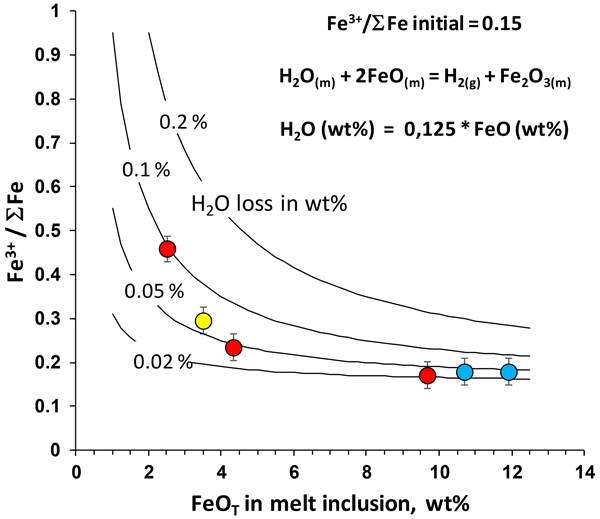
The new spectroscopic method, based on the syncrotron radiation, allows for determination of Fe oxidation state in tiny objects or in heterogeneous samples. This technique is expected to be an important tool in geosciences unraveling redox conditions in rocks and magmas as well as in material sciences providing constraints on material properties.
Melanie J. Sieber, Max Wilke, Oona Appelt, Marcus Oelze, and Monika Koch-Müller
Eur. J. Mineral., 34, 411–424, https://doi.org/10.5194/ejm-34-411-2022, https://doi.org/10.5194/ejm-34-411-2022, 2022
Short summary
Short summary
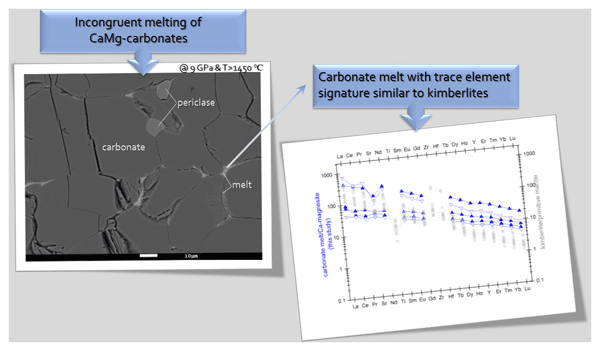
Carbonates reduce the melting point of the mantle, and carbonate melts produced in low-degree melting of a carbonated mantle are considered the precursor of CO2-rich magmas. We established experimentally the melting relations of carbonates up to 9 GPa, showing that Mg-carbonates melt incongruently to periclase and carbonate melt. The trace element signature of carbonate melts parental to kimberlites is approached by melting of Mg-rich carbonates.
Cited articles
Brown, E. H.: Phase equilibria among pumpellyite, lawsonite, epidote and associated minerals in low grade metamorphic rocks, Contrib. Mineral. Petrol., 64, 123–136, 1977.
Botcharnikov, R., Wilke, M., Garrevoet, J., Portnyagin, M., Klimm, K., Buhre, S., Krasheninnikov, S., Almeev, R., Moune, S., and Falkenberg, G.: Confocal μ-XANES as a tool to analyze Fe oxidation state in heterogeneous samples: the case of melt inclusions in olivine from the Hekla volcano, Eur. J. Mineral., 36, 195–208, https://doi.org/10.5194/ejm-36-195-2024, 2024.
Chantel, J., Mookherjee, M., and Frost, D. J.: The elasticity of lawsonite at high pressure and the origin of low velocity layers in subduction zones, Earth Planet. Sci. Lett., 349–350, 116–125, https://doi.org/10.1016/j.epsl.2012.06.034, 2012.
Chapman, T. and Clarke, G. L.: Cryptic evidence for the former presence of lawsonite in blueschist and eclogite, J. Metamorph. Geol., 39, 343–362, https://doi.org/10.1111/jmg.12578, 2021.
Dollase, W. A.: Mössbauer spectra and iron distribution in the epidote group minerals, Zeitschr. Kristall., 138, 41–63, 1973.
Fehr, K. T. and Heuss-Aßbichler, S.: Intracrystalline equilibria and immiscibility along the join clinozoisite–epidote: An experimental and 57Fe Mössbauer study, Neues Jb Miner. Ab., 172, 43–76, 1997.
Fornash, K. F. and Whitney, D. L.: Lawsonite-rich veins and layers as archives of fluid and element cycling at the slab-mantle interface (Sivrihisar Massif, Turkey), Chem. Geol., 533, 119356, https://doi.org/10.1016/j.chemgeo.2019.119356, 2020.
Fornash, K. F., Whitney, D. L., and Seaton, N. C. A.: Lawsonite composition and zoning as an archive of metamorphic processes in subduction zones, Geosphere, 15, 24–46, https://doi.org/10.1130/GES01455.1, 2019.
Frei, D., Liebscher, A., Franz, G., and Dulski, P.: Trace element geochemistry of epidote minerals, Rev. Mineral. Geochem., 56, 553–605, 2004.
Gerrits, A. R., Inglis, E. C., Dragovic, B., Starr, P. G., Baxter, E. F., and Burton, K. W.: Release of oxidizing fluids in subduction zones recorded by iron isotope zonation in garnet, Nat. Geosci., 12, 1029, https://doi.org/10.1038/s41561-019-0471-y, 2019.
Grodzicki, M., Heuss-Assbichler, S., and Amthauer, G.: Mössbauer investigations and molecular orbital calculations, Phys. Chem. Minerals., 28, 675–681, 2001.
Hernández-Uribe, D. and Tsujimori, T.: Progressive lawsonite eclogitization of the oceanic crust: Implications for deep mass transfer in subduction zones, Geology, 51, 678–682, https://doi.org/10.1130/G51052.1, 2023.
Kang, P., Whitney, D. L., Martin, L. A. J., and Fornash, K. F.: Lawsonite trace-element record of subduction fluids, J. Petrol., 63, 1–32, https://doi.org/10.1093/petrology/egac065, 2022.
Kang, P., Martin, L. A. J., Vitale Brovarone, A., and Whitney, D. L.: Lawsonite and garnet oxygen isotope record of fluid-rock interaction during subduction, Geochem. Geophys., 25, e2023GC011389, https://doi.org/10.1029/2023GC011389, 2024.
Kita, S., Okada, T., Nakajima, J., Matsuzawa, T., and Hasegawa, A.: Existence of a seismic belt in the upper plane of the double seismic zone extending in the along-arc direction at depths of 70–100 km beneath NE Japan, Geophys. Res. Lett., 33, L24310, https://doi.org/10.1029/2006GL028239, 2006.
López-Carmona, A., Pitra, P., and Abati, J.: Blueschist-facies metapelites from the Malpica-Tui Unit (NW Iberian Massif): phase equilibria modelling and H2O and Fe2O3 influence in high-pressure assemblages, J. Metamorph. Geol., 31, 263–280, https://doi.org/10.1111/jmg.12018, 2013.
Martin, L. A. J., Rubatto, D., Vitale Brovarone, A., and Hermann, J.: Lawsonite eclogite facies metasomatism of a granulite sliver associated to ophiolites in Alpine Corsica, Lithos, 125, 620–640, 2011.
Martin, L. A. J., Hermann, J., Gauthiez-Putallaz, L., Whitney, D. L., Fornash, K. F., and Evans, N.: Lawsonite geochemistry and stability – Implications for trace element and water cycles in subduction zones, J. Metamorph. Geol., 32, 455–478, https://doi.org/10.1111/jmg.12093, 2014.
Mattinson, C. G., Zhang, R. Y., Tsujimori, T., and Liou, J. G.: Epidote-rich talc-kyanite-phengite eclogites, Sulu terrane, eastern China: P-T-fO2 estimates and the significance of the epidote-talc assemblage in eclogite, Am. Mineral., 89, 1772–1783, 2004.
Muñoz-Montecinos, J., Angiboust, S., Garcia-Casco, A., Glodny, J., and Bebout, G.: Episodic hydrofracturing and large-scale flushing along deep subduction interfaces: Implications for fluid transfer and carbon recycling (Zagros Orogen, southeastern Iran), Chem. Geol., 571, 120173, https://doi.org/10.1016/j.chemgeo.2021.120173, 2021.
Poli, S. and Schmidt, M. W.: Experimental subsolidus studies on epidote minerals, Rev. Mineral. Geochem, 56, 171–195, 2004.
Rosa, A. D., Garbarino, G., Rodrigues, J. E., Mijit, E., Jacobs, J., Bugnazet, D., Pasternak, S., Berruyer, G., Moyne, A., Clavel, C., Perrin, F., Anzellini, S., Meneghini, C., Occelli, F., Zhan, X., Ishimatsu, N., Sakai, T., Boccato, S., Torchio, R., Hernandez, J.-A., Heat, C. J. S., Dominijanni, S., Morard, G., Antonangeli, D., Petitdemange, S., Wehinger, B., Mezouar, M., Kovalskii, G., Morgenroth, W., Wilke, M., Di Cicco, A., Bouhifd, M. A., Irifune, T., Lomachenko, K. A., and Mathon, O.: New opportunities for high pressure X-ray absorption spectroscopy at ID24-DCM and BM23 with the Extremely Brilliant Source of the ESRF, High Pressure Research, 1–29 pp., https://doi.org/10.1080/08957959.2024.2364281, 2024.
Schmid, R., Wilke, M., Oberhänsli, R., Janssens, K., Falkenberg, G., Franz, L., and Gaab, A.: Micro-XANES Determination of ferric iron and its application in thermobarometry, Lithos, 70, 381–392, 2003.
Schmidt, M. W. and Poli, S.: The stability of lawsonite and zoisite at high pressures: experiments in CASH to 92 kbar and implications for the presence of hydrous phases in subducted lithosphere, Earth Planet. Sci. Lett., 124, 105–118, 1994.
Shiraishi, R., Muto, J., Tsunoda, A., Sawa, S., and Suzuki, A: Localized deformation of lawsonite during cold subduction, J. Geophys. Res.-Solid Earth, 127, e2021JB022134, https://doi.org/10.1029/2021JB022134, 2022.
Spandler, C., Hermann, J., Arculus, R., and Mavrogenes, J.: Redistribution of trace elements during prograde metamorphism from lawsonite blueschist to eclogite facies: Implications for deep subduction-zone processes, Contrib. Mineral. Petrol., 146, 205–222, https://doi.org/10.1007/s00410-003-0495-5, 2003.
Sutton, S. R., Lanzirotti, A., Newville, M., Dyar, M. D., and Delaney, J.: Oxybarometry and valence quantification based on microscale X-ray absorption fine structure (XAFS) spectroscopy of multivalent elements, Chem. Geol., 531, 119305, https://doi.org/10.1016/j.chemgeo.2019.119305, 2020.
Vitale Brovarone, A., Alard, O., Beyssac, O., Martin, L., and Picatto, M.: Lawsonite metasomatism and trace element recycling in subduction zones, J. Metamorph. Geol., 32, 489–514, https://doi.org/10.1111/jmg.12074, 2014.
Warren, C. J. and Waters, D. J: Oxidized eclogites and garnet-blueschists from Oman: P-T path modelling in the NCFMASHO system, J. Metamorph. Geol., 24, 783–802, https://doi.org/10.1111/j.1525-1314.2006.00668.x, 2006.
Waychunas, G. A., Brown, G. E, and Apted, M. J.: X-ray K-edge absorption spectra of Fe minerals and model compounds: II. EXAFS, Phys. Chem. Minerals, 13, 31–47, 1986.
Weber, S.-U., Grodzicki, M., Geiger, C. A., Lottermoser, W., Tippelt, G., Redhammer, G. J., Bernroider, M., and Amthauer, G.: 57Fe Mössbauer measurements and electronic structure calculations on natural lawsonites, Phys. Chem. Mineral., 34, 1–9, https://doi.org/10.1007/s00269-006-0121-y, 2007.
Whitney, D. L., Fornash, K. F., Kang, P., Ghent, E. D., Martin, L., Okay, A. I., and Vitale Brovarone, A.: Lawsonite composition and zoning as tracers of subduction processes: a global review, Lithos, 370–371, 105636, https://doi.org/10.1016/j.lithos.2020.105636, 2020.
Wilke, M., Farges, F., Petit, P. E., Brown, G. E., and Martin, F.: Oxidation state and coordination of Fe in minerals: an Fe K XANES spectroscopic study, Am. Mineral., 86, 714–730, 2001.
Wilke, M., Hahn, O., Woodland, A. B., and Rickers, K.: The oxidation state of iron determined by Fe K-edge XANES – application to iron gall ink in historical manuscripts, J. Anal. At. Spectrom., 24, 1364–1372, https://doi.org/10.1039/b904438h, 2009.
Wilke, M., Partzsch, G. M., Bernhardt, R., and Lattard, D.: Determination of the iron oxidation state in basaltic glasses using XANES at the K-edge, Chem. Geol., 213, 71–87, https://doi.org/10.1016/j.chemgeo.2004.08.034, 2004.
Download
The requested paper has a corresponding corrigendum published. Please read the corrigendum first before downloading the article.
- Article
(2361 KB) - Full-text XML
- Corrigendum
-
Supplement
(1541 KB) - BibTeX
- EndNote
Short summary
The Earth recycles water and other elements in a vast system that involves the oceans, minerals, magma, and the atmosphere. We studied the part of the system that involves minerals, specifically, lawsonite and epidote because they contain both water and iron. Iron in these minerals is usually assumed to be Fe3+, but we discovered an unexpected amount of Fe2+. Reactions involving different states of Fe and water in minerals affect many processes related to element cycling in the Earth.
The Earth recycles water and other elements in a vast system that involves the oceans, minerals,...


