Articles | Volume 33, issue 2
https://doi.org/10.5194/ejm-33-209-2021
© Author(s) 2021. This work is distributed under
the Creative Commons Attribution 4.0 License.
https://doi.org/10.5194/ejm-33-209-2021
© Author(s) 2021. This work is distributed under
the Creative Commons Attribution 4.0 License.
Local mode interpretation of the OH overtone spectrum of 1:1 phyllosilicates
Etienne Balan
CORRESPONDING AUTHOR
Sorbonne Université, CNRS, MNHN, Institut de Minéralogie, de
Physique des Matériaux et de Cosmochimie (IMPMC), 4 place Jussieu, 75252
Paris CEDEX 05, France
Emmanuel Fritsch
Sorbonne Université, CNRS, MNHN, Institut de Minéralogie, de
Physique des Matériaux et de Cosmochimie (IMPMC), 4 place Jussieu, 75252
Paris CEDEX 05, France
Institut de Recherche pour le Développement (IRD), Centre de
Nouméa, 101 Promenade Roger Laroque, Anse Vata,
98848 Nouméa, New Caledonia
Farid Juillot
Sorbonne Université, CNRS, MNHN, Institut de Minéralogie, de
Physique des Matériaux et de Cosmochimie (IMPMC), 4 place Jussieu, 75252
Paris CEDEX 05, France
Institut de Recherche pour le Développement (IRD), Centre de
Nouméa, 101 Promenade Roger Laroque, Anse Vata,
98848 Nouméa, New Caledonia
Thierry Allard
Sorbonne Université, CNRS, MNHN, Institut de Minéralogie, de
Physique des Matériaux et de Cosmochimie (IMPMC), 4 place Jussieu, 75252
Paris CEDEX 05, France
Sabine Petit
Institut de Chimie des Milieux et Matériaux de Poitiers (IC2MP),
CNRS UMR 7285, Université de Poitiers, 6 rue Michel Brunet, 86073,
Poitiers CEDEX 9, France
Related authors
Michael C. Jollands, Shiyun Jin, Martial Curti, Maxime Guillaumet, Keevin Béneut, Paola Giura, and Etienne Balan
Eur. J. Mineral., 35, 873–890, https://doi.org/10.5194/ejm-35-873-2023, https://doi.org/10.5194/ejm-35-873-2023, 2023
Short summary
Short summary
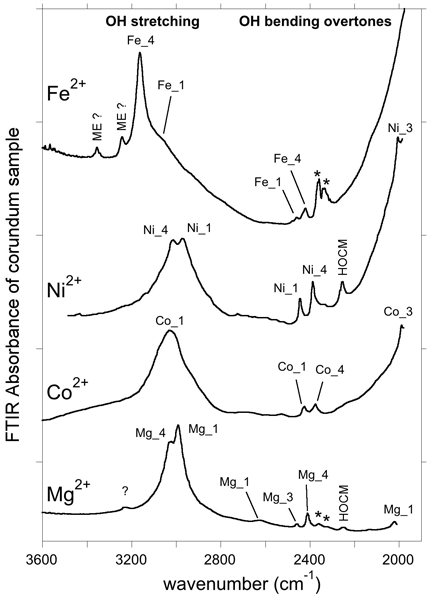
The infrared spectrum of hydrous defects in corundum is routinely used in gemology, but the assignment of absorption bands to specific defects remains elusive. Here, we theoretically study selected defects and compare the results with available experimental data. The main results are the assignment of the
3161 cm−1 seriesto OH groups associated with Fe2+ ions and the interpretation of bands below 2700 cm−1 in corundum containing divalent cations in terms of overtones of OH bending modes.
Etienne Balan, Guillaume Radtke, Chloé Fourdrin, Lorenzo Paulatto, Heinrich A. Horn, and Yves Fuchs
Eur. J. Mineral., 35, 105–116, https://doi.org/10.5194/ejm-35-105-2023, https://doi.org/10.5194/ejm-35-105-2023, 2023
Short summary
Short summary
Assignment of OH-stretching bands to specific atomic-scale environments in tourmaline is still debated, which motivates detailed theoretical studies of their vibrational properties. We have theoretically investigated the OH-stretching spectrum of foitite, showing that specific OH bands observed in the vibrational spectra of iron-rich and Na-deficient tourmalines are affected by the magnetic configuration of iron ions and X-site vacancy ordering.
Etienne Balan, Lorenzo Paulatto, Qianyu Deng, Keevin Béneut, Maxime Guillaumet, and Benoît Baptiste
Eur. J. Mineral., 34, 627–643, https://doi.org/10.5194/ejm-34-627-2022, https://doi.org/10.5194/ejm-34-627-2022, 2022
Short summary
Short summary
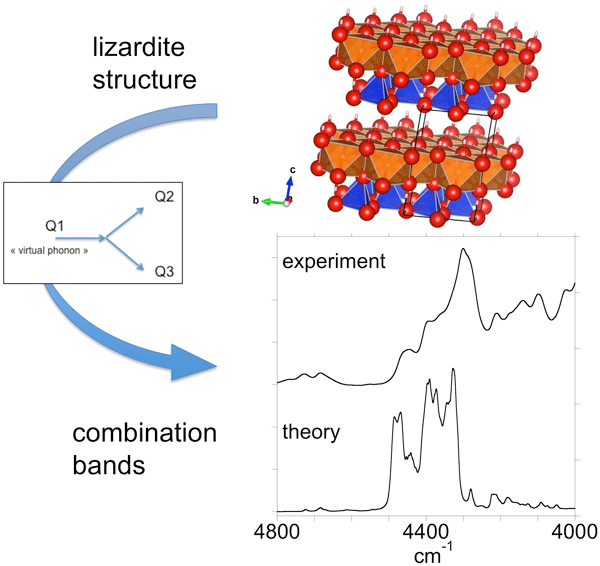
The near-infrared spectra of hydrous minerals involve OH stretching vibrations, but their interpretation is not straightforward due to anharmonicity and vibrational coupling. We analyze the spectra of well-ordered samples of talc, brucite and lizardite to better assess the various factors contributing to the absorption bands. The results clarify the relations between the overtone spectra and their fundamental counterparts and provide a sound interpretation of the two-phonon combination bands.
Yves Fuchs, Chloé Fourdrin, and Etienne Balan
Eur. J. Mineral., 34, 239–251, https://doi.org/10.5194/ejm-34-239-2022, https://doi.org/10.5194/ejm-34-239-2022, 2022
Short summary
Short summary
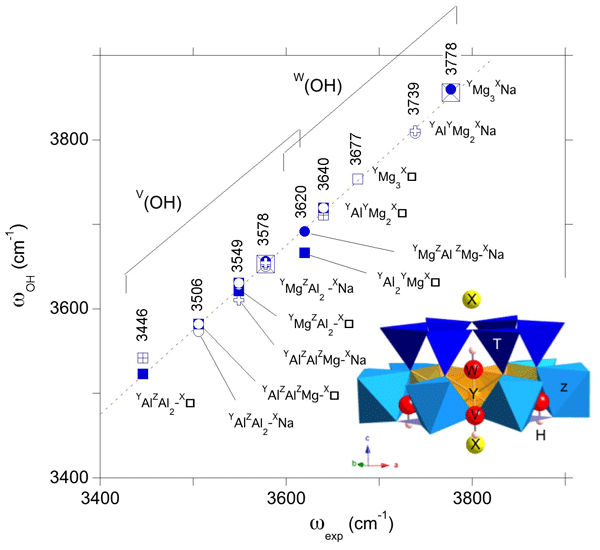
Information about the local structure of tourmaline-group minerals can be obtained from the characteristic OH stretching bands in their vibrational spectra. However, their assignment to specific atomic-scale environments is debated. We address this question theoretically by investigating a series of dravite models. Our results support a local role of cationic occupancies in determining the OH stretching frequencies and bring constraints for the interpretation of the vibrational spectra.
Emmanuel Fritsch, Etienne Balan, Sabine Petit, and Farid Juillot
Eur. J. Mineral., 33, 743–763, https://doi.org/10.5194/ejm-33-743-2021, https://doi.org/10.5194/ejm-33-743-2021, 2021
Short summary
Short summary
The study presents and discusses mid- and near-infrared spectra of three Mg–Ni mineral series (serpentine-like and talc-like minerals, sepiolite) commonly found in reactivated faults and sequences of clay infillings of the New Caledonian Ni-silicate deposits. This spectroscopic study sheds light on the nature of the residual mineral phases found in the clay infillings (serpentine-like minerals) and reveals the aptitude of the newly formed minerals (talc-like minerals and sepiolite) to store Ni.
Etienne Balan, Emmanuel Fritsch, Guillaume Radtke, Lorenzo Paulatto, Farid Juillot, Fabien Baron, and Sabine Petit
Eur. J. Mineral., 33, 647–657, https://doi.org/10.5194/ejm-33-647-2021, https://doi.org/10.5194/ejm-33-647-2021, 2021
Short summary
Short summary
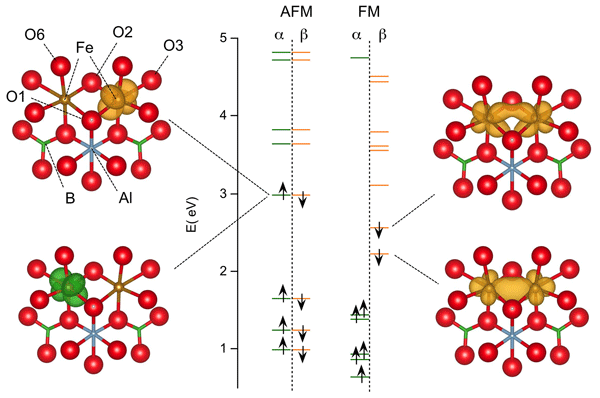
Interpretation of vibrational spectra of serpentines is complexified by the common occurrence of divalent and trivalent cationic impurities at tetrahedral and octahedral sites. We theoretically investigate the effect of Fe and Al on the vibrational properties of lizardite, focusing on the OH stretching modes. The results allow us to disentangle the specific effects related to the valence and coordination states of the impurities, supporting a detailed interpretation of the experimental spectra.
Emmanuel Fritsch, Etienne Balan, Sabine Petit, and Farid Juillot
Eur. J. Mineral., 33, 447–462, https://doi.org/10.5194/ejm-33-447-2021, https://doi.org/10.5194/ejm-33-447-2021, 2021
Short summary
Short summary
The study provides new insights into the OH stretching vibrations of serpentine species (lizardite, chrysotile, antigorite) encountered in veins of peridotite. A combination of infrared spectroscopy in the mid-infrared and near-infrared ranges and Raman spectroscopy enabled us to interpret most of the observed bands in the fundamental and first overtone regions of the spectra and to propose consistent spectral decomposition and assignment of the OH stretching bands for the serpentine species.
Etienne Balan, Emmanuel Fritsch, Guillaume Radtke, Lorenzo Paulatto, Farid Juillot, and Sabine Petit
Eur. J. Mineral., 33, 389–400, https://doi.org/10.5194/ejm-33-389-2021, https://doi.org/10.5194/ejm-33-389-2021, 2021
Short summary
Short summary
The infrared absorption spectrum of an antigorite sample, an important serpentine-group mineral, is compared to its theoretical counterpart computed at the density functional level. The model reproduces most of the observed bands, supporting their assignment to specific vibrational modes. The results provide robust interpretations of the significant differences observed between the antigorite spectrum and that of lizardite, the more symmetric serpentine variety.
Pierre Le Pape, Benoît Baptiste, Guillaume Radtke, Delphine Cabaret, Julie Aufort, Jessica Brest, Camille Baya, Erik Elkaim, Georges Ona-Nguema, Farid Juillot, and Guillaume Morin
Eur. J. Mineral., 38, 135–152, https://doi.org/10.5194/ejm-38-135-2026, https://doi.org/10.5194/ejm-38-135-2026, 2026
Short summary
Short summary
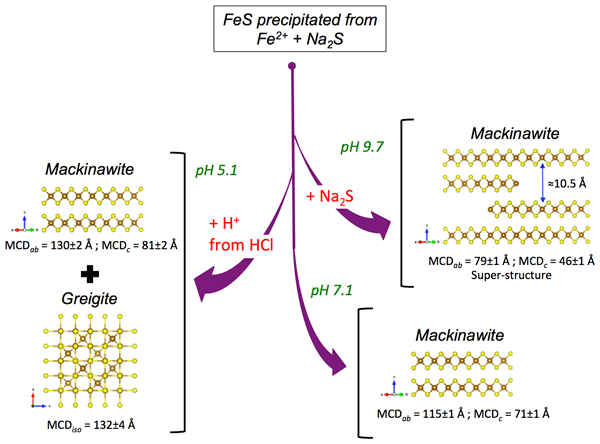
Iron sulfides are ubiquitous minerals of sedimentary environments. Several research works consider it to be that they preserve evidence of their original deposition environment, allowing us to derive paleo-environmental information. However, linking environmental factors to final mineralogy requires gaining mechanistic-level information about their formation pathways. Here, we propose a mackinawite to greigite "corrosion" pathway, with H+ acting as an oxidant.
Michael C. Jollands, Shiyun Jin, Martial Curti, Maxime Guillaumet, Keevin Béneut, Paola Giura, and Etienne Balan
Eur. J. Mineral., 35, 873–890, https://doi.org/10.5194/ejm-35-873-2023, https://doi.org/10.5194/ejm-35-873-2023, 2023
Short summary
Short summary
The infrared spectrum of hydrous defects in corundum is routinely used in gemology, but the assignment of absorption bands to specific defects remains elusive. Here, we theoretically study selected defects and compare the results with available experimental data. The main results are the assignment of the
3161 cm−1 seriesto OH groups associated with Fe2+ ions and the interpretation of bands below 2700 cm−1 in corundum containing divalent cations in terms of overtones of OH bending modes.
Etienne Balan, Guillaume Radtke, Chloé Fourdrin, Lorenzo Paulatto, Heinrich A. Horn, and Yves Fuchs
Eur. J. Mineral., 35, 105–116, https://doi.org/10.5194/ejm-35-105-2023, https://doi.org/10.5194/ejm-35-105-2023, 2023
Short summary
Short summary
Assignment of OH-stretching bands to specific atomic-scale environments in tourmaline is still debated, which motivates detailed theoretical studies of their vibrational properties. We have theoretically investigated the OH-stretching spectrum of foitite, showing that specific OH bands observed in the vibrational spectra of iron-rich and Na-deficient tourmalines are affected by the magnetic configuration of iron ions and X-site vacancy ordering.
Etienne Balan, Lorenzo Paulatto, Qianyu Deng, Keevin Béneut, Maxime Guillaumet, and Benoît Baptiste
Eur. J. Mineral., 34, 627–643, https://doi.org/10.5194/ejm-34-627-2022, https://doi.org/10.5194/ejm-34-627-2022, 2022
Short summary
Short summary
The near-infrared spectra of hydrous minerals involve OH stretching vibrations, but their interpretation is not straightforward due to anharmonicity and vibrational coupling. We analyze the spectra of well-ordered samples of talc, brucite and lizardite to better assess the various factors contributing to the absorption bands. The results clarify the relations between the overtone spectra and their fundamental counterparts and provide a sound interpretation of the two-phonon combination bands.
Yves Fuchs, Chloé Fourdrin, and Etienne Balan
Eur. J. Mineral., 34, 239–251, https://doi.org/10.5194/ejm-34-239-2022, https://doi.org/10.5194/ejm-34-239-2022, 2022
Short summary
Short summary
Information about the local structure of tourmaline-group minerals can be obtained from the characteristic OH stretching bands in their vibrational spectra. However, their assignment to specific atomic-scale environments is debated. We address this question theoretically by investigating a series of dravite models. Our results support a local role of cationic occupancies in determining the OH stretching frequencies and bring constraints for the interpretation of the vibrational spectra.
Emmanuel Fritsch, Etienne Balan, Sabine Petit, and Farid Juillot
Eur. J. Mineral., 33, 743–763, https://doi.org/10.5194/ejm-33-743-2021, https://doi.org/10.5194/ejm-33-743-2021, 2021
Short summary
Short summary
The study presents and discusses mid- and near-infrared spectra of three Mg–Ni mineral series (serpentine-like and talc-like minerals, sepiolite) commonly found in reactivated faults and sequences of clay infillings of the New Caledonian Ni-silicate deposits. This spectroscopic study sheds light on the nature of the residual mineral phases found in the clay infillings (serpentine-like minerals) and reveals the aptitude of the newly formed minerals (talc-like minerals and sepiolite) to store Ni.
Etienne Balan, Emmanuel Fritsch, Guillaume Radtke, Lorenzo Paulatto, Farid Juillot, Fabien Baron, and Sabine Petit
Eur. J. Mineral., 33, 647–657, https://doi.org/10.5194/ejm-33-647-2021, https://doi.org/10.5194/ejm-33-647-2021, 2021
Short summary
Short summary
Interpretation of vibrational spectra of serpentines is complexified by the common occurrence of divalent and trivalent cationic impurities at tetrahedral and octahedral sites. We theoretically investigate the effect of Fe and Al on the vibrational properties of lizardite, focusing on the OH stretching modes. The results allow us to disentangle the specific effects related to the valence and coordination states of the impurities, supporting a detailed interpretation of the experimental spectra.
Emmanuel Fritsch, Etienne Balan, Sabine Petit, and Farid Juillot
Eur. J. Mineral., 33, 447–462, https://doi.org/10.5194/ejm-33-447-2021, https://doi.org/10.5194/ejm-33-447-2021, 2021
Short summary
Short summary
The study provides new insights into the OH stretching vibrations of serpentine species (lizardite, chrysotile, antigorite) encountered in veins of peridotite. A combination of infrared spectroscopy in the mid-infrared and near-infrared ranges and Raman spectroscopy enabled us to interpret most of the observed bands in the fundamental and first overtone regions of the spectra and to propose consistent spectral decomposition and assignment of the OH stretching bands for the serpentine species.
Etienne Balan, Emmanuel Fritsch, Guillaume Radtke, Lorenzo Paulatto, Farid Juillot, and Sabine Petit
Eur. J. Mineral., 33, 389–400, https://doi.org/10.5194/ejm-33-389-2021, https://doi.org/10.5194/ejm-33-389-2021, 2021
Short summary
Short summary
The infrared absorption spectrum of an antigorite sample, an important serpentine-group mineral, is compared to its theoretical counterpart computed at the density functional level. The model reproduces most of the observed bands, supporting their assignment to specific vibrational modes. The results provide robust interpretations of the significant differences observed between the antigorite spectrum and that of lizardite, the more symmetric serpentine variety.
Cited articles
Balan, E., Allard, T., Boizot, B., Morin, G., and Muller, J.-P.:
Structural FE3+ in natural kaolinites: New insights from electron
paramagnetic resonance spectra fitting at X and Q-band frequencies, Clays
Clay Mineral., 47, 605–616, https://doi.org/10.1346/CCMN.1999.0470507, 1999.
Balan, E., Saitta, A. M., Mauri, F., and Calas, G.: First-principles modeling
of the infrared spectrum of kaolinite, Am. Mineral., 86, 1321–1330,
https://doi.org/10.2138/am-2001-11-1201, 2001.
Balan, E., Allard, T., Morin, G., and Calas, G.: Incorporation of Cr3+
in dickite: a spectroscopic study, Phys. Chem. Miner., 4, 273–279,
https://doi.org/10.1007/s00269-001-0231-5, 2002a.
Balan, E., Saitta, A. M., Mauri, F., Lemaire, C., and Guyot, F.:
First-principles calculation of the infrared spectrum of lizardite, Am.
Mineral., 87, 1286–1290, https://doi.org/10.2138/am-2002-1003, 2002b.
Balan, E., Lazzeri, M., Saitta, A. M., Allard, T., Fuchs, Y., and Mauri, F.:
First-principles study of OH stretching modes in kaolinite, dickite and
nacrite, Am. Mineral., 90, 50–60, https://doi.org/10.2138/am.2005.1675,
2005.
Balan, E., Lazzeri, M., Delattre, S., Meheut, M., Refson, K., and Winkler,
B.: Anharmonicity of inner-OH stretching modes in hydrous phyllosilicates:
assessment from first-principles frozen- phonon calculations, Phys. Chem.
Miner., 34, 621–625, https://doi.org/10.1007/s00269-007-0176-4, 2007.
Balan, E., Delattre, S., Guillaumet, M., and Salje, E. K. H.: Low-temperature
infrared spectroscopic study of OH stretching modes in kaolinite and
dickite, Am. Mineral., 95, 1257–1266, https://doi.org/10.2138/am.2010.3447,
2010.
Balan, E., Bish, D. L., and Calas, G.: Kaolin-group minerals: from
hydrogen-bonded layers to environmental recorders, Elements, 10, 183–188,
https://doi.org/10.2113/gselements.10.3.183, 2014.
Baron, F. and Petit, S.: Interpretation of the infrared spectra of the
lizardite-nepouite series in the near and middle infrared range, Am.
Mineral., 101, 423–430, https://doi.org/10.2138/am-2016-5352, 2016.
Bish, D. L.: Rietveld refinement of the kaolinite structure at 1.5 K, Clays
Clay Miner., 41, 738–744, https://doi.org/10.1346/CCMN.1993.0410613, 1993.
Bish, D. L. and Johnston, C. T.: Rietveld refinement and Fourier-transform
infrared spectroscopy study of the dickite structure at low temperature,
Clays Clay Miner., 41, 297–304, https://doi.org/10.1346/CCMN.1993.0410304,
1993.
Bishop, J. L., Murad E., and Dyar, M. D.: The influence of octahedral and
tetrahedral cation substitution on the structure of smectites and
serpentines as observed through infrared spectroscopy, Clay Miner., 37,
617–628, https://doi.org/10.1180/0009855023740064, 2002.
Bishop, J. L., Noe Dobrea, E. Z., McKeown, N. K., Parente, M., Ehlman, B. L.,
Michalski, J. R., Milliken, R. E., Poulet, F., Swayze, G. A., Mustard, J.
F., Murchie, S. L., and Bibring, J.-P.: Phyllosilicate diversity and past
aqueous activity revealed at Mawrth Vallis, Mars Science, 321, 830–833, https://doi.org/10.1126/science.1159699, 2008.
Blanchard, M., Méheut, M., Delon, L., Poirier, M., Micoud, P., Le Roux,
C., and Martin, F.: Infrared spectroscopic study of the synthetic Mg-Ni talc
series, Phys. Chem. Miner., 45, 843–854,
https://doi.org/10.1007/s00269-018-0966-x, 2018.
Blount, A. M., Threadgold, I. M., and Bailey, S. W.: Refinement of the cystal
structure of nacrite, Clays Clay Miner., 17, 185–194,
https://doi.org/10.1346/CCMN.1969.0170307, 1969.
Bogani, F.: Two-phonon resonances and bound-states in molecular crystals. I.
General theory, J. Phys. C, 1, 1283–1295, 1978a.
Bogani, F.: Two-phonon resonances and bound-states in molecular crystals.
II. Absorption coefficient, J. Phys. C, 11, 1297–1309, https://doi.org/10.1088/0022-3719/11/7/019, 1978b.
Bogani, F., Giua, R., and Schettino, V.: Two-exciton spectra of HCl and HBr
crystals, Chem. Phys., 88, 375–389,
https://doi.org/10.1016/0301-0104(84)87004-4, 1984.
Carter, J., Poulet, F., Bibring, J.-P., Mangold, N., and Murchie, S.:
Hydrous minerals on Mars as seen by the CRISM and OMEGA imaging
spectrometers: Updated global view, J. Geophys. Res.-Planet., 118, 831–858, https://doi.org/10.1029/2012JE004145, 2013.
Carteret, C.: Mid- and near-Infrared study of hydroxyl groups at a silica
surface: H-Bond effect, J. Phys. Chem. C, 113, 13300–13308,
https://doi.org/10.1021/jp9008724, 2009.
Cheng, H., Yang, J., Liu, Q., Zhang, J., and Frost, R. L.: A spectroscopic
comparison of selected Chinese kaolinite, coal bearing kaolinite and
halloysite: a midinfrared and nearinfrared study, Spectrochim. Acta A, 77,
856–861, https://doi.org/10.1016/j.saa.2010.08.018, 2010.
Child, M. S.: Local mode overtone spectra, Acc. Chem. Res., 18, 45–50,
https://doi.org/10.1021/ar00110a003, 1985.
Child, M. S. and Lawton, R. T.: Local and normal vibrational states: a
harmonically coupled anharmonic-oscillator model, Faraday Discuss.,
71, 273–285, https://doi.org/10.1039/DC9817100273, 1981.
Child, M. S. and Halonen, L.: Overtone frequencies and intensities in the
local mode picture, in: Advances in Chemical Physics, edited by:
Prigogine, I. and Rice, S., Wiley, vol. 57,
https://doi.org/10.1002/9780470142813.ch1, 1984.
Delineau, T., Allard, T., Muller, J.-P., Barres O., Yvon, J., and Cases, J.-M.:
FTIR reflectance vs. EPR studies of structural iron in kaolinites, Clays
Clay Miner., 42, 308–320, https://doi.org/10.1346/CCMN.1994.0420309, 1994.
Farmer, V. C.: The infrared spectra of minerals, Mineralogical Society,
London, https://doi.org/10.1180/mono-4, 1974.
Farmer, V. C.: Differing effect of particle size and shape in the infrared
and Raman spectra of kaolinite, Clay Miner., 33, 601–604, 1998.
Farmer, V. C.: Transverse and longitudinal crystal modes associated with OH
stretching vibrations in single crystals of kaolinite and dickite,
Spectrochim. Acta A, 56, 927–930,
https://doi.org/10.1016/S1386-1425(99)00182-1, 2000.
Fritsch, E., Juillot, F., Dublet, G., Fonteneau, L, Fandeur, D., Martin, E.,
Caner, L. Auzende A-L., Grauby, O., and Beaufort, D.: An alternative model for
the formation of hydrous Mg/Ni layer silicates (“deweylite”/“garnierite”) in
faulted peridotites of New Caledonia: I. Texture and mineralogy of a
paragenetic succession of silicate infillings, Eur. J. Mineral., 28, 295–311,
https://doi.org/10.1127/ejm/2015/0027-2503, 2016.
Greenberger, R. N., Mustard, J. F., Cloutis, E. A., Pratt, L. M., Sauer, P.
E., Mann, P., Turner, K., Dyar, M. D., and Bish, D. L.: Serpentinization, iron
oxidation, and aqueous conditions in an ophiolite: Implications for hydrogen
production and habitability on Mars, Earth Planet. Sc. Lett., 416, 21–34,
https://doi.org/10.1016/j.epsl.2015.02.002, 2015.
Guatame-García, A., Buxton, M., Deon, F., Lievens, C., and Hecker, C.:
Toward an on-line characterization of kaolin calcination process using
short-wave infrared spectroscopy, Miner. Process. Extract. Metall. Rev., 39,
420–431, https://doi.org/10.1080/08827508.2018.1459617, 2018.
Halonen, L. and Child, M. S.: Local mode theory for C3V molecules:
CH3D, CHD3, SiH3D, and SiHD3, J. Chem. Phys., 79, 4355,
https://doi.org/10.1063/1.446317, 1983.
Jakob, P. and Persson, B. N.: Infrared spectroscopy of overtones and
combination bands, J. Chem. Phys., 109, 8641,
https://doi.org/10.1063/1.477531, 1998.
Johnston, C. T., Elzea-Kogel, J., Bish, D. L., Kogure, T., and Murray, H. H.:
Low-temperature FTIR study of kaolin-group minerals, Clays Clay Miner., 56,
470–485, https://doi.org/10.1346/CCMN.2008.0560408, 2008.
Kimball, J. C., Fong, C. Y., and Shen, Y. R.: Anharmonicity, phonon
localization, two-phonon bound states, and vibrational spectra, Phys. Rev.
B, 23, 4946, https://doi.org/10.1103/PhysRevB.23.4946, 1981.
King, T. V. V., and Clark, R. N.: Spectral characteristics of chlorites and
Mg-serpentines using high-resolution reflectance spectroscopy, J. Geophys.
Res., 94, 13997–14008, https://doi.org/10.1029/JB094iB10p13997, 1989.
Lai, M., Liao, Z., Zhou, Z., Kao, C., Li, Y., and Wang, H.: Uses of
near-infrared transmission spectra for the identification of hydrothermal
kaolinite, dickite and kaolinite-dickite, Spectrochim. Acta A, 208, 179–184,
https://doi.org/10.1016/j.saa.2018.09.063, 2019.
Lewis, I. R., Chaffin, N. C., Gunter, M. E., and Griffiths, P. R.: Vibrational
spectroscopic studies of asbestos and comparison of suitability for remote
analysis, Spectrochim. Acta A, 52, 315–328,
https://doi.org/10.1016/0584-8539(95)01560-4, 1996.
Madejová, J., Balan, E., and Petit, S.: Application of vibrational
spectroscopy (IR and Raman) on the characterization of industrial minerals,
EMU Notes in Mineralogy, vol. 9 “Advances in the Characterization of
Industrial Minerals”, 171–226, https://doi.org/10.1180/EMU-notes.9, 2011.
Mathian, M., Hebert, B., Baron, F., Petit, S., Lescuyer, J.-L., Furic, R.,
and Beaufort D.: Identifying the phyllosilicate minerals of hypogene ore
deposits in lateritic saprolites using the near-IR spectroscopy second
derivative methodology, J. Geochem. Expl., 186, 298–314,
10.1016/j.gexplo.2017.11.019, 2018.
Petit, S., Madejová, J., Decarreau, A., and Martin, F.: Characterization
of octahedral substitutions in kaolinites using near infrared spectroscopy,
Clays Clay Miner., 47, 103–108,
https://doi.org/10.1346/CCMN.1999.0470111, 1999.
Petit, S., Martin, F., Wiewiora, A., De Parseval, P., and Decarreau, A.:
Crystal-chemistry of talc: a near infrared (NIR) spectroscopy study, Am.
Mineral., 89, 319–326, https://doi.org/10.2138/am-2004-2-310, 2004a.
Petit, S., Decarreau, A., Martin, F., and Robert, R.: Refined relationship
between the position of the fundamental OH stretching and the first
overtones for clays, Phys. Chem. Miner. 31, 585–592,
https://doi.org/10.1007/s00269-004-0423-x, 2004b.
Pineau, M., Baron, F., Mathian, M., Le Deit, L., Rondeau, B., Allard, T., and
Mangold, N.: Estimating kaolinite crystallinity using near-infrared
spectroscopy, 51st Lunar and Planetary Science Conference, The
Woodlands, Houston, Texas, United States, 2020.
Prencipe, M., Noel, Y., Bruno, M., and Dovesi, R.: The vibrational spectrum
of lizardite-1T [Mg3Si2O5(OH)4] at the Γ point:
A contribution from an ab initio B3LYP calculation, Am. Mineral., 94,
986–994, https://doi.org/10.2138/am.2009.3127, 2009.
Salje, E. K. H.: Hard mode Spectroscopy: Experimental studies of structural
phase transitions, Phase Transitions, 37, 83–110,
https://doi.org/10.1080/01411599208222888, 1992.
Sibert, E. L.: Modeling vibrational anharmonicity in infrared spectra of high
frequency vibrations of polyatomic molecules, J. Chem. Phys, 150, 090901,
https://doi.org/10.1063/1.5079626, 2019.
Szalay, V., Kovaìcs, L., Wöhlecke, M., and Libowitzky, E.: Stretching
potential and equilibrium length of the OH bonds in solids, Chem. Phys.
Lett., 354, 56–61, https://doi.org/10.1016/S0009-2614(02)00099-4, 2002.
Tosoni, S., Doll, K., and Ugliengo, P.: Hydrogen bond in layered materials:
Structural and vibrational properties of kaolinite by a periodic B3LYP
approach, Chem. Mater., 18, 2135–2143, https://doi.org/10.1021/cm060227e,
2006.
Wöhlecke, M. and Kovaìcs, L.: OH− ions in oxide
crystal, Crit. Rev. Solid State, 25, 1–86,
https://doi.org/10.1080/20014091104161, 2001.
Short summary
The OH overtone bands of kaolinite- and serpentine-group minerals observed in their near-infrared (NIR) spectra are widely used but their relation to stretching modes involving coupled OH groups is uncertain. Here, we map a molecular model of harmonically coupled anharmonic oscillators on the spectroscopic properties of 1:1 phyllosilicates. This makes it possible to interpret most of the observed bands and support the assignment of some of them to cationic substitutions in serpentines.
The OH overtone bands of kaolinite- and serpentine-group minerals observed in their...