Articles | Volume 34, issue 6
https://doi.org/10.5194/ejm-34-645-2022
© Author(s) 2022. This work is distributed under
the Creative Commons Attribution 4.0 License.
the Creative Commons Attribution 4.0 License.
Special issue:
https://doi.org/10.5194/ejm-34-645-2022
© Author(s) 2022. This work is distributed under
the Creative Commons Attribution 4.0 License.
the Creative Commons Attribution 4.0 License.
Research article
| 
14 Dec 2022
Research article |
| 14 Dec 2022
| 14 Dec 2022
Iron oxidation state in serpentines and magnesian chlorites of subduction-related rocks
Université de Lyon, ENSL, UCBL, CNRS, LGL-TPE, 69007 Lyon,
France
Clémentine Fellah
Université de Lyon, ENSL, UCBL, CNRS, LGL-TPE, 69007 Lyon,
France
Catherine McCammon
Bayerisches Geoinstitut, University of Bayreuth, 95447 Bayreuth, Germany
Related authors

Bruno Reynard, Jannick Ingrin, Anne-Céline Ganzhorn, Julie Jonfal, Hélène Pilorgé, Clémentine Fellah, Nadège Hilairet, and Laurent Remusat
Eur. J. Mineral., 38, 103–116, https://doi.org/10.5194/ejm-38-103-2026, https://doi.org/10.5194/ejm-38-103-2026, 2026
Short summary
Short summary
Interactions between minerals and water are fundamental to many geological processes on Earth, in meteorites, and on other planetary bodies, for instance, in the development of plate tectonics. In this study, we experimentally determine how quickly hydrogen isotopes are exchanged between minerals and fluids. We then explore how exchange rates can inform us about past interactions between rocks and water on the Earth and in meteorites using hydrogen isotope measurements in natural minerals.
Bruno Reynard and Xin Zhong
Solid Earth, 14, 591–602, https://doi.org/10.5194/se-14-591-2023, https://doi.org/10.5194/se-14-591-2023, 2023
Short summary
Short summary
Rocks are brought to great depths and back to the Earth's surface by the tectonic processes that shape mountain ranges. Tiny mineral inclusions can record how deep rocks went. Quartz, a common mineral inclusion, was put in the laboratory at conditions that mimic those encountered at depths to about 100 km. A laser-based spectroscopy (Raman) was calibrated to read pressure from quartz inclusions in rocks and to unravel their deep travel.
Thomas Letulle, Guillaume Suan, Mathieu Daëron, Mikhail Rogov, Christophe Lécuyer, Arnauld Vinçon-Laugier, Bruno Reynard, Gilles Montagnac, Oleg Lutikov, and Jan Schlögl
Clim. Past, 18, 435–448, https://doi.org/10.5194/cp-18-435-2022, https://doi.org/10.5194/cp-18-435-2022, 2022
Short summary
Short summary
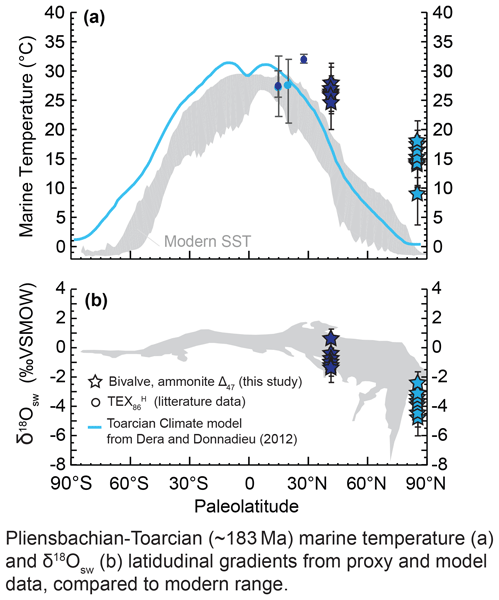
In this study, we applied geochemical tools to well-preserved ∼180-million-year-old marine mollusc shells from polar and mid-latitude seas. These results indicate that polar shells grew at temperatures of 8–18°C, while mid-latitude shells grew at temperatures of 24–28°C. These results, together with previously published data, raise concerns about the ability of climate models to predict accurate polar temperatures under reasonably high atmospheric CO2 levels.
Thomas Gyomlai, Muriel Andreani, Emeline Caujolle, Baptiste Debret, Valentine Puzenat-Vassor, Benoit Ildefonse, and Clémentine Fellah
EGUsphere, https://doi.org/10.5194/egusphere-2026-3184, https://doi.org/10.5194/egusphere-2026-3184, 2026
This preprint is open for discussion and under review for The Cryosphere (TC).
Short summary
Short summary
Understanding past iceberg activity during the Quaternary is key to constraining ice‑sheet dynamics and freshwater release during melting. We document ice‑rafted dropstones dredged at 36° N on the Mid‑Atlantic Ridge that form a calc‑alkaline magmatic series and yield ages of ~1700–1630 Ma. This indicates derivation from the Labradorian arc‑accretion orogeny in eastern Canada, implying a source in the Gulf of Saint Lawrence that favored southward iceberg transport to lower latitudes.
Bruno Reynard, Jannick Ingrin, Anne-Céline Ganzhorn, Julie Jonfal, Hélène Pilorgé, Clémentine Fellah, Nadège Hilairet, and Laurent Remusat
Eur. J. Mineral., 38, 103–116, https://doi.org/10.5194/ejm-38-103-2026, https://doi.org/10.5194/ejm-38-103-2026, 2026
Short summary
Short summary
Interactions between minerals and water are fundamental to many geological processes on Earth, in meteorites, and on other planetary bodies, for instance, in the development of plate tectonics. In this study, we experimentally determine how quickly hydrogen isotopes are exchanged between minerals and fluids. We then explore how exchange rates can inform us about past interactions between rocks and water on the Earth and in meteorites using hydrogen isotope measurements in natural minerals.
Bruno Reynard and Xin Zhong
Solid Earth, 14, 591–602, https://doi.org/10.5194/se-14-591-2023, https://doi.org/10.5194/se-14-591-2023, 2023
Short summary
Short summary
Rocks are brought to great depths and back to the Earth's surface by the tectonic processes that shape mountain ranges. Tiny mineral inclusions can record how deep rocks went. Quartz, a common mineral inclusion, was put in the laboratory at conditions that mimic those encountered at depths to about 100 km. A laser-based spectroscopy (Raman) was calibrated to read pressure from quartz inclusions in rocks and to unravel their deep travel.
Thomas Letulle, Guillaume Suan, Mathieu Daëron, Mikhail Rogov, Christophe Lécuyer, Arnauld Vinçon-Laugier, Bruno Reynard, Gilles Montagnac, Oleg Lutikov, and Jan Schlögl
Clim. Past, 18, 435–448, https://doi.org/10.5194/cp-18-435-2022, https://doi.org/10.5194/cp-18-435-2022, 2022
Short summary
Short summary
In this study, we applied geochemical tools to well-preserved ∼180-million-year-old marine mollusc shells from polar and mid-latitude seas. These results indicate that polar shells grew at temperatures of 8–18°C, while mid-latitude shells grew at temperatures of 24–28°C. These results, together with previously published data, raise concerns about the ability of climate models to predict accurate polar temperatures under reasonably high atmospheric CO2 levels.
Cited articles
Aja, S. U. and Dyar, M. D.: The stability of Fe–Mg chlorites in
hydrothermal solutions – I. Results of experimental investigations, Appl.
Geochem., 17, 1219–1239,
https://doi.org/10.1016/S0883-2927(01)00131-7, 2002.
Andreani, M., Muñoz, M., Marcaillou, C., and Delacour, A.: μ-XANES study of iron redox state in serpentine during oceanic
serpentinization, Lithos, 178, 70–83,
https://doi.org/10.1016/j.lithos.2013.04.008, 2013.
Beck, P., De Andrade, V., Orthous-Daunay, F. R., Veronesi, G., Cotte, M.,
Quirico, E., and Schmitt, B.: The redox state of iron in the matrix of CI,
CM and metamorphosed CM chondrites by XANES spectroscopy, Geochim.
Cosmochim. Ac., 99, 305–316,
https://doi.org/10.1016/j.gca.2012.04.041, 2012.
Bertoldi, C., Benisek, A., Cemic, L., and Dachs, E.: The heat capacity of
two natural chlorite group minerals derived from differential scanning
calorimetry, Phys. Chem. Mineral., 28, 332–336,
https://doi.org/10.1007/s002690100157, 2001.
Billault, V., Beaufort, D., Patrier, P., and Petit, S.: Crystal chemistry of
Fe-sudoites from uranium deposits in the Athabasca Basin (Saskatchewan,
Canada), Clay. Clay Mineral., 50, 70–81, 2002.
Chernosky, J. V., Berman, R. G., and Bryndzia, L. T.: Stability, phase
relations, and thermodynamic properties of chlorite and serpentine group
minerals, Rev. Mineral. Geochem., 19, 295–346, 1988.
Cottrell, E., Lanzirotti, A., Mysen, B., Birner, S., Kelley, K. A.,
Botcharnikov, R., Davis, F. A., and Newville, M.: A Mössbauer-based
XANES calibration for hydrous basalt glasses reveals radiation-induced
oxidation of Fe, Am. Mineral., 103, 489–501, https://doi.org/10.2138/am-2018-6268,
2018.
Debret, B. and Sverjensky, D.: Highly oxidising fluids generated during
serpentinite breakdown in subduction zones, Sci. Rep., 7, 10351, https://doi.org/10.1038/s41598-017-09626-y,
2017.
Debret, B., Andreani, M., Munoz, M., Bolfan-Casanova, N., Carlut, J.,
Nicollet, C., Schwartz, S., and Trcera, N.: Evolution of Fe redox state in
serpentine during subduction, Earth Planet. Sc. Lett., 400,
206–218, https://doi.org/10.1016/j.epsl.2014.05.038, 2014.
Debret, B., Bolfan-Casanova, N., Padron-Navarta, J. A., Martin-Hernandez,
F., Andreani, M., Garrido, C. J., Sanchez-Vizcaino, V. L., Gomez-Pugnaire,
M. T., Munoz, M., and Trcera, N.: Redox state of iron during high-pressure
serpentinite dehydration, Contrib. Mineral. Petr., 169, 36,
https://doi.org/10.1007/s00410-015-1130-y, 2015.
De Grave, E., Vandenbruwaene, J., and Van Bockstael, M.: 57Fe Mössbauer
spectroscopic analysis of chlorite, Phys. Chem. Mineral., 15,
173–180, https://doi.org/10.1007/bf00308781, 1987.
Drago, V., Baggio Saitovitch, E., and Danon, J.: Mössbauer spectroscopy
of electron irradiated natural layered silicates, J. Inorg.
Nucl. Chem., 39, 973–979,
https://doi.org/10.1016/0022-1902(77)80246-7, 1977.
Dyar, M. D., Gunter, M. E., Delaney, J. S., Lanzarotti, A., and Sutton, S.
R.: Systematics in the structure and XANES spectra of pyroxenes, amphiboles,
and micas as derived from oriented single crystals, Can.
Mineral., 40, 1375–1393, https://doi.org/10.2113/gscanmin.40.5.1375, 2002.
Ehlmann, B. L., Mustard, J. F., Swayze, G. A., Clark, R. N., Bishop, J. L.,
Poulet, F., Marais, D. J. D., Roach, L. H., Milliken, R. E., Wray, J. J.,
Barnouin-Jha, O., and Murchie, S. L.: Identification of hydrated silicate
minerals on Mars using MRO-CRISM: Geologic context near Nili Fossae and
implications for aqueous alteration, J. Geophys.
Res.-Planet., 114, E00d08, https://doi.org/10.1029/2009je003339, 2009.
Ellison, E. T., Mayhew, L. E., Miller, H. M., and Templeton, A. S.: Quantitative microscale Fe redox imaging by multiple energy X-ray fluorescence mapping at the Fe K pre-edge peak, Am. Mineral., 105, 1812–1829, https://doi.org/10.2138/am-2020-7359, 2020.
Etiope, G., Schoell, M., and Hosgormez, H.: Abiotic methane flux from the
Chimaera seep and Tekirova ophiolites (Turkey): Understanding gas exhalation
from low temperature serpentinization and implications for Mars, Earth
Planet. Sc. Lett., 310, 96–104, https://doi.org/10.1016/j.epsl.2011.08.001, 2011.
Evans, B. W.: The serpentinite multisystem revisited: Chrysotile is
metastable, Int. Geol. Rev., 46, 479–506, 2004.
Evans, B. W., Dyar, M. D., and Kuehner, S. M.: Implications of ferrous and
ferric iron in antigorite, Am. Mineral., 97, 184–196, 2012.
Evans, K. A.: The redox budget of subduction zones, Earth-Sci. Rev.,
113, 11–32, https://doi.org/10.1016/j.earscirev.2012.03.003, 2012.
Fruh-Green, G. L., Connolly, J. A. D., Plas, A., Kelley, D. S., and Grobety,
B.: Serpentinization of oceanic peridotites: Implications for geochemical
cycles and biological activity, in: Subseafloor Biosphere at Mid-Ocean
Ranges, edited by: Wilcock, W. S. D., DeLong, E. F., Kelley, D. S., Baross,
J. A., and Cary, S. C., Geophys. Monogr. Ser., 144, 119–136,
https://doi.org/10.1029/144gm08, 2004.
Fuchs, Y., Linares, J., and Mellini, M.: Mössbauer and infrared
spectroscopy of lizardite-1T from Monte Fico, Elba, Phys. Chem.
Mineral., 26, 111–115, 1998.
Gaborieau, M., Laubier, M., Bolfan-Casanova, N., McCammon, C. A., Vantelon, D., Chumakov, A. I., Schiavi, F., Neuville, D. R., and Venugopal, S.: Determination of Fe3+
Galvez, M. E., Beyssac, O., Martinez, I., Benzerara, K., Chaduteau, C.,
Malvoisin, B., and Malavieille, J.: Graphite formation by carbonate
reduction during subduction, Nat. Geosci., 6, 473–477,
https://doi.org/10.1038/ngeo1827, 2013.
Ganzhorn, A.-C., Pilorgé, H., Le Floch, S., Montagnac, G., Cardon, H.,
and Reynard, B.: Deuterium-hydrogen inter-diffusion in chlorite, Chem.
Geol., 493, 518–524, https://doi.org/10.1016/j.chemgeo.2018.07.010, 2018.
Garenne, A., Beck, P., Montes-Hernandez, G., Bonal, L., Quirico, E., Proux,
O., and Hazemann, J. L.: The iron record of asteroidal processes in
carbonaceous chondrites, Meteorit. Planet. Sci., 54, 2652–2665,
https://doi.org/10.1111/maps.13377, 2019.
Goodman, B. A. and Bain, D. C.: Mössbauer Spectra of Chlorites and Their
Decomposition Products, in: Developments in Sedimentology, edited by:
Mortland, M. M. and Farmer, V. C., Elsevier, 65–74,
https://doi.org/10.1016/S0070-4571(08)70702-7, 1979.
Gregori, D. A. and Mercader, R. C.: Mössbauer study of some Argentinian
chlorites, Hyperfine Interact., 83, 495–498, https://doi.org/10.1007/BF02074324, 1994.
Guggenheim, S. and Eggleton, R. A.: Modulated crystal structures of
greenalite and caryopilite; a system with long-range, in-plane structural
disorder in the tetrahedra sheet, Can. Mineral., 36, 163–179,
1998.
Hilairet, N., Daniel, I., and Reynard, B.: Equation of state of antigorite,
stability field of serpentines, and seismicity in subduction zones,
Geophys. Res. Lett., 33, L02302, https://doi.org/10.1029/2005GL024728, 2006.
Kelley, D. S., Karson, J. A., Blackman, D. K., Fruh-Green, G. L.,
Butterfield, D. A., Lilley, M. D., Olson, E. J., Schrenk, M. O., Roe, K. K.,
Lebon, G. T., Rivizzigno, P., and Party, A. T. S.: An off-axis hydrothermal
vent field near the Mid-Atlantic Ridge at 30∘ N, Nature, 412,
145–149, https://doi.org/10.1038/35084000, 2001.
Lainé, M., Allard, T., Balan, E., Martin, F., Von Bardeleben, H. J.,
Robert, J.-L., and Caër, S. L.: Reaction Mechanisms in Talc under
Ionizing Radiation: Evidence of a High Stability of H Atoms, J.
Phys. Chem. C, 120, 2087–2095, https://doi.org/10.1021/acs.jpcc.5b11396, 2016.
Lougear, A., Grodzicki, M., Bertoldi, C., Trautwein, A. X., Steiner, K., and
Amthauer, G.: Mössbauer and molecular orbital study of chlorites,
Phys. Chem. Mineral., 27, 258–269, https://doi.org/10.1007/s002690050255, 2000.
Malmström, M., Banwart, S., Lewenhagen, J., Duro, L., and Bruno, J.: The
dissolution of biotite and chlorite at 25 ∘C in the near-neutral
pH region, J. Contamin. Hydrol., 21, 201–213,
https://doi.org/10.1016/0169-7722(95)00047-X, 1996.
Masci, L., Dubacq, B., Verlaguet, A., Chopin, C., De Andrade, V., and
Herviou, C.: A XANES and EPMA study of Fe3+ in chlorite: Importance of
oxychlorite and implications for cation site distribution and
thermobarometry, Am. Mineral., 104, 403–417, https://doi.org/10.2138/am-2019-6766,
2019.
Mayhew, L. E. and Ellison, E. T.: A synthesis and meta-analysis of the Fe
chemistry of serpentinites and serpentine minerals, Philos.
T. R. Soc. A, 378, 20180420, https://doi.org/10.1098/rsta.2018.0420, 2020.
McCammon, C. A., Chaskar, V., and Richards, G. G.: A technique for spatially
Mössbauer spectroscopy applied to quenched metallurgical slags,
Meas. Sci. Technol., 2, 657–662, 1991.
Mellini, M., Fuchs, Y., Viti, C., Lemaire, C., and Linarès, J.: Insights
into the antigorite structure from Mössbauer and FTIR spectroscopies,
Europ. J. Mineral., 14, 97–104, 2002.
Mitra, S. and Bidyananda, M.: Crystallo-chemical characteristics of
chlorites from the greenstone belt of South India, and their geothermometric
signiificance, Clay Sci., 11, 479–501,
https://doi.org/10.11362/jcssjclayscience1960.11.479, 2001.
Moore, T.: Petrology and tectonic implications of the blueschist-bearing
Puerto Nuevo melange complex, Vizcaino Peninsula, Baja California Sur,
Mexico, Geol. Soc. Am. Memoir, 164, 43–58, 1986.
Muir, I. J., Metson, J. B., and Bancroft, G. M.: 57Fe Moessbauer spectra of
perovskite and titanite, Can. Mineral., 22, 689–694, 1984.
Muñoz, M., De Andrade, V., Vidal, O., Lewin, E., Pascarelli, S., and
Susini, J.: Redox and speciation micromapping using dispersive X-ray
absorption spectroscopy: Application to iron in chlorite mineral of a
metamorphic rock thin section, Geochem. Geophy. Geosy., 7, Q11020,
https://doi.org/10.1029/2006GC001381, 2006.
Muñoz, M., Vidal, O., Marcaillou, C., Pascarelli, S., Mathon, O., and
Farges, F.: Iron oxidation state in phyllosilicate single crystals using
Fe-K pre-edge and XANES spectroscopy: Effects of the linear polarization of
the synchrotron X-ray beam, Am. Mineral., 98, 1187–1197,
https://doi.org/10.2138/am.2013.4289, 2013.
O'Hanley, D. S. and Dyar, M. D.: The composition of lizardite 1T and the
formation of magnetite in serpentinites, Am. Mineral., 78,
391–404, 1993.
O'Hanley, D. S. and Dyar, M. D.: The composition of chrysotile and its
relationship with lizardite, Can. Mineral., 36, 727–739, 1998.
Padrón-Navarta, J. A., López Sánchez-Vizcaíno, V., Garrido,
C. J., and Gómez-Pugnaire, M. T.: Metamorphic Record of High-pressure
Dehydration of Antigorite Serpentinite to Chlorite Harzburgite in a
Subduction Setting (Cerro del Almirez, Nevado–Filábride Complex,
Southern Spain), J. Petrol., 52, 2047–2078,
https://doi.org/10.1093/petrology/egr039, 2011.
Peretti, A., Dubessy, J., Mullis, J., Frost, B. R., and Trommsdorff, V.:
Highly reducing conditions during Alpine metamorphism of the Malenco
peridotite (Sondrio, northern Italy) indicated by mineral paragenesis and H2
in fluid inclusions, Contrib. Mineral. Petr., 112,
329–340, https://doi.org/10.1007/BF00310464, 1992.
Piccoli, F., Hermann, J., Pettke, T., Connolly, J. A. D., Kempf, E. D., and
Vieira Duarte, J. F.: Subducting serpentinites release reduced, not
oxidized, aqueous fluids, Sci. Rep., 9, 19573,
https://doi.org/10.1038/s41598-019-55944-8, 2019.
Piilonen, P. C., Rancourt, D. G., Evans, R. J., Lalonde, A. E., McDonald, A. M., and Shabani, A. A. T.: The relationships between crystal-chemical and hyperfine parameters in members of the astrophyllite-group: A combined57Fe Mossbauer spectroscopy and single-crystal X-ray diffraction study, European J. Mineral., 16, 989–1002, https://doi.org/10.1127/0935-1221/2004/0016-0989, 2004.
Pons, M., Quitté, G., Fujii, T., Rosing, M., Reynard, B., Moynier, F.,
Douchet, C., and Albarède, F.: Early Archean serpentine mud volcanoes at
Isua, Greenland, as a niche for early life, P. Natl.
Acad. Sci. USA, 108, 17639–17643, https://doi.org/10.1073/pnas.1108061108, 2011.
Potapkin, V., Chumakov, A. I., Smirnov, G. V., Celse, J.-P., Ruffer, R., McCammon, C., and Dubrovinsky, L.: The 57Fe Synchrotron Mossbauer Source at the ESRF, J. Synchrot. Rad., 19, 559–569, https://doi.org/10.1107/S0909049512015579, 2012.
Prescher, C., McCammon, C., and Dubrovinsky, L.: MossA: a program for
analyzing energy-domain Mossbauer spectra from conventional and synchrotron
sources, J. Appl. Crystallogr., 45, 329–331,
https://doi.org/10.1107/S0021889812004979, 2012.
Rancourt, D. G.: Mössbauer spectroscopy of minerals, Phys. Chem. Mineral., 21, 244–249, https://doi.org/10.1007/BF00202138, 1994.
Reynard, B., Mibe, K., and Van de Moortele, B.: Electrical conductivity of
the serpentinised mantle and fluid flow in subduction zones, Earth
Planet. Sc. Lett., 307, 387–394, https://doi.org/10.1016/j.epsl.2011.05.013, 2011.
Reynard, B., Bezacier, L., and Caracas, R.: Serpentines, talc, chlorites,
and their high-pressure phase transitions: a Raman spectroscopic study,
Phys. Chem. Mineral., 42, 641–649, 10.1007/s00269-015-0750-0,
2015.
Rigault, C.: Cristallochimie du fer dans les chlorites de basse température: implications pour la géothermométrie et la détermination des paléoconditions redox dans les gisements d’uranium, Université de Poitiers, France, 280 pp., 2010.
Rozenson, I., Bauminger, E., and Heller-Kallai, L.: Mössbauer spectra of
iron in 1:1 phyllosilicate, Am. Mineral., 64, 893–901, 1979.
Scambelluri, M., Piccardo, G. B., Philippot, P., Robbiano, A., and Negretti,
L.: High salinity fluid inclusions formed from recycled seawater in deeply
subducted alpine serpentinite, Earth Planet. Sc. Lett., 148,
485–499, 1997.
Schulte, M., Blake, D., Hoehler, T., and McCollom, T.: Serpentinization and
its implications for life on the early Earth and Mars, Astrobiology, 6,
364–376, https://doi.org/10.1089/ast.2006.6.364, 2006.
Schwartz, S., Guillot, S., Reynard, B., Lafay, R., Debret, B., Nicollet, C.,
Lanari, P., and Auzende, A. L.: Pressure-temperature estimates of the
lizardite/antigorite transition in high pressure serpentinites, Lithos, 178,
197–210, https://doi.org/10.1016/j.lithos.2012.11.023, 2013.
Sedlock, R. L.: Four phases of Mesozoic deformation in the Sierra de San Andres Ophiolite, Vizcaíno Peninsula, west-central Baja California, México, in: Tectonic evolution of northwestern Mexico and the Southwestern USA, edited by: Johnson, S. E., Paterson, S. R., Fletcher, J. M., Girty, G. H., Kimbrough, D. L., and Martín-Barajas, A., Geological Society of America, https://doi.org/10.1130/0-8137-2374-4.73, 2003.
Smyth, J. R., Dyar, M. D., May, H. M., Bricker, O. P., and Acker, J. G.:
Crystal Structure Refinement and Mössbauer Spectroscopy of an Ordered,
Triclinic Clinochlore, Clay. Clay Mineral., 45, 544–550,
https://doi.org/10.1346/CCMN.1997.0450406, 1997.
Sobolev, V. N., McCammon, C. A., Taylor, L. A., Snyder, G. A., and Sobolev,
N. V.: Precise Moessbauer milliprobe determination of ferric iron in
rock-forming minerals and limitations of electron microprobe analysis,
Am. Mineral., 84, 78–85, https://doi.org/10.2138/am-1999-1-208, 1999.
Steven, C., Dyar, M. D., McCanta, M., Newville, M., and Lanzirotti, A.: Wave
vector and field vector orientation dependence of Fe K pre-edge X-ray
absorption features in clinopyroxenes, Am. Mineral., https://doi.org/10.2138/am-2022-8547,
2022.
Trincal, V., Lanari, P., Buatier, M., Lacroix, B., Charpentier, D., Labaume,
P., and Muñoz, M.: Temperature micro-mapping in oscillatory-zoned
chlorite: Application to study of a green-schist facies fault zone in the
Pyrenean Axial Zone (Spain), Am. Mineral., 100, 2468–2483,
https://doi.org/10.2138/am-2015-5217, 2015.
Tsujimori, T. and Itaya, T.: Blueschist-facies metamorphism during Paleozoic
orogeny in southwestern Japan: Phengite K–Ar ages of blueschist-facies
tectonic blocks in a serpentinite melange beneath early Paleozoic Oeyama
ophiolite, Island Arc, 8, 190–205, 1999.
Ulmer, P. and Trommsdorff, V.: Serpentine Stability to Mantle Depths and
Subduction-Related Magmatism, Science, 268, 858–861,
https://doi.org/10.1126/science.268.5212.858, 1995.
Vidal, O., De Andrade, V., Lewin, E., Munoz, M., Parra, T., and Pascarelli,
S.: P–T-deformation-Fe3+
Vitale Brovarone, A., Martinez, I., Elmaleh, A., Compagnoni, R., Chaduteau,
C., Ferraris, C., and Esteve, I.: Massive production of abiotic methane
during subduction evidenced in metamorphosed ophicarbonates from the Italian
Alps, Nat. Commun., 8, 14134, https://doi.org/10.1038/ncomms14134, 2017.
Vitale Brovarone, A., Sverjensky, D. A., Piccoli, F., Ressico, F.,
Giovannelli, D., and Daniel, I.: Subduction hides high-pressure sources of
energy that may feed the deep subsurface biosphere, Nat. Commun.,
11, 3880, https://doi.org/10.1038/s41467-020-17342-x, 2020.
Votyakov, S. L., Chaschukhin, I. S., Galakhova, O. L., and Gulyaeva, T. Y.:
Crystal chemistry of lizardite as an indicator of early serpentinization in
ultramafic rocks, I. Compositional and structural features of the mineral
according to spectroscopic data, Geochem. Int., 43, 862–880,
2005.
Wilke, M., Farges, F., Petit, P. E., Brown, G. E., and Martin, F.: Oxidation
state and coordination of Fe in minerals: a Fe-XANES spectroscopic study,
Am. Mineral., 86, 714–730, 2001.
Zazzi, Å., Hirsch, T. K., Leonova, E., Kaikkonen, A., Grins, J.,
Annersten, H., and Edeìn, M.: Structural investigations of natural and
synthetic chlorite minerals by X-ray diffraction, Mössbauer
spectropscopy and solid-state nuclear magnetic resonance, Clay. Clay
Mineral., 54, 252–265, https://doi.org/10.1346/CCMN.2006.0540210, 2006.
Short summary
Serpentines, magnesian clay-like minerals formed in subduction zones, contain iron in either ferrous or ferric form. The oxidation state of the iron form controls the composition of fluids that form when they are destabilized by heating. Results obtained here with Mössbauer spectroscopy are compared with X-ray spectroscopy and shown to be more reliable for serpentines and magnesium-rich chlorites. Fluids released by serpentines in subduction may be less oxidized than previously thought.
Serpentines, magnesian clay-like minerals formed in subduction zones, contain iron in either...


Special issue