Articles | Volume 38, issue 6
https://doi.org/10.5194/ejm-38-669-2026
© Author(s) 2026. This work is distributed under
the Creative Commons Attribution 4.0 License.
https://doi.org/10.5194/ejm-38-669-2026
© Author(s) 2026. This work is distributed under
the Creative Commons Attribution 4.0 License.
New insights into the high-pressure behaviour of the cyclosilicate benitoite, BaTiSi3O9

Benedetta Chrappan Soldavini
Dipartimento di Scienze della Terra, Università degli Studi di Milano, Via Botticelli 23, 20133 Milano, Italy
Gaston Garbarino
ESRF – European Synchrotron Radiation Facility, 71 Avenue des Martyrs, CS40220, 38043 Grenoble CEDEX, France
Michael Hanfland
ESRF – European Synchrotron Radiation Facility, 71 Avenue des Martyrs, CS40220, 38043 Grenoble CEDEX, France
Marco Merlini
Dipartimento di Scienze della Terra, Università degli Studi di Milano, Via Botticelli 23, 20133 Milano, Italy
Related authors
Benedetta Chrappan Soldavini, Marco Merlini, Mauro Gemmi, Paola Parlanti, Patrizia Fumagalli, Sula Milani, Boby Joseph, Giorgio Bais, Maurizio Polentarutti, Alexander Kurnosov, and Stefano Poli
Eur. J. Mineral., 37, 13–24, https://doi.org/10.5194/ejm-37-13-2025, https://doi.org/10.5194/ejm-37-13-2025, 2025
Short summary
Short summary
The CaSiO3 system exhibits structural complexity with various polymorphs under different pressure and temperature conditions. This study stabilizes a new high-pressure polymorph, parabreyite, via multianvil syntheses at 4–5 GPa and 600–800 °C. Parabreyite's triclinic structure, with distinct threefold tetrahedral rings, was solved using 3D electron diffraction and X-ray diffraction. Elastic properties, thermal expansion and Raman spectra differences with breyite were analyzed.
Roberto Conconi, Marco Merlini, Patrizia Fumagalli, Enrico Mugnaioli, Luigi Folco, and Giancarlo Capitani
Eur. J. Mineral., 37, 233–247, https://doi.org/10.5194/ejm-37-233-2025, https://doi.org/10.5194/ejm-37-233-2025, 2025
Short summary
Short summary
The study of minerals at microscopic and nanoscopic scales is essential for understanding the processes behind their formation. Indeed, by examining minerals in such detail, it is possible to uncover the underlying mechanisms that govern mineral development, from crystal growth to chemical reactions, providing insights into broader geological and environmental processes. The understanding of these processes is especially crucial when minerals contain elements valuable to various industries.
Benedetta Chrappan Soldavini, Marco Merlini, Mauro Gemmi, Paola Parlanti, Patrizia Fumagalli, Sula Milani, Boby Joseph, Giorgio Bais, Maurizio Polentarutti, Alexander Kurnosov, and Stefano Poli
Eur. J. Mineral., 37, 13–24, https://doi.org/10.5194/ejm-37-13-2025, https://doi.org/10.5194/ejm-37-13-2025, 2025
Short summary
Short summary
The CaSiO3 system exhibits structural complexity with various polymorphs under different pressure and temperature conditions. This study stabilizes a new high-pressure polymorph, parabreyite, via multianvil syntheses at 4–5 GPa and 600–800 °C. Parabreyite's triclinic structure, with distinct threefold tetrahedral rings, was solved using 3D electron diffraction and X-ray diffraction. Elastic properties, thermal expansion and Raman spectra differences with breyite were analyzed.
Sula Milani, Deborah Spartà, Patrizia Fumagalli, Boby Joseph, Roberto Borghes, Valentina Chenda, Juliette Maurice, Giorgio Bais, and Marco Merlini
Eur. J. Mineral., 34, 351–358, https://doi.org/10.5194/ejm-34-351-2022, https://doi.org/10.5194/ejm-34-351-2022, 2022
Short summary
Short summary
This work presents new thermoelastic parameters and the structural evolution of burbankite at high pressure and high temperature, obtained by in situ synchrotron radiation single-crystal diffraction measurements. Burbankite is a carbonate that may potentially play a key role as an upper-mantle reservoir of light REE3+. We observed that the density of burbankite is greater with respect to carbonatitic magmas, indicating a possible fractionation of this phase in upper-mantle conditions.
Cited articles
Angel, R. J., Bujak, M., Zhao, J., Gatta, G. D., and Jacobsen, S. D.: Effective hydrostatic limits of pressure media for high-pressure crystallographic studies, J. Appl. Crystallogr., 40, 26–32, https://doi.org/10.1107/S0021889806045523, 2007.
Angel, R. J., Gonzalez-Platas, J., and Alvaro, M.: EosFit7c and a Fortran module (library) for equation of state calculations, Z. Kristallogr., 229, 405–419, https://doi.org/10.1515/zkri-2013-1711, 2014.
Anzolini, C., Angel, R. J., Merlini, M., Derzsi, M., Tokár, K., Milani, S., Krebs, M. Y., Brenker, F. E., Nestola, F., and Harris, J. W.: Depth of formation of CaSiO3-walstromite included in super-deep diamonds, Lithos, 265, 138–147, https://doi.org/10.1016/j.lithos.2016.09.023, 2016.
Austin, D.: The Benitoite Story, Independently published, 80 pp., https://g30010.eos-intl.net/G30010/OPAC/Details/Record (last access date: 14 September 2026), 1988.
Belmonte, D., Ottonello, G., and Zuccolini, M. V.: Ab initio-assisted assessment of the CaO-SiO2 system under pressure, Calphad, 59, 12–30, https://doi.org/10.1016/j.calphad.2017.07.005, 2017.
Birch, F.: Finite elastic strain of cubic crystals, Phys. Rev., 71, 809–824, https://doi.org/10.1103/PhysRev.71.809, 1947.
Brenker, F. E., Nestola, F., Brenker, L., Peruzzo, L., and Harris, J. W.: Origin, properties, and structure of breyite: The second most abundant mineral inclusion in super-deep diamonds, Am. Mineral., 106, 38–43, https://doi.org/10.2138/am-2020-7513, 2021.
Chatterjee, N. D., Johannes, W., and Leistner, H.: The system CaO-Al2O3-SiO2-H2O: new phase equilibria data, some calculated phase relations, and their petrological applications, Contrib. Mineral. Petrol., 88, 1–13, https://doi.org/10.1007/BF00371406, 1984.
Chrappan Soldavini, B., Merlini, M., Gemmi, M., Parlanti, P., Fumagalli, P., Milani, S., and Poli, S.: Crystal structure and elastic properties of parabreyite: a new high-pressure ring silicate in the CaSiO3 system, Eur. J. Mineral., 37, 13–24, https://doi.org/10.5194/ejm-37-13-2025, 2025.
Chariton, S., Bykov, M., Bykova, E., and Koemets, E.: The crystal structures of Fe-bearing MgCO3 sp2- and sp3-carbonates at 98 GPa from single-crystal X-ray diffraction using synchrotron radiation, Res. Commun., 3, 715–719, 2020.
Fisher, K.: Verfeinerung der Kristallstruktur von Benitoit BaTi[Si3O9], Z. Kristallogr., 129, 222–243, https://doi.org/10.1524/zkri.1969.129.1-4.222, 1969.
Gaft, M., Nagli, L., Waychunas, G., and Weiss, D.: The nature of blue luminescence from natural benitoite BaTiSi3O9, Phys. Chem. Miner., 31, 365–373, https://doi.org/10.1007/s00269-004-0407-x, 2004.
Hejny, C., Miletich, R., Jasser, A., Schouwink, P., Crichton, W., and Kahlenberg, V.: Second-order P6c2–P31c transition and structural crystallography of the cyclosilicate benitoite, BaTiSi3O9, at high pressure, Am. Mineral., 97, 1749–1763, https://doi.org/10.2138/am.2012.4175, 2012.
Henry, M.: Retrosynthesis in inorganic crystal structures: Application to nesosilicate and inosilicate networks, Coord. Chem. Rev., 178–180, 1109–1163, https://doi.org/10.1016/S0010-8545(98)00167-2, 1998.
Joswig, W., Stachel, T., Harris, J. W., Baur, W. H., and Brey, G. P.: New Ca-silicate inclusions in diamonds – tracers from the lower mantle, Earth Planet. Sci. Lett., 173, 1–6, https://doi.org/10.1016/S0012-821X(99)00216-2, 1999.
Klotz, S., Chervin, J. C., Munsch, P., and Le Marchand, G.: Hydrostatic limits of 11 pressure transmitting media, J. Phys. D: Appl. Phys., 42, 075413, https://doi.org/10.1088/0022-3727/42/7/075413, 2009.
Laird, J. and Albee, A. L.: Chemical composition and physical, optical, and structural properties of benitoite, neptunite, and joaquinite, Am. Mineral., 57, 85–102, 1972.
Laurs, B. M., Rohtert, W. R., and Gray, M.: Benitoite from the New Idria district, San Benito County, California, Gems Gemol., 33, 166–187, 1997.
Louderback, G. D. and Blasdale, W. C.: Benitoite, a new California gem mineral, with chemical analysis, Univ. Calif. Dept. Geol. Sci. Bull., 5, 149–153, 1907.
Louderback, G. D. and Blasdale, W. C.: Benitoite, its paragenesis and mode of occurrence, Univ. Calif. Dept. Geol. Sci. Bull., 5, 331–380, 1909.
Mao, H. K., Xu, J., and Bell, P. M.: Calibration of the ruby pressure gauge to 800 kbar under quasi-hydrostatic conditions, J. Geophys. Res., 91, 4673–4676, https://doi.org/10.1029/JB091iB05p04673, 1986.
Merlini, M. and Hanfland, M.: Single-crystal diffraction at megabar conditions by synchrotron radiation, High Press. Res., 33, 511–522, https://doi.org/10.1080/08957959.2013.831088, 2013.
Merlini, M., Cerantola, V., Gatta, G. D., Gemmi, M., Hanfland, M., and Kupenko, I.: Dolomite-IV: Candidate structure for a carbonate in the Earth's lower mantle, Am. Mineral., 102, 1763–1766, https://doi.org/10.2138/am-2017-6101, 2017.
Momma, K. and Izumi, F.: VESTA: A three-dimensional visualization system for electronic and structural analysis, J. Appl. Crystallogr., 41, 653–658, https://doi.org/10.1107/S0021889808012016, 2008.
Palatinus, L. and Chapuis, G.: SUPERFLIP: A computer program for the solution of crystal structures by charge flipping in arbitrary dimensions, J. Appl. Crystallogr., 40, 786–790, https://doi.org/10.1107/S0021889807029238, 2007.
Petříček, V., Dušek, M., and Palatinus, L.: Crystallographic computing system JANA2006: General features, Z. Kristallogr., 229, 345–352, https://doi.org/10.1515/zkri-2014-1737, 2014.
Ringwood, A. E. and Major, A.: High-pressure reconnaissance investigations in the system Mg2SiO4-MgO-H2O, Earth Planet. Sci. Lett., 2, 130–133, https://doi.org/10.1016/0012-821X(67)90114-8, 1967.
Rigaku Oxford Diffraction: CrysAlisPro Software system, version 1.171.38.46, Rigaku Corporation, Oxford, https://rigaku.com/products/crystallography/x-ray-diffraction/application-notes/px018-crysalispro-software-package-single-crystal (last access: 14 September 2026), 2018.
Rothkirch, A., Gatta, G. D., Meyer, M., Merkel, S., Merlini, M., and Liermann, H. P.: Single-crystal diffraction at the Extreme Conditions beamline P02.2: Procedure for collecting and analyzing high-pressure single-crystal data, J. Synchrotron Radiat., 20, 711–720, https://doi.org/10.1107/S0909049513018621, 2013.
Wise, W. S. and Gill, R. H.: Minerals of the Benitoite Gem mine, Mineral. Rec., 8, 442–452, 1977.
Woodland, A. B., Girnis, A. V., Bulatov, V. K., Brey, G. P., and Höfer, H. E.: Breyite inclusions in diamond: experimental evidence for possible dual origin, Eur. J. Mineral., 32, 171–185, https://doi.org/10.5194/ejm-32-171-2020, 2020.
Yang, H. and Prewitt, T. C.: Crystal structure and compressibility of a two-layer polytype of pseudowollastonite (CaSiO3), Am. Mineral., 84, 1902–1905, https://doi.org/10.2138/am-1999-11-1224, 1999.
Zachariassen, W. H.: The crystal structure of benitoite, BaTiSi3O9, Z. Kristallogr., 74, 139–146, https://doi.org/10.1524/zkri.1930.74.1.139, 1930.
Short summary
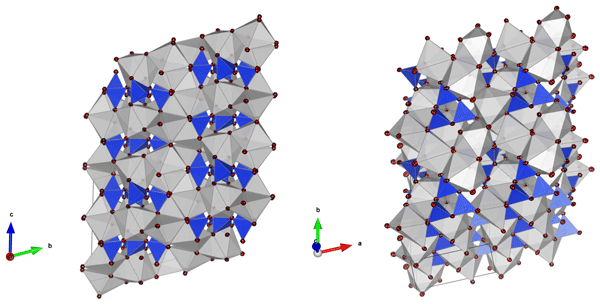
The high-pressure behavior of benitoite was studied by synchrotron single-crystal X-ray diffraction up to 22.3 GPa. Three phase transitions were identified: benitoite → II (3.9–4.4 GPa), II → III (12.4–13.1 GPa), and III → IV (16.4–17.1 GPa). Structural evolution and deformation mechanisms are reported, highlighting Si₃O₉ ring rearrangements. These results clarify ring stabilization in silicates and offer analogues for high-pressure CaSiO₃ phases and sp³ carbonates in planetary interiors.
The high-pressure behavior of benitoite was studied by synchrotron single-crystal X-ray...