Articles | Volume 38, issue 5
https://doi.org/10.5194/ejm-38-635-2026
© Author(s) 2026. This work is distributed under
the Creative Commons Attribution 4.0 License.
the Creative Commons Attribution 4.0 License.
https://doi.org/10.5194/ejm-38-635-2026
© Author(s) 2026. This work is distributed under
the Creative Commons Attribution 4.0 License.
the Creative Commons Attribution 4.0 License.
Research article
| 
20 Oct 2026
Research article |
| 20 Oct 2026
| 20 Oct 2026
Experimental constraints on the stability of Mg-rich tourmaline and the boron concentration of hydrothermal fluids
Julien Fort
Institut des Sciences de la Terre d'Orléans (ISTO), UMR 7327, Université d'Orléans, CNRS, BRGM, 45071 Orléans, France
Stanislas Sizaret
CORRESPONDING AUTHOR

Institut des Sciences de la Terre d'Orléans (ISTO), UMR 7327, Université d'Orléans, CNRS, BRGM, 45071 Orléans, France
Michel Pichavant
Institut des Sciences de la Terre d'Orléans (ISTO), UMR 7327, Université d'Orléans, CNRS, BRGM, 45071 Orléans, France
Arnault Lassin
Institut des Sciences de la Terre d'Orléans (ISTO), UMR 7327, Université d'Orléans, CNRS, BRGM, 45071 Orléans, France
Bureau de Recherches Géologiques et Minières (BRGM), 45060 Orléans, France
Johann Tuduri
Bureau de Recherches Géologiques et Minières (BRGM), 45060 Orléans, France
Olivier Blein
Bureau de Recherches Géologiques et Minières (BRGM), 45060 Orléans, France
Related authors
No articles found.

Colin Fauguerolles, Teddy Castelain, Johan Villeneuve, and Michel Pichavant
Eur. J. Mineral., 36, 555–579, https://doi.org/10.5194/ejm-36-555-2024, https://doi.org/10.5194/ejm-36-555-2024, 2024
Short summary
Short summary
To explore the influence of the redox state of the environment on the serpentinization reaction, we have developed an original experimental setup. Reducing conditions, leading to the formation of serpentine and magnetite, and oxidizing conditions, leading to the formation of serpentine and hematite, are discussed in terms of analogues of low- and high-permeability hydrothermal systems, respectively. The influence of the redox on brucite stability and hydrogen production is also established.
Michel Pichavant, Arnaud Villaros, Julie A.-S. Michaud, and Bruno Scaillet
Eur. J. Mineral., 36, 225–246, https://doi.org/10.5194/ejm-36-225-2024, https://doi.org/10.5194/ejm-36-225-2024, 2024
Short summary
Short summary
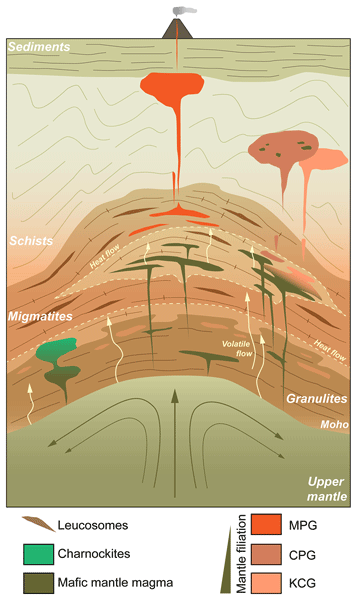
Models for the generation of silicic magmas are divided into two groups: intra-crustal melting and basaltic origin. Peraluminous felsic leucogranites are considered as the only granite examples showing no mantle input. This interpretation is re-evaluated, and we show that leucogranites, as most other crustal granite types, can have a mantle filiation. This stresses the critical importance of the mantle for granite generation and opens the way for unification of silicic magma generation models.
Cited articles
Acosta-Vigil, A., London, D., Morgan, G. B., and Dewers, T. A.: Solubility of excess alumina in hydrous granitic melts in equilibrium with peraluminous minerals at 700–800 °C and 200 MPa, and applications of the aluminum saturation index, Contrib. Mineral. Petrol., 146, 100–119, https://doi.org/10.1007/s00410-003-0486-6, 2003.
Akinfiev, N. N., Voronin, M. V., Zotov, A. V., and Prokof'ev, V. Yu.: Experimental investigation of the stability of a chloroborate complex and thermodynamic description of aqueous species in the B-Na-Cl-O-H system up to 350 °C, Geochem. Int., 44, 867–878, https://doi.org/10.1134/S0016702906090035, 2006.
Audétat, A., Günther, D., and Heinrich, C. A.: Causes for Large-Scale Metal Zonation around Mineralized Plutons: Fluid Inclusion LA-ICP-MS Evidence from the Mole Granite, Australia, Econ. Geol., 95, 1563–1581, https://doi.org/10.2113/gsecongeo.95.8.1563, 2000.
Audétat, A., Pettke, T., Heinrich, C. A., and Bodnar, R. J.: Special Paper: The Composition of Magmatic-Hydrothermal Fluids in Barren and Mineralized Intrusions, Econ. Geol., 103, 877–908, https://doi.org/10.2113/gsecongeo.103.5.877, 2008.
Bačík, P., Dikej, J., Fridrichová, J., Miglierini, M., and Števko, M.: Chemical composition and evolution of tourmaline-supergroup minerals from the Sb hydrothermal veins in Rožňava area, Western Carpathians, Slovakia, Mineral. Petrol., 111, 609–624, https://doi.org/10.1007/s00710-017-0507-1, 2017.
Baksheev, I. A., Tikhomirov, P. L., Yapaskurt, V. O., Vigasina, M. F., Prokof'ev, V. Yu., and Ustinov, V. I.: Tourmaline of the Mramorny tin cluster, Chukotia peninsula, Russia, Can. Mineral., 47, 1177–1194, https://doi.org/10.3749/canmin.47.5.1177, 2009.
Beckett-Brown, C. E., McDonald, A. M., and McClenaghan, M. B.: Recognizing Tourmaline in Mineralized Porphyry Cu Systems: Textures and Major-Element Chemistry, Can. J. Mineral. Petrol., 61, 3–29, https://doi.org/10.3749/2200011, 2023.
Berryman, E. J., Wunder, B., Wirth, R., Rhede, D., Schettler, G., Franz, G., and Heinrich, W.: An experimental study on K and Na incorporation in dravitic tourmaline and insight into the origin of diamondiferous tourmaline from the Kokchetav Massif, Kazakhstan, Contrib. Mineral. Petrol., 169, 28, https://doi.org/10.1007/s00410-015-1116-9, 2015.
Berryman, E. J., Wunder, B., Rhede, D., Schettler, G., Franz, G., and Heinrich, W.: P–T–X controls on Ca and Na distribution between Mg–Al tourmaline and fluid, Contrib. Mineral. Petrol., 171, 31, https://doi.org/10.1007/s00410-016-1246-8, 2016.
Blanc, Ph., Lassin, A., Piantone, P., Azaroual, M., Jacquemet, N., Fabbri, A., and Gaucher, E. C.: Thermoddem: A geochemical database focused on low temperature water/rock interactions and waste materials, Appl. Geochem., 27, 2107–2116, https://doi.org/10.1016/j.apgeochem.2012.06.002, 2012.
Broska, I. and Kubiš, M.: Accessory minerals and evolution of tin-bearing S-type granites in the western segment of the Gemeric Unit (Western Carpathians), Geol. Carpathica, 69, 483–497, https://doi.org/10.1515/geoca-2018-0028, 2018.
Burnham, C. W., Holloway, J. R., and Davis, N. F.: Thermodynamic Properties of Water to 1,000 °C and 10,000 Bars, Geological Society of America, 1969.
Charoy, B.: Greisenisation, minéralisation et fluides associés à Cligga Head, Cornwall (sud-ouest de l’Angleterre), Bull. Minéralogie, 102(5), 633–641, https://doi.org/10.3406/bulmi.1979.7312, 1979
Cheng, L., Zhang, C., Yang, X., Qi, D., Zhou, Y., and Holtz, F.: Experimental investigation of reactions between two-mica granite and boron-rich fluids: Implications for the formation of tourmaline granite, Sci. China Earth Sci., 62, 1630–1644, https://doi.org/10.1007/s11430-019-9442-y, 2019.
Codeço, M. S., Weis, P., Trumbull, R. B., Pinto, F., Lecumberri-Sanchez, P., and Wilke, F. D. H.: Chemical and boron isotopic composition of hydrothermal tourmaline from the Panasqueira W-Sn-Cu deposit, Portugal, Chem. Geol., 468, 1–16, https://doi.org/10.1016/j.chemgeo.2017.07.011, 2017.
Dingwell, D. B., Pichavant, M., and Holtz, F.: Chapter 8. Experimental Studies of Boron in Granitic Melts, in: Boron_Mineralogy, Petrology and Geochemistry, vol. 33, edited by: Anovitz, L. M. and Grew, E. S., De Gruyter, Berlin, Boston, 331–386, https://doi.org/10.1515/9781501509223-010, 1996.
Drivenes, K., Larsen, R. B., Müller, A., Sørensen, B. E., Wiedenbeck, M., and Raanes, M. P.: Late-magmatic immiscibility during batholith formation: assessment of B isotopes and trace elements in tourmaline from the Land's End granite, SW England, Contrib. Mineral. Petrol., 169, 56, https://doi.org/10.1007/s00410-015-1151-6, 2015.
Drivenes, K., Larsen, R. B., Müller, A., and Sørensen, B. E.: Crystallization and uplift path of late Variscan granites evidenced by quartz chemistry and fluid inclusions: Example from the Land's End granite, SW England, Lithos, 252–253, 57–75, https://doi.org/10.1016/j.lithos.2016.02.011, 2016.
Dutrow, B. L. and Henry, D. J.: Tourmaline: A Geologic DVD, Elements, 7, 301–306, https://doi.org/10.2113/gselements.7.5.301, 2011.
Dutrow, B. L. and Henry, D. J.: Fibrous Tourmaline: A Sensitive Probe of Fluid Compositions and Petrologic Environments, Can. Mineral., 54, 311–335, https://doi.org/10.3749/canmin.1600019, 2016.
Dutrow, B. L. and Henry, D. J.: Tourmaline compositions and textures: reflections of the fluid phase, J. Geosci., 99–110, https://doi.org/10.3190/jgeosci.256, 2018.
Fort, J.: Tourmalinisation of perigranitic hydrothermal systems: experimental approach to the stability field and dynamics of metasomatic processes in borosilicate systems, Sciences de la Terre/Métallogénie, Université d'Orléans, Orléans, 237 pp., 2023.
Frikken, P. H., Cooke, D. R., Walshe, J. L., Archibald, D., Skarmeta, J., Serrano, L., and Vargas, R.: Mineralogical and Isotopic Zonation in the Sur-Sur Tourmaline Breccia, Río Blanco-Los Bronces Cu-Mo Deposit, Chile: Implications for Ore Genesis, Econ. Geol., 100, 935–961, https://doi.org/10.2113/gsecongeo.100.5.935, 2005.
Frondel, C., Hurlbut, C. S. J., and Colette, R. C.: Synthesis of Tourmaline, Am. Mineral., 32, 680–681, 1947.
Fuchs, Y., Lagache, M., and Linares, J.: Fe-tourmaline synthesis under different T and fO2 conditions, Am. Mineral., 83, 525–534, 1998.
Fusswinkel, T., Wagner, T., and Sakellaris, G.: Fluid evolution of the Neoarchean Pampalo orogenic gold deposit (E Finland): Constraints from LA-ICPMS fluid inclusion microanalysis, Chem. Geol., 450, 96–121, https://doi.org/10.1016/j.chemgeo.2016.12.022, 2016.
Gleeson, S. A., Wilkinson, J. J., Shaw, H. F., and Herrington, R. J.: Post-magmatic hydrothermal circulation and the origin of base metal mineralization, Cornwall, UK, J. Geol. Soc., 157, 589–600, https://doi.org/10.1144/jgs.157.3.589, 2000.
Gunter, W. D., Myers, J., and Girsperger, S.: Hydrogen: Metal Membranes, in: Hydrothermal Experimental Techniques, John Wiley & Sons, New-York, 100–120, 1987.
Harlaux, M., Kouzmanov, K., Gialli, S., Laurent, O., Rielli, A., Dini, A., Chauvet, A., Menzies, A., Kalinaj, M., and Fontboté, L.: Tourmaline as a Tracer of Late-Magmatic to Hydrothermal Fluid Evolution: The World-Class San Rafael Tin (-Copper) Deposit, Peru, Econ. Geol., https://doi.org/10.5382/econgeo.4762, 2020.
Hawthorne, F. C. and Darrell J. H.: Classification of the Minerals of the Tourmaline Group, Eur. J. Mineral., 11(2), 201–216, https://doi.org/10.1127/ejm/11/2/0201, 1999
Henry, D. J. and Dutrow, B. L.: Chapter 10. Metamorphic Tourmaline and its Petrologic Applications, in: Boron_Mineralogy, Petrology and Geochemistry, vol. 33, edited by: Grew, E. S. and Anovitz, L. M., De Gruyter, Berlin, Boston, 503–558, 1996.
Henry, D. J. and Guidotti, C. V.: Tourmaline as a petrogenetic indicator mineral: an example from the staurolite-grade metapelites of NW Maine, Am. Mineral., 70, 1–15, 1985.
Hong, W., Cooke, D. R., Zhang, L., Fox, N., and Thompson, J.: Tourmaline-rich features in the Heemskirk and Pieman Heads granites from western Tasmania, Australia: Characteristics, origins, and implications for tin mineralization, Am. Mineral., 102, 876–899, https://doi.org/10.2138/am-2017-5838, 2017.
Kelly, C. J., Davis, W. J., Potter, E. G., and Corriveau, L.: Geochemistry of hydrothermal tourmaline from IOCG occurrences in the Great Bear magmatic zone: Implications for fluid source(s) and fluid composition evolution, Ore Geol. Rev., 118, 103329, https://doi.org/10.1016/j.oregeorev.2020.103329, 2020.
Kutzschbach, M., Wunder, B., Meixner, A., Wirth, R., Heinrich, W., and Franz, G.: Jeremejevite as a precursor for olenitic tourmaline: consequences of non-classical crystallization pathways for composition, textures and B isotope patterns of tourmaline, Eur. J. Mineral., 29, 239–255, https://doi.org/10.1127/ejm/2017/0029-2604, 2017
Kontak, D. J. and Clark, A. H.: Genesis of the Giant, Bonanza San Rafael Lode Tin Deposit, Peru: Origin and Significance of Pervasive Alteration, Econ. Geol., 97, 1741–1777, https://doi.org/10.2113/gsecongeo.97.8.1741, 2002.
Korges, M., Weis, P., Lüders, V., and Laurent, O.: Sequential evolution of Sn–Zn–In mineralization at the skarn-hosted Hämmerlein deposit, Erzgebirge, Germany, from fluid inclusions in ore and gangue minerals, Miner. Deposita, 55, 937–952, https://doi.org/10.1007/s00126-019-00905-4, 2020.
Lasaga, A. C.: Kinetic Theory in the Earth Sciences, Princeton university press, Princeton, 811 pp., 1998.
Lassin, A., Azaroual, M., and Mercury, L.: Geochemistry of unsaturated soil systems: Aqueous speciation and solubility of minerals and gases in capillary solutions, Geochim. Cosmochim. Ac., 69, 5187–5201, https://doi.org/10.1016/j.gca.2005.05.020, 2005.
Launay, G., Sizaret, S., Guillou-Frottier, L., Gloaguen, E., and Pinto, F.: Deciphering fluid flow at the magmatic-hydrothermal transition: A case study from the world-class Panasqueira W–Sn–(Cu) ore deposit (Portugal), Earth Planet. Sci. Lett., 499, 1–12, https://doi.org/10.1016/j.epsl.2018.07.012, 2018.
Lecumberri-Sanchez, P., Vieira, R., Heinrich, C. A., Pinto, F., and Wälle, M.: Fluid-rock interaction is decisive for the formation of tungsten deposits, Geology, 45, 579–582, https://doi.org/10.1130/G38974.1, 2017.
Legros, H., Elongo, V., Laurent, O., Adlakha, E., Chelle-Michou, C., Falck, H., and Lecumberri-Sanchez, P.: Formation of the Lened W-(Be) Skarn Deposit by Neutralization of a Magmatic Fluid – Evidence from H3BO3-Rich Fluids, Geosciences, 12, 236, https://doi.org/10.3390/geosciences12060236, 2022.
Li, X., Chi, G., Zhou, Y., Deng, T., and Zhang, J.: Oxygen fugacity of Yanshanian granites in South China and implications for metallogeny, Ore Geol. Rev., 88, 690–701, https://doi.org/10.1016/j.oregeorev.2017.02.002, 2017.
London, D.: Experimental synthesis and stability of tourmaline: a historical overview, Can. Mineral., 49, 117–136, https://doi.org/10.3749/canmin.49.1.117, 2011.
London, D., Hervig, R. L., and Morgan, G. B.: Melt-vapor solubilities and elemental partitioning in peraluminous granite-pegmatite systems: experimental results with Macusani glass at 200 MPa, Contrib. Mineral. Petrol., 99, 360–373, https://doi.org/10.1007/BF00375368, 1988.
Lynch, G. and Ortega, J.: Hydrothermal alteration and tourmaline-albite equilibria at the Coxheath porphyry Cu-Mo-Au deposit, Nova Scotia, Can. Mineral., 35, 79–94, 1997.
Morgan, G. B.: A spreadsheet for calculating normative mole fractions of end-member species for Na-Ca-Li-Fe2+-Mg-Al tourmalines from electron microprobe data, Am. Mineral., 101, 111–119, https://doi.org/10.2138/am-2016-5392, 2016.
Morgan, G. B. and London, D.: Experimental reactions of amphibolite with boron-bearing aqueous fluids at 200 MPa: implications for tourmaline stability and partial melting in mafic rocks, Contrib. Mineral. Petrol., 102, 281–297, https://doi.org/10.1007/BF00373721, 1989.
Nakano, T. and Nakamura, E.: Boron isotope geochemistry of metasedimentary rocks and tourmalines in a subduction zone metamorphic suite, Phys. Earth Planet. Inter., 127, 233–252, https://doi.org/10.1016/S0031-9201(01)00230-8, 2001.
Ogorodova, L. P., Melchakova, L. V., Kiseleva, I. A., and Peretyazhko, I. S.: Thermodynamics of natural tourmalines – Dravite and schorl, Thermochim. Acta, 539, 1–6, https://doi.org/10.1016/j.tca.2012.03.008, 2012.
Orlando, A., Ruggieri, G., Chiarantini, L., Montegrossi, G., and Rimondi, V.: Experimental Investigation of Biotite-Rich Schist Reacting with B-Bearing Fluids at Upper Crustal Conditions and Correlated Tourmaline Formation, Minerals, 7, 23, https://doi.org/10.3390/min7090155, 2017.
Parkhurst, D. L. and Appelo, C. A. J.: Description of input and examples for PHREEQC version 3 – A computer program for speciation, batch-reaction, one-dimensional transport, and inverse geochemical calculations, in: US Geological Survey Techniques and Methods, US Geological Survey, Denver, CO, USA, 497 pp., https://doi.org/10.3133/tm6A43, 2013.
Pichavant, M.: An experimental study of the effect of boron on a water saturated haplogranite at 1 Kbar vapour pressure: Geological applications, Contrib. Mineral. Petrol., 76, 430–439, https://doi.org/10.1007/BF00371485, 1981.
Pichavant, M.: Melt-fluid interaction deduced from studies of silicate-B2O3-H2O systems at 1 kbar, Bull. Minéralogie, 106, 201–211, https://doi.org/10.3406/bulmi.1983.7680, 1983.
Pichavant, M. and Manning, D.: Petrogenesis of tourmaline granites and topaz granites; the contribution of experimental data, Phys. Earth Planet. Inter., 35, 31–50, https://doi.org/10.1016/0031-9201(84)90032-3, 1984.
Pokrovski, G. S., Schott, J., and Sergeyev, A. S.: Experimental determination of the stability constants of NaSO4− and NaB (OH)40 in hydrothermal solutions using a new high-temperature sodium-selective glass electrode – Implications for boron isotopic fractionation, Chem. Geol., 124, 253–265, https://doi.org/10.1016/0009-2541(95)00057-S, 1995.
Pokrovski, G. S., Borisova, A. Y., and Bychkov, A. Y.: Speciation and Transport of Metals and Metalloids in Geological Vapors, Rev. Mineral. Geochem., 76, 165–218, https://doi.org/10.2138/rmg.2013.76.6, 2013.
Pownceby, M. I. and O'Neill, H. St. C.: Thermodynamic data from redox reactions at high temperatures. III. Activity-composition relations in Ni-Pd alloys from EMF measurements at 850–1250 K, and calibration of the NiO + Ni-Pd assemblage as a redox sensor, Contrib. Mineral. Petrol., 116, 327–339, https://doi.org/10.1007/BF00306501, 1994.
Prokof'ev, V. Y., Akinfiev, N. N., and Groznova, E. O.: On the Boron Concentration and Forms of Its Occurrence in Hydrothermal Ore-Forming Fluids, Geol. Ore Depos., 44, 386–397, 2002.
Qiu, Y., Zhang, R., Chou, I.-M., Wang, X., Hu, W., Zhang, W., Lu, J., Li, G., and Li, Z.: Boron-rich ore-forming fluids in hydrothermal W-Sn deposits from South China: Insights from in situ Raman spectroscopic characterization of fluid inclusions, Ore Geol. Rev., 132, 104048, https://doi.org/10.1016/j.oregeorev.2021.104048, 2021.
Scaillet, B., Pichavant, M., Roux, J., Humbert, G., and Lefèvre, A.: Improvements of the Shaw membrane technique for measurement and control of fH2 at high temperatures and pressures, Am. Mineral., 77, 647–655, 1992.
Schatz, O. J., Dolejš, D., Stix, J., Williams-Jones, A. E., and Layne, G. D.: Partitioning of boron among melt, brine and vapor in the system haplogranite–H2O–NaCl at 800 °C and 100 MPa, Chem. Geol., 210, 135–147, https://doi.org/10.1016/j.chemgeo.2004.06.007, 2004.
Sciuba, M., Beaudoin, G., and Makvandi, S.: Chemical composition of tourmaline in orogenic gold deposits, Miner. Deposita, 56, 537–560, https://doi.org/10.1007/s00126-020-00981-x, 2021.
Setkova, T. V., Balitsky, V. S., and Shapovalov, Yu. B.: Experimental Study of the Stability and Synthesis of the Tourmaline Supergroup Minerals, Geochem. Int., 57, 1082–1094, https://doi.org/10.1134/S0016702919100094, 2019.
Shock, E. L., Helgeson, H. C., and Sverjensky, D. A.: Calculation of the thermodynamic and transport properties of aqueous species at high pressures and temperatures: Standard partial molal properties of inorganic neutral species, Geochim. Cosmochim. Ac., 53, 2157–2183, https://doi.org/10.1016/0016-7037(89)90341-4, 1989.
Slack, J. F. and Trumbull, R. B.: Tourmaline as a Recorder of Ore-Forming Processes, Elements, 7, 321–326, https://doi.org/10.2113/gselements.7.5.321, 2011.
Smith, M., Banks, D. A., Yardley, B. W. D., and Boyce, A.: Fluid inclusion and stable isotope constraints on the genesis of the Cligga Head Sn-W deposit, S.W. England, Eur. J. Mineral., 8, 961–974, https://doi.org/10.1127/ejm/8/5/0961, 1996.
Taylor, J. R., Wall, V. J., and Pownceby, M. I.: The calibration and application of accurate redox sensors, Am. Mineral., 77, 284–295, 1992.
Tuduri, J., Chauvet, A., Barbanson, L., Bourdier, J.-L., Labriki, M., Ennaciri, A., Badra, L., Dubois, M., Ennaciri-Leloix, C., Sizaret, S., and Maacha, L.: The Jbel Saghro Au(–Ag, Cu) and Ag–Hg Metallogenetic Province: Product of a Long-Lived Ediacaran Tectono-Magmatic Evolution in the Moroccan Anti-Atlas, Minerals, 8, 592, https://doi.org/10.3390/min8120592, 2018.
Van Der Does, L. M., Hulsbosch, N., Kaskes, P., Elsen, J., Claeys, P., Muchez, P., and Sirbescu, M.-L. C.: Tourmaline growth in the border and wall zones of the emmons pegmatite (maine, U.S.A.): evidence for disequilibrium crystallization and boundary layer formation, Am. Mineral., 109, 785–798, https://doi.org/10.2138/am-2023-8991, 2024.
van Hinsberg, V. J. and Schumacher, J. C.: Using estimated thermodynamic properties to model accessory phases: the case of tourmaline, J. Metamorph. Geol., 25, 769–779, https://doi.org/10.1111/j.1525-1314.2007.00728.x, 2007.
van Hinsberg, V. J. and Schumacher, J. C.: The geothermobarometric potential of tourmaline, based on experimental and natural data, Am. Mineral., 94, 761–770, https://doi.org/10.2138/am.2009.3022, 2009.
van Hinsberg, V. J., Henry, D. J., and Dutrow, B. L.: Tourmaline as a Petrologic Forensic Mineral: A Unique Recorder of Its Geologic Past, Elements, 7, 327–332, https://doi.org/10.2113/gselements.7.5.327, 2011a.
van Hinsberg, V. J., Henry, D. J., and Marschall, H. R.: Tourmaline: an ideal indicator of its host environment, Can. Mineral., 49, 1–16, https://doi.org/10.3749/canmin.49.1.1, 2011b.
van Hinsberg, V. J., Franz, G., and Wood, B. J.: Determining subduction-zone fluid composition using a tourmaline mineral probe, Geochem. Perspect. Lett., 160–169, https://doi.org/10.7185/geochemlet.1719, 2017.
von Goerne, G., Franz, G., and Robert, J. L.: Upper thermal stability of tourmaline + quartz in the system MgO-Al2O3-SiO2-B2O3-H2O and Na2O-MgO-Al2O3-SiO2-B2O3-H2O-HCl in hydrothermal solutions and siliceous melts, Can. Mineral., 37, 1025–1039, 1999a.
von Goerne, G., Franz, G., and Wirth, R.: Hydrothermal synthesis of large dravite crystals by the chamber method, Eur. J. Mineral., 11, 1061–1078, https://doi.org/10.1127/ejm/11/6/1061, 1999b.
von Goerne, G., Franz, G., and Heinrich, W.: Synthesis of tourmaline solid solutions in the system Na2O–MgO–Al2O3–SiO2–B2O3–H2O–HCl and the distribution of Na between tourmaline and fluid at 300 to 700 °C and 200 MPa, Contrib. Mineral. Petrol., 141, 160–173, https://doi.org/10.1007/s004100100243, 2001.
von Goerne, G., Franz, G., and van Hinsberg, V. J.: Experimental determination of Na-Ca distribution between tourmaline and fluid in the system CaO-Na2O-MgO-Al2O3-SiO2-B2O3-H2O, Can. Mineral., 49, 137–152, https://doi.org/10.3749/canmin.49.1.137, 2011.
Wang, P., Kosinski, J. J., Lencka, M. M., Anderko, A., and Springer, R. D.: Thermodynamic modeling of boric acid and selected metal borate systems, Pure Appl. Chem., 85, 2117–2144, https://doi.org/10.1351/pac-con-12-07-09, 2013.
Weisbrod, A., Polak, C., and Roy, D.: Experimental study of tourmaline solubility in the system Na-Mg-Al-Si-B-O-H. Applications to the boron content of natural hydrothermal fluids and tourmalinization processes., Experimental Mineralogy and Geochemistry, Nancy, France, 140–141, 1986.
Williamson, B. J., Spratt, J., Adams, J. T., Tindle, A. G., and Stanley, C. J.: Geochemical Constraints from Zoned Hydrothermal Tourmalines on Fluid Evolution and Sn Mineralization: an Example from Fault Breccias at Roche, SW England, J. Petrol., 41, 1439–1453, https://doi.org/10.1093/petrology/41.9.1439, 2000.
Williamson, B. J., Müller, A., and Shail, R. K.: Source and partitioning of B and Sn in the Cornubian batholith of southwest England, Ore Geol. Rev., 38, 1–8, https://doi.org/10.1016/j.oregeorev.2010.05.002, 2010.
Wolf, M. B. and London, D.: Boron in granitic magmas: stability of tourmaline in equilibrium with biotite and cordierite, Contrib. Mineral. Petrol., 130, 12–30, https://doi.org/10.1007/s004100050346, 1997.
Zimmermann, R., Knop, E., Heinrich, W., Pehlke, I., and Franz, G.: Disequilibrium in cation exchange experiments between Na-K-Ca amphiboles and aqueous Na-K-Ca chloride solutions: effects of fractional crystallization, Eur. J. Mineral., 9, 97–114, https://doi.org/10.1127/ejm/9/1/0097, 1996.
Short summary
This experimental study determines the minimum boron concentrations required to form tourmaline under hydrothermal conditions. Results show that temperature influences boron thresholds going from 2 wt % at 400 °C to 3.4 wt % B2O3 at 600 °C. Thermodynamic models are able to reproduce the same behavior, but the values show a mismatch if not refined to account for the chemistry of the experimental results. Those new constrains are of great help in predicting natural fluid–rock interactions and ore deposit formation.
This experimental study determines the minimum boron concentrations required to form tourmaline...


