Articles | Volume 38, issue 4
https://doi.org/10.5194/ejm-38-519-2026
© Author(s) 2026. This work is distributed under
the Creative Commons Attribution 4.0 License.
https://doi.org/10.5194/ejm-38-519-2026
© Author(s) 2026. This work is distributed under
the Creative Commons Attribution 4.0 License.
Fengruiite, [Ag6Sb2S7][Ag9CuS2Te2], a new Ag–Sb–Te sulfosalt mineral from the Haopinggou Ag–Pb–Zn–Au deposit, eastern Qinling, China

Yongfei Tian
State Key Laboratory of Continental Evolution and Early Life, Department of Geology, Northwest University, Xi'an, 710069, China
Guowu Li
Crystal Structure Laboratory, Science Research Institute, China University of Geosciences, Beijing, 100083, China
Ningyue Sun
Crystal Structure Laboratory, Science Research Institute, China University of Geosciences, Beijing, 100083, China
Min Liu
CORRESPONDING AUTHOR
Ministry of Natural Resources (MNR) Key Laboratory for Exploration Theory and Technology of Critical Mineral Resources, China University of Geosciences, Beijing, 100083, China
Jingwen Mao
Ministry of Natural Resources (MNR) Key Laboratory for Exploration Theory and Technology of Critical Mineral Resources, China University of Geosciences, Beijing, 100083, China
MNR Key Laboratory of Metallogeny and Mineral Assessment, Institute of Mineral Resources, CAGS, Beijing, 100037, China
Yunpeng Dong
State Key Laboratory of Continental Evolution and Early Life, Department of Geology, Northwest University, Xi'an, 710069, China
Peng Liu
State Key Laboratory of Continental Evolution and Early Life, Department of Geology, Northwest University, Xi'an, 710069, China
Wei Jian
Ministry of Natural Resources (MNR) Key Laboratory for Exploration Theory and Technology of Critical Mineral Resources, China University of Geosciences, Beijing, 100083, China
Wei Yao
State Key Laboratory of Continental Evolution and Early Life, Department of Geology, Northwest University, Xi'an, 710069, China
Xiuquan Wang
Henan Found Mining Co., Ltd., Luoyang, 471700, China
Huishou Ye
MNR Key Laboratory of Metallogeny and Mineral Assessment, Institute of Mineral Resources, CAGS, Beijing, 100037, China
Related authors
No articles found.
Junxiang Zhang, Jiaopeng Sun, Yunpeng Dong, Xiaofeng Han, Xiangyang Yang, and Yukun Qi
EGUsphere, https://doi.org/10.5194/egusphere-2026-4406, https://doi.org/10.5194/egusphere-2026-4406, 2026
This preprint is open for discussion and under review for Solid Earth (SE).
Short summary
Short summary
- Two basin transition events occurred at ca. 295–265 Ma and ca. 250–240 Ma.
- Retroarcbasin evolved from Carboniferous extension to Permian
- Retroarcdrainage reorganization in syn-orogenic basin occurred at mid-Triassic.
- Retroarcbasin fluctuation coincided with changing tectonic regime of the
- An evolving Andean-type arc system across the northern North China was depicted.
Bo Yang, Yuan Xue, Li Yang, Ningyue Sun, Guowu Li, Junfang Yu, Guoying Yan, Jianyong Liu, Yonggang Zhao, Wenxiang Meng, Zhenyu Chen, Lei Chen, Ze Liu, Zhao Yan, Xinyu Hou, Xin Ao, and Jinlong Wang
Eur. J. Mineral., 38, 449–459, https://doi.org/10.5194/ejm-38-449-2026, https://doi.org/10.5194/ejm-38-449-2026, 2026
Short summary
Short summary
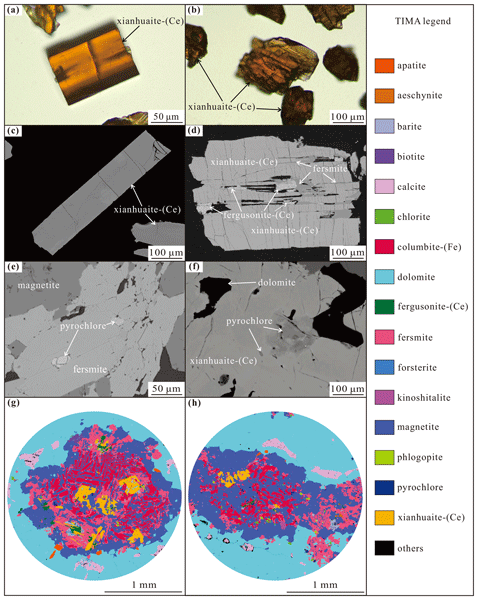
Researchers studying the Bayan Obo deposit in northern China discovered an unknown mineral named xianhuaite-(Ce). The mineral contains the elements potassium, cerium, and niobium. Using microscopes, chemical analyses, and X-ray measurements, the researchers determined its structure and properties. The study shows that this mineral records the formation of rare earth and niobium ores in geological processes, improving our understanding of how these important resources formed.
Yuan Xue, Ningyue Sun, Hongping He, Aiqing Chen, and Yiping Yang
Eur. J. Mineral., 34, 95–108, https://doi.org/10.5194/ejm-34-95-2022, https://doi.org/10.5194/ejm-34-95-2022, 2022
Short summary
Short summary
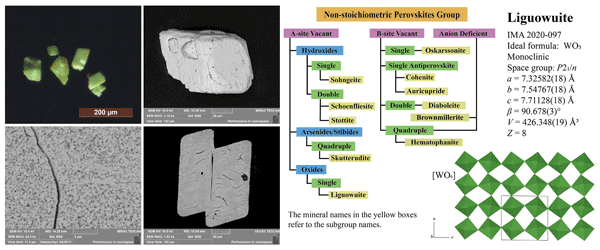
Liguowuite, a new member of the non-stoichiometric perovskite group minerals, ideally WO3, has been found in the Panzhihua–Xichang region, China. Liguowuite is monoclinic and is in space group P21 / n, with a = 7.32582(18) Å, b = 7.54767(18) Å, c = 7.71128(18) Å, β = 90.678(3)°, V = 426.348(19) Å3, and Z = 8. According to the hierarchical scheme for perovskite supergroup minerals, liguowuite is the first reported example of A-site vacant single oxide, i.e., a new perovskite subgroup.
Cited articles
Bindi, L., Evain, M., Spry, P. G., and Menchetti, S.: The pearceite-polybasite group of minerals: Crystal chemistry and new nomenclature rules, Am. Mineral., 92, 918–925, https://doi.org/10.2138/am.2007.2440, 2007.
Bindi, L., Voudouris, P., and Spry, P. G.: Structural role of tellurium in the minerals of the pearceite-polybasite group, Mineral. Mag., 77, 419–428, https://doi.org/10.1180/minmag.2013.077.4.02, 2013.
Bindi, L., Stanley, C. J., and Spry, P. G.: New structural data reveal benleonardite to be a member of the pearceite-polybasite group, Mineral. Mag., 79, 1213–1221, https://doi.org/10.1180/minmag.2015.079.5.15, 2015.
Cai, N. Z. and Su, Z. B.: Stratigraphic subdivision and distinction of primary rock-types of the Taihua Group in the Xiaoqinling Mountain, Reg. Geol. China, 13, 35–44, 1985 (in Chinese with English abstract).
Cook, N. J. and Ciobanu, C. L.: Bismuth tellurides and sulphosalts from the Larga hydrothermal system, Metaliferi Mts., Romania: Paragenesis and genetic significance, Mineral. Mag., 68, 301–321, https://doi.org/10.1180/0026461046820188, 2004.
Czamanske, G. K. and Hall, W. E.: The Ag-Bi-Pb-Sb-S-Se-Te mineralogy of the Darwin lead-silver-zinc deposit, southern California, Econ. Geol., 70, 1092–1110, https://doi.org/10.2113/gsecongeo.70.6.1092, 1975.
Dincă, G., Popescu, G. C., and Topa, D.: Decoding the mineralogy and geochemistry of sulfosalts in the Săcărâmb Au-Ag-Te ore deposit (Romania): Unveiling a fresh insight into the evolution of a complex hydrothermal system, Ore Geol. Rev., 176, 106424, https://doi.org/10.1016/j.oregeorev.2024.106424, 2025.
Dolomanov, O. V., Bourhis, L. J., Gildea, R. J., Howard, J. A. K., and Puschmann, H.: OLEX2: a complete structure solution, refinement and analysis program, J. Appl. Crystallogr., 42, 339–341, https://doi.org/10.1107/S0021889808042726, 2009.
Fan, G. H., Li, J. W., Zhong, R. C., Gleeson, S. A., Yao, Z. S., Harlov, D. E., Deng, X. D., Cui, H., Yu, C., and Gao, W. S.: Polymetallic Te-rich melts contribute to efficient enrichment and precipitation of Au in hydrothermal ore deposits, Geochim. Cosmochim. Ac., 397, 176–187, https://doi.org/10.1016/j.gca.2025.03.027, 2025.
Hui, K. X., Qin, K. Z., Han, R., Zhao, J. X., Wang, L., Gao, S., and Zhang, X. N.: Magmatic-hydrothermal silver deposits, argentiferous provinces and the main controlling factors of formation, Acta Petrol. Sin., 37, 2502–2520, 2021 (in Chinese with English abstract).
Jian, W., Mao, J. W., Lehmann, B., Cook, N. J., Xie, G. Q., Liu, P., Duan, C., Alles, J., and Niu, Z. J.: Au-Ag-Te–rich melt inclusions in hydrothermal gold-quartz veins, Xiaoqinling lode gold district, central China, Econ. Geol., 116, 1239–1248, https://doi.org/10.5382/econgeo.4811, 2021.
Li, H. M., Chen, Y. C., Wang, D. H., Ye, H. S., Wang, Y. B., Zhang, C. Q., and Dai, J. Z.: SHRIMP U-Pb ages of metamorphic rocks and veins in the Xiaoqinling area, and their geological significance, Acta Petrol. Sin., 23, 2504–2512, 2007 (in Chinese with English abstract).
Li, Z. K., Li, J. W., Zhao, X. F., Zhou, M. F., Selby, D., Bi, S. J., Sui, J. X., and Zhao, Z. J.: Crustal-Extension Ag-Pb-Zn Veins in the Xiong'ershan District, Southern North China Craton: Constraints from the Shagou Deposit, Econ. Geol., 108, 1703–1729, https://doi.org/10.2113/econgeo.108.7.1703, 2013.
Li, Z. K., Li, J. W., Cooke, D. R., Danyushevsky, L., Zhang, L., O'Brien, H., Lahaye, Y., Zhang, W., and Xu, H. J.: Textures, trace elements, and Pb isotopes of sulfides from the Haopinggou vein deposit, southern North China Craton: implications for discrete Au and Ag–Pb–Zn mineralization, Contrib. Mineral. Petrol., 171, 1–26, https://doi.org/10.1007/s00410-016-1309-x, 2016.
Liu, J. J., Wang, D. Z., Zhai, D. G., Gao, S., Zhang, B., Wang, J. X., Zhang, B., Wang, G. Z., Wang, Z. L., Wang, L. W., and Weng, G. M.: Study on role of low-melting point chalcophile elements (LMCE) in gold mineralization and its promotion mechanisms in gold enrichment, Mineral. Deposits, 43, 712–734, 2024 (in Chinese with English abstract).
Ni, Z. Y., Wang, R. M., Tong, Y., Yang, C., and Dai, T. M.: 207Pb 206Pb age of zircon and 40Ar/39Ar of amphibole from plagioclase amphibolite in the Taihua Group, Luoning, Henan, China, Geol. Rev., 49, 361–366, 2003 (in Chinese with English abstract).
Palyanova, G. A.: Gold and Silver Minerals in Sulfide Ore, Geol. Ore Depos., 62, 383–406, https://doi.org/10.1134/s1075701520050050, 2020.
Sharp, T. G. and Buseck, P. R.: The distribution of Ag and Sb in galena: Inclusions versus solid solution, Am. Mineral., 78, 85–95, 1993.
Sheldrick, G. M.: SHELXT – integrated space-group and crystal-structure determination, Acta Crystallogr. A, 71, 3–8, https://doi.org/10.1107/S2053273314026370, 2015a.
Sheldrick, G. M.: Crystal structure refinement with SHELXL, Acta Crystallogr. C, 71, 3–8, https://doi.org/10.1107/S2053229614024218, 2015b.
Simmons, S. F., White, N. C., and John, D. A.: Geological Characteristics of Epithermal Precious and Base Metal Deposits, Society of Economic Geologists, Inc., One Hundredth Anniversary, 485–522, https://doi.org/10.5382/av100.16, 2005.
Simon, A. C., Candela, P. A., Piccoli, P. M., Mengason, M., and Englander, L.: The effect of crystal-melt partitioning on the budgets of Cu, Au, and Ag, Am. Mineral., 93, 1437–1448, https://doi.org/10.2138/am.2008.2812, 2008.
Tian, Y. F., Mao, J. W., Jian, W., Wang, Y. T., Feng, R., Ye, H. S., Liu, J. C., Wu, S. T., Zhu, L., Xu, H. S., Guan, H. L., and Wang, P.: Recognition of the Xiayu intermediate-sulfidation epithermal Ag-Pb-Zn-Au(-Cu) mineralization in the East Qinling polymetallic ore belt, China: Constraints from geology and geochronology, Ore Geol. Rev., 156, 105398, https://doi.org/10.1016/j.oregeorev.2023.105398, 2023.
Tombros, S., Seymour, K. S., and Williams-Jones, A. E.: Controls on Tellurium in Base, Precious, and Telluride Minerals in the Panormos Bay Ag-Au-Te Deposits, Tinos Island, Cyclades, Greece, Econ. Geol., 105, 1097–1111, https://doi.org/10.2113/econgeo.105.6.1097, 2010.
Tooth, B., Ciobanu, C. L., Green, L., O'Neill, B., and Brugger, J.: Bi-melt formation and gold scavenging from hydrothermal fluids: An experimental study, Geochim. Cosmochim. Ac., 75, 5423–5443, https://doi.org/10.1016/j.gca.2011.07.020, 2011.
Wang, L., Qin, K. Z., Song, G. X., and Li, G. M.: A review of intermediate sulfidation epithermal deposits and subclassification, Ore Geol. Rev., 107, 434–456, https://doi.org/10.1016/j.oregeorev.2019.02.023, 2019.
Withers, R. L., Norén, L., Welberry, T. R., Bindi, L., Evain, M., and Menchetti, S.: A composite modulated structure mechanism for Ag+ fast ion conduction in pearceite and polybasite mineral solid electrolytes, Solid State Ionics, 179, 2080–2089, 2008.
Yuningsih, E. T. and Matsueda, H.: Study on the Cu–As–Sb–Ag–Bi–Pb–Te Sulfosalt Minerals from the Hydrothermal System of Southwestern Hokkaido, Japan, Resour. Geol., 68, 209–226, https://doi.org/10.1111/rge.12157, 2018.
Short summary
We studied a newly discovered silver-rich mineral from an ore deposit in central China to understand how silver is stored in nature. Using microscopy, chemical, and crystal-structure tests, we found that this mineral is a new species with a unique tellurium-rich structure. Our results show that tellurium helped trap and concentrate silver in hot mineral-forming fluids, offering new clues to how silver-rich deposits form.
We studied a newly discovered silver-rich mineral from an ore deposit in central China to...