Articles | Volume 38, issue 4
https://doi.org/10.5194/ejm-38-373-2026
© Author(s) 2026. This work is distributed under
the Creative Commons Attribution 4.0 License.
https://doi.org/10.5194/ejm-38-373-2026
© Author(s) 2026. This work is distributed under
the Creative Commons Attribution 4.0 License.
Yttrotungstite-(Nd), a new mineral species from the Nyakabingo tungsten mine, Kigali, Rwanda

Laboratoire de Minéralogie, Département de Géologie, Université de Liège, Bâtiment B18, Sart Tilman, 4000 Liège, Belgium
Simon Philippo
Musée national d'histoire naturelle de Luxembourg, 25 Rue Münster, 2160 Luxembourg, Luxembourg
Pietro Vignola
CNR-Istituto di Geologia Ambientale e Geoingegneria – via Mario Bianco, 9 – 20131 Milano, Italy
Maël Guennou
Department of Physics and Materials Science, University of Luxembourg, 30 avenue des Hauts-Fourneaux, 6342 Esch-sur-Alzette, Luxembourg
Related authors
Ferdinando Bosi, Frédéric Hatert, Marco Pasero, and Stuart J. Mills
Eur. J. Mineral., 38, 347–352, https://doi.org/10.5194/ejm-38-347-2026, https://doi.org/10.5194/ejm-38-347-2026, 2026
Ferdinando Bosi, Frédéric Hatert, Marco Pasero, and Stuart J. Mills
Eur. J. Mineral., 38, 231–235, https://doi.org/10.5194/ejm-38-231-2026, https://doi.org/10.5194/ejm-38-231-2026, 2026
Short summary
Ferdinando Bosi, Frédéric Hatert, Marco Pasero, and Stuart J. Mills
Eur. J. Mineral., 38, 117–122, https://doi.org/10.5194/ejm-38-117-2026, https://doi.org/10.5194/ejm-38-117-2026, 2026
Ferdinando Bosi, Frédéric Hatert, Marco Pasero, and Stuart J. Mills
Eur. J. Mineral., 37, 921–925, https://doi.org/10.5194/ejm-37-921-2025, https://doi.org/10.5194/ejm-37-921-2025, 2025
Ferdinando Bosi, Frédéric Hatert, Nicolas Meisser, Marco Pasero, and Stuart Mills
Eur. J. Mineral., 37, 871–876, https://doi.org/10.5194/ejm-37-871-2025, https://doi.org/10.5194/ejm-37-871-2025, 2025
Short summary
Short summary
This study explains how scientists determine whether a newly found solid phase is truly a natural mineral. We refine existing guidelines by introducing updated recommendations that improve the credibility of proposals for minerals with uncertain origins. Using three examples, we show how geological and textural evidence can confirm or challenge natural authenticity. Our new checklist helps reduce misinterpretation and ensures more reliable mineral recognition.
Florent Bomal, Frédéric Hatert, Simon Philippo, Maël Guennou, Martin Depret, Hao Wang, Pierre Lefèvre, and Muriel Erambert
Eur. J. Mineral., 37, 709–731, https://doi.org/10.5194/ejm-37-709-2025, https://doi.org/10.5194/ejm-37-709-2025, 2025
Short summary
Short summary
Seventeen tourmalines from Brazil were investigated by structural and chemical techniques. Most samples are Na-dominant and belong to the alkali group. They correspond to fluor-elbaites or elbaites, except one sample, which corresponds to a rossmanite. Structural data indicate that the B site is fully occupied by boron, that the T site is occupied by Si, and that the Z site is mainly occupied by Al. The X site contains vacancies, Na, K, and Ca, and the Y site is mainly occupied by Li, Al, and Fe2+.
Ferdinando Bosi, Frédéric Hatert, Marco Pasero, and Stuart J. Mills
Eur. J. Mineral., 37, 695–698, https://doi.org/10.5194/ejm-37-695-2025, https://doi.org/10.5194/ejm-37-695-2025, 2025
Ferdinando Bosi, Frédéric Hatert, Marco Pasero, and Stuart J. Mills
Eur. J. Mineral., 37, 549–553, https://doi.org/10.5194/ejm-37-549-2025, https://doi.org/10.5194/ejm-37-549-2025, 2025
Ferdinando Bosi, Frédéric Hatert, Marco Pasero, and Stuart J. Mills
Eur. J. Mineral., 37, 337–342, https://doi.org/10.5194/ejm-37-337-2025, https://doi.org/10.5194/ejm-37-337-2025, 2025
Ferdinando Bosi, Frédéric Hatert, Marco Pasero, and Stuart J. Mills
Eur. J. Mineral., 37, 249–255, https://doi.org/10.5194/ejm-37-249-2025, https://doi.org/10.5194/ejm-37-249-2025, 2025
Ferdinando Bosi, Frédéric Hatert, Marco Pasero, and Stuart J. Mills
Eur. J. Mineral., 37, 75–78, https://doi.org/10.5194/ejm-37-75-2025, https://doi.org/10.5194/ejm-37-75-2025, 2025
Ferdinando Bosi, Frédéric Hatert, Marco Pasero, and Stuart J. Mills
Eur. J. Mineral., 36, 1005–1010, https://doi.org/10.5194/ejm-36-1005-2024, https://doi.org/10.5194/ejm-36-1005-2024, 2024
Ferdinando Bosi, Frédéric Hatert, Marco Pasero, and Stuart J. Mills
Eur. J. Mineral., 36, 917–923, https://doi.org/10.5194/ejm-36-917-2024, https://doi.org/10.5194/ejm-36-917-2024, 2024
Martin Depret, Frédéric Hatert, Michel Blondieau, Stéphane Puccio, Muriel M. L. Erambert, Fabrice Dal Bo, and Florent Bomal
Eur. J. Mineral., 36, 687–708, https://doi.org/10.5194/ejm-36-687-2024, https://doi.org/10.5194/ejm-36-687-2024, 2024
Short summary
Short summary
Ardennite is a rare Mn-rich aluminosilicate that was originally described in Salmchâteau, Belgium. In the last few years, new samples of ardennites have been found at several localities close to Salmchâteau. These samples were analysed by electron microprobe, single-crystal X-ray diffraction, and infrared spectroscopy. The results given in this paper allow us to identify the main substitution mechanisms that occur in Belgian ardennites and to discuss the nomenclature of the ardennite group.
Ferdinando Bosi, Frédéric Hatert, Marco Pasero, and Stuart J. Mills
Eur. J. Mineral., 36, 599–604, https://doi.org/10.5194/ejm-36-599-2024, https://doi.org/10.5194/ejm-36-599-2024, 2024
Ferdinando Bosi, Frédéric Hatert, Marco Pasero, and Stuart J. Mills
Eur. J. Mineral., 36, 525–528, https://doi.org/10.5194/ejm-36-525-2024, https://doi.org/10.5194/ejm-36-525-2024, 2024
Ferdinando Bosi, Frédéric Hatert, Marco Pasero, and Stuart J. Mills
Eur. J. Mineral., 36, 361–367, https://doi.org/10.5194/ejm-36-361-2024, https://doi.org/10.5194/ejm-36-361-2024, 2024
Ferdinando Bosi, Frédéric Hatert, Marco Pasero, and Stuart J. Mills
Eur. J. Mineral., 36, 165–172, https://doi.org/10.5194/ejm-36-165-2024, https://doi.org/10.5194/ejm-36-165-2024, 2024
Fabrice Dal Bo, Henrik Friis, Marlina A. Elburg, Frédéric Hatert, and Tom Andersen
Eur. J. Mineral., 36, 73–85, https://doi.org/10.5194/ejm-36-73-2024, https://doi.org/10.5194/ejm-36-73-2024, 2024
Short summary
Short summary
We report the description and the characterization of a new mineral species, found in a rock sample from the geological formation called the Pilanesberg Complex, South Africa. This is a silicate mineral that contains a significant amount of sodium, calcium, iron, titanium and fluorine. Its atomic structure shows that it is related to other wöhlerite-group minerals. This work provides new insights into the crystallization conditions that ruled the formation of the Pilanesberg complex.
Ferdinando Bosi, Frédéric Hatert, Marco Pasero, and Stuart J. Mills
Eur. J. Mineral., 35, 1073–1078, https://doi.org/10.5194/ejm-35-1073-2023, https://doi.org/10.5194/ejm-35-1073-2023, 2023
Ferdinando Bosi, Frédéric Hatert, Marco Pasero, and Stuart J. Mills
Eur. J. Mineral., 35, 891–895, https://doi.org/10.5194/ejm-35-891-2023, https://doi.org/10.5194/ejm-35-891-2023, 2023
Ferdinando Bosi, Frédéric Hatert, Marco Pasero, and Stuart J. Mills
Eur. J. Mineral., 35, 659–664, https://doi.org/10.5194/ejm-35-659-2023, https://doi.org/10.5194/ejm-35-659-2023, 2023
Lyudmila M. Lyalina, Ekaterina A. Selivanova, and Frédéric Hatert
Eur. J. Mineral., 35, 427–437, https://doi.org/10.5194/ejm-35-427-2023, https://doi.org/10.5194/ejm-35-427-2023, 2023
Short summary
Short summary
There are unresolved problems related to the nomenclature and identification of mineral species belonging to the triphylite group of minerals. They can be solved by discarding the traditional views on succession of mineral species during oxidation. In other words, it is necessary to separate the concepts of the origin of the mineral and the boundaries of the species.
Ferdinando Bosi, Frédéric Hatert, Marco Pasero, and Stuart J. Mills
Eur. J. Mineral., 35, 397–402, https://doi.org/10.5194/ejm-35-397-2023, https://doi.org/10.5194/ejm-35-397-2023, 2023
Ferdinando Bosi, Frédéric Hatert, Marco Pasero, and Stuart J. Mills
Eur. J. Mineral., 35, 285–293, https://doi.org/10.5194/ejm-35-285-2023, https://doi.org/10.5194/ejm-35-285-2023, 2023
Ferdinando Bosi, Ritsuro Miyawaki, Frédéric Hatert, Marco Pasero, and Stuart J. Mills
Eur. J. Mineral., 35, 75–79, https://doi.org/10.5194/ejm-35-75-2023, https://doi.org/10.5194/ejm-35-75-2023, 2023
Ritsuro Miyawaki, Frédéric Hatert, Marco Pasero, and Stuart J. Mills
Eur. J. Mineral., 34, 591–601, https://doi.org/10.5194/ejm-34-591-2022, https://doi.org/10.5194/ejm-34-591-2022, 2022
Ritsuro Miyawaki, Frédéric Hatert, Marco Pasero, and Stuart J. Mills
Eur. J. Mineral., 34, 463–468, https://doi.org/10.5194/ejm-34-463-2022, https://doi.org/10.5194/ejm-34-463-2022, 2022
Ritsuro Miyawaki, Frédéric Hatert, Marco Pasero, and Stuart J. Mills
Eur. J. Mineral., 34, 385–391, https://doi.org/10.5194/ejm-34-385-2022, https://doi.org/10.5194/ejm-34-385-2022, 2022
Ritsuro Miyawaki, Frédéric Hatert, Marco Pasero, and Stuart J. Mills
Eur. J. Mineral., 34, 359–364, https://doi.org/10.5194/ejm-34-359-2022, https://doi.org/10.5194/ejm-34-359-2022, 2022
Ritsuro Miyawaki, Frédéric Hatert, Marco Pasero, and Stuart J. Mills
Eur. J. Mineral., 34, 253–257, https://doi.org/10.5194/ejm-34-253-2022, https://doi.org/10.5194/ejm-34-253-2022, 2022
Ritsuro Miyawaki, Frédéric Hatert, Marco Pasero, and Stuart J. Mills
Eur. J. Mineral., 34, 143–148, https://doi.org/10.5194/ejm-34-143-2022, https://doi.org/10.5194/ejm-34-143-2022, 2022
Ritsuro Miyawaki, Frédéric Hatert, Marco Pasero, and Stuart J. Mills
Eur. J. Mineral., 34, 1–6, https://doi.org/10.5194/ejm-34-1-2022, https://doi.org/10.5194/ejm-34-1-2022, 2022
Ritsuro Miyawaki, Frédéric Hatert, Marco Pasero, and Stuart J. Mills
Eur. J. Mineral., 33, 639–646, https://doi.org/10.5194/ejm-33-639-2021, https://doi.org/10.5194/ejm-33-639-2021, 2021
Ritsuro Miyawaki, Frédéric Hatert, Marco Pasero, and Stuart J. Mills
Eur. J. Mineral., 33, 479–484, https://doi.org/10.5194/ejm-33-479-2021, https://doi.org/10.5194/ejm-33-479-2021, 2021
Ferdinando Bosi, Frédéric Hatert, Marco Pasero, and Stuart J. Mills
Eur. J. Mineral., 38, 347–352, https://doi.org/10.5194/ejm-38-347-2026, https://doi.org/10.5194/ejm-38-347-2026, 2026
Ferdinando Bosi, Frédéric Hatert, Marco Pasero, and Stuart J. Mills
Eur. J. Mineral., 38, 231–235, https://doi.org/10.5194/ejm-38-231-2026, https://doi.org/10.5194/ejm-38-231-2026, 2026
Short summary
Ferdinando Bosi, Frédéric Hatert, Marco Pasero, and Stuart J. Mills
Eur. J. Mineral., 38, 117–122, https://doi.org/10.5194/ejm-38-117-2026, https://doi.org/10.5194/ejm-38-117-2026, 2026
Ferdinando Bosi, Frédéric Hatert, Marco Pasero, and Stuart J. Mills
Eur. J. Mineral., 37, 921–925, https://doi.org/10.5194/ejm-37-921-2025, https://doi.org/10.5194/ejm-37-921-2025, 2025
Ferdinando Bosi, Frédéric Hatert, Nicolas Meisser, Marco Pasero, and Stuart Mills
Eur. J. Mineral., 37, 871–876, https://doi.org/10.5194/ejm-37-871-2025, https://doi.org/10.5194/ejm-37-871-2025, 2025
Short summary
Short summary
This study explains how scientists determine whether a newly found solid phase is truly a natural mineral. We refine existing guidelines by introducing updated recommendations that improve the credibility of proposals for minerals with uncertain origins. Using three examples, we show how geological and textural evidence can confirm or challenge natural authenticity. Our new checklist helps reduce misinterpretation and ensures more reliable mineral recognition.
Florent Bomal, Frédéric Hatert, Simon Philippo, Maël Guennou, Martin Depret, Hao Wang, Pierre Lefèvre, and Muriel Erambert
Eur. J. Mineral., 37, 709–731, https://doi.org/10.5194/ejm-37-709-2025, https://doi.org/10.5194/ejm-37-709-2025, 2025
Short summary
Short summary
Seventeen tourmalines from Brazil were investigated by structural and chemical techniques. Most samples are Na-dominant and belong to the alkali group. They correspond to fluor-elbaites or elbaites, except one sample, which corresponds to a rossmanite. Structural data indicate that the B site is fully occupied by boron, that the T site is occupied by Si, and that the Z site is mainly occupied by Al. The X site contains vacancies, Na, K, and Ca, and the Y site is mainly occupied by Li, Al, and Fe2+.
Ferdinando Bosi, Frédéric Hatert, Marco Pasero, and Stuart J. Mills
Eur. J. Mineral., 37, 695–698, https://doi.org/10.5194/ejm-37-695-2025, https://doi.org/10.5194/ejm-37-695-2025, 2025
Ferdinando Bosi, Frédéric Hatert, Marco Pasero, and Stuart J. Mills
Eur. J. Mineral., 37, 549–553, https://doi.org/10.5194/ejm-37-549-2025, https://doi.org/10.5194/ejm-37-549-2025, 2025
Ferdinando Bosi, Frédéric Hatert, Marco Pasero, and Stuart J. Mills
Eur. J. Mineral., 37, 337–342, https://doi.org/10.5194/ejm-37-337-2025, https://doi.org/10.5194/ejm-37-337-2025, 2025
Ferdinando Bosi, Frédéric Hatert, Marco Pasero, and Stuart J. Mills
Eur. J. Mineral., 37, 249–255, https://doi.org/10.5194/ejm-37-249-2025, https://doi.org/10.5194/ejm-37-249-2025, 2025
Ferdinando Bosi, Frédéric Hatert, Marco Pasero, and Stuart J. Mills
Eur. J. Mineral., 37, 75–78, https://doi.org/10.5194/ejm-37-75-2025, https://doi.org/10.5194/ejm-37-75-2025, 2025
Ferdinando Bosi, Frédéric Hatert, Marco Pasero, and Stuart J. Mills
Eur. J. Mineral., 36, 1005–1010, https://doi.org/10.5194/ejm-36-1005-2024, https://doi.org/10.5194/ejm-36-1005-2024, 2024
Ferdinando Bosi, Frédéric Hatert, Marco Pasero, and Stuart J. Mills
Eur. J. Mineral., 36, 917–923, https://doi.org/10.5194/ejm-36-917-2024, https://doi.org/10.5194/ejm-36-917-2024, 2024
Martin Depret, Frédéric Hatert, Michel Blondieau, Stéphane Puccio, Muriel M. L. Erambert, Fabrice Dal Bo, and Florent Bomal
Eur. J. Mineral., 36, 687–708, https://doi.org/10.5194/ejm-36-687-2024, https://doi.org/10.5194/ejm-36-687-2024, 2024
Short summary
Short summary
Ardennite is a rare Mn-rich aluminosilicate that was originally described in Salmchâteau, Belgium. In the last few years, new samples of ardennites have been found at several localities close to Salmchâteau. These samples were analysed by electron microprobe, single-crystal X-ray diffraction, and infrared spectroscopy. The results given in this paper allow us to identify the main substitution mechanisms that occur in Belgian ardennites and to discuss the nomenclature of the ardennite group.
Ferdinando Bosi, Frédéric Hatert, Marco Pasero, and Stuart J. Mills
Eur. J. Mineral., 36, 599–604, https://doi.org/10.5194/ejm-36-599-2024, https://doi.org/10.5194/ejm-36-599-2024, 2024
Ferdinando Bosi, Frédéric Hatert, Marco Pasero, and Stuart J. Mills
Eur. J. Mineral., 36, 525–528, https://doi.org/10.5194/ejm-36-525-2024, https://doi.org/10.5194/ejm-36-525-2024, 2024
Ferdinando Bosi, Frédéric Hatert, Marco Pasero, and Stuart J. Mills
Eur. J. Mineral., 36, 361–367, https://doi.org/10.5194/ejm-36-361-2024, https://doi.org/10.5194/ejm-36-361-2024, 2024
Ferdinando Bosi, Frédéric Hatert, Marco Pasero, and Stuart J. Mills
Eur. J. Mineral., 36, 165–172, https://doi.org/10.5194/ejm-36-165-2024, https://doi.org/10.5194/ejm-36-165-2024, 2024
Fabrice Dal Bo, Henrik Friis, Marlina A. Elburg, Frédéric Hatert, and Tom Andersen
Eur. J. Mineral., 36, 73–85, https://doi.org/10.5194/ejm-36-73-2024, https://doi.org/10.5194/ejm-36-73-2024, 2024
Short summary
Short summary
We report the description and the characterization of a new mineral species, found in a rock sample from the geological formation called the Pilanesberg Complex, South Africa. This is a silicate mineral that contains a significant amount of sodium, calcium, iron, titanium and fluorine. Its atomic structure shows that it is related to other wöhlerite-group minerals. This work provides new insights into the crystallization conditions that ruled the formation of the Pilanesberg complex.
Ferdinando Bosi, Frédéric Hatert, Marco Pasero, and Stuart J. Mills
Eur. J. Mineral., 35, 1073–1078, https://doi.org/10.5194/ejm-35-1073-2023, https://doi.org/10.5194/ejm-35-1073-2023, 2023
Ferdinando Bosi, Frédéric Hatert, Marco Pasero, and Stuart J. Mills
Eur. J. Mineral., 35, 891–895, https://doi.org/10.5194/ejm-35-891-2023, https://doi.org/10.5194/ejm-35-891-2023, 2023
Ferdinando Bosi, Frédéric Hatert, Marco Pasero, and Stuart J. Mills
Eur. J. Mineral., 35, 659–664, https://doi.org/10.5194/ejm-35-659-2023, https://doi.org/10.5194/ejm-35-659-2023, 2023
Lyudmila M. Lyalina, Ekaterina A. Selivanova, and Frédéric Hatert
Eur. J. Mineral., 35, 427–437, https://doi.org/10.5194/ejm-35-427-2023, https://doi.org/10.5194/ejm-35-427-2023, 2023
Short summary
Short summary
There are unresolved problems related to the nomenclature and identification of mineral species belonging to the triphylite group of minerals. They can be solved by discarding the traditional views on succession of mineral species during oxidation. In other words, it is necessary to separate the concepts of the origin of the mineral and the boundaries of the species.
Ferdinando Bosi, Frédéric Hatert, Marco Pasero, and Stuart J. Mills
Eur. J. Mineral., 35, 397–402, https://doi.org/10.5194/ejm-35-397-2023, https://doi.org/10.5194/ejm-35-397-2023, 2023
Ferdinando Bosi, Frédéric Hatert, Marco Pasero, and Stuart J. Mills
Eur. J. Mineral., 35, 285–293, https://doi.org/10.5194/ejm-35-285-2023, https://doi.org/10.5194/ejm-35-285-2023, 2023
Ferdinando Bosi, Ritsuro Miyawaki, Frédéric Hatert, Marco Pasero, and Stuart J. Mills
Eur. J. Mineral., 35, 75–79, https://doi.org/10.5194/ejm-35-75-2023, https://doi.org/10.5194/ejm-35-75-2023, 2023
Ritsuro Miyawaki, Frédéric Hatert, Marco Pasero, and Stuart J. Mills
Eur. J. Mineral., 34, 591–601, https://doi.org/10.5194/ejm-34-591-2022, https://doi.org/10.5194/ejm-34-591-2022, 2022
Ritsuro Miyawaki, Frédéric Hatert, Marco Pasero, and Stuart J. Mills
Eur. J. Mineral., 34, 463–468, https://doi.org/10.5194/ejm-34-463-2022, https://doi.org/10.5194/ejm-34-463-2022, 2022
Ritsuro Miyawaki, Frédéric Hatert, Marco Pasero, and Stuart J. Mills
Eur. J. Mineral., 34, 385–391, https://doi.org/10.5194/ejm-34-385-2022, https://doi.org/10.5194/ejm-34-385-2022, 2022
Ritsuro Miyawaki, Frédéric Hatert, Marco Pasero, and Stuart J. Mills
Eur. J. Mineral., 34, 359–364, https://doi.org/10.5194/ejm-34-359-2022, https://doi.org/10.5194/ejm-34-359-2022, 2022
Ritsuro Miyawaki, Frédéric Hatert, Marco Pasero, and Stuart J. Mills
Eur. J. Mineral., 34, 253–257, https://doi.org/10.5194/ejm-34-253-2022, https://doi.org/10.5194/ejm-34-253-2022, 2022
Ritsuro Miyawaki, Frédéric Hatert, Marco Pasero, and Stuart J. Mills
Eur. J. Mineral., 34, 143–148, https://doi.org/10.5194/ejm-34-143-2022, https://doi.org/10.5194/ejm-34-143-2022, 2022
Ritsuro Miyawaki, Frédéric Hatert, Marco Pasero, and Stuart J. Mills
Eur. J. Mineral., 34, 1–6, https://doi.org/10.5194/ejm-34-1-2022, https://doi.org/10.5194/ejm-34-1-2022, 2022
Ritsuro Miyawaki, Frédéric Hatert, Marco Pasero, and Stuart J. Mills
Eur. J. Mineral., 33, 639–646, https://doi.org/10.5194/ejm-33-639-2021, https://doi.org/10.5194/ejm-33-639-2021, 2021
Ritsuro Miyawaki, Frédéric Hatert, Marco Pasero, and Stuart J. Mills
Eur. J. Mineral., 33, 479–484, https://doi.org/10.5194/ejm-33-479-2021, https://doi.org/10.5194/ejm-33-479-2021, 2021
Cited articles
Bosi, F., Hatert, F., Pasero, M., and Mills, S. J.: IMA Commission on New Minerals, Nomenclature and Classification (CNMNC) – Newsletter 76, Eur. J. Mineral., 35, 1073–1078, https://doi.org/10.5194/ejm-35-1073-2023, 2023.
Bosi, F., Hatert, F., Pasero, M., and Mills, S. J.: IMA Commission on New Minerals, Nomenclature and Classification (CNMNC) – Newsletter 91, European Journal of Mineralogy, in press, 2026.
Burnham, C. W.: LCLSQ version 8.4, least-squares refinement of crystallographic lattice parameters, Department of Earth & Planetary Sciences, Harvard University, 24 pp., 1991.
Davis, R. J. and Smith, G. W.: Yttrotungstite, Mineral. Mag., 38, 261–285, 1971.
De Clercq, F., Muchez, P., Dewaele, S., and Boyce, A.: The tungsten mineralisation at Nyakabingo and Gifurwe (Rwanda): Preliminary results, Geol. Belg., 11, 251–258, 2008.
Dewaele, S., De Clercq, F., Hulsbosch, N., Piessens, K., Boyce, A., Burgess, R., and Muchez, P.: Genesis of the vein-type tungsten mineralization at Nyakabingo (Rwanda) in the Karagwe–Ankole belt, Central Africa, Mineralium Deposita, 51, 283–307, 2016.
European Union: Critical Raw Materials Resilience: Charting a Path towards greater Security and Sustainability, https://eur-lex.europa.eu/legal-content/EN/TXT/?uri=CELEX:52020DC0474 (last access: 14 January 2026), 2020.
Fransolet, A.-M.: Etude minéralogique et pétrologique des phosphates de pegmatites granitiques, unpublished PhD thesis, University of Liège, Belgium, 1975.
Gagné, O. C. and Hawthorne, F. C.: Comprehensive derivation of bond-valence parameters for ion pairs involving oxygen, Acta Crystallogr. B, 71, 562–578, 2015.
Gaines, R.V., Skinner, H.C.W., Foord, E.E., Mason, B. and Rozenzweig, A.: Dana's new mineralogy, 8th Edn., John Wiley & Sons, New York, 1819 pp., ISBN 0-471-19310-0, 1997.
Goldmann, S., Melcher, F., Gäbler, H.-E., Dewaele, S., De Clercq, F., and Muchez, P.: Mineralogy and trace element chemistry of ferberite/reinite from tungsten deposits in central Rwanda, Minerals, 3, 121–144, 2013.
Hardcastle, F. D. and Wachs, I. E.: Determination of the molecular structures of tungstates by Raman spectroscopy, J. Raman Spectrosc., 26, 397–405, 1995.
Hulsbosch, N., Boiron, M.-C., Dewaele; S., and Muchez, P.: Fluid fractionation of tungsten during granite-pegmatite differentiation and the metal source of peribatholitic W quartz veins: Evidence from the Karagwe-Ankole Belt (Rwanda), Geochim. Cosmochim. Ac., 175, 299–318, 2016.
Jarosewich, E. and Boatner, L. A.: Rare-earth element reference samples for electron microprobe analysis, Geostand. Geoanal. Res., 15, 397–399, 1991.
Kolitsch, U., Blaß, G., Graf, H.-W., and Gröbner, J.: Neufunde aus der Grube Clara im mittleren Schwarzwald, Lapis, 29, 18–23, 2004.
Libowitzky, E.: Correlation of O-H stretching frequencies and O-H…O hydrogen bond lengths in minerals, Monatsh. Chem., 130, 1047–1059, 1999.
Mandarino, J. A.: The Gladstone-Dale relationship: part IV, The compatibility concept and its application, Can. Mineral., 19, 441–450, 1981.
Momma, K. and Izumi, F.: Vesta 3 for three-dimensional visualization of crystal, volumetric and morphology data, J. Appl. Crystallogr., 44, 1272–1276, 2011.
Nickel, E. H. and Mandarino, J.A.: Procedures involving the IMA Commission on New Minerals and Mineral Names and guidelines on mineral nomenclature, Am. Mineral., 72, 1031–1042, 1987.
Oxford Diffraction: CrysAlis CCD and CrysAlis RED, version 1.71, Oxford Diffraction, Oxford, England, 2007.
Sahama, T. G.: The secondary tungsten minerals, a review, Mineral. Rec., 12, 81–87, 1981.
Sahama, T. G., von Knorring, O., and Lehtinen, M.: Cerotungstite, a cerian analogue to yttrotungstite, from Uganda, Bull. Geol. Soc. Fin., 42, 223–228, 1970.
Strunz, H. and Nickel, E. H.: Strunz mineralogical tables, chemical structural mineral classification system, E. Schweitzerbart'sche Verlagsbuchhandlung, Stuttgart, 870 pp., ISBN 3-510-65188-X, 2002.
Warr, L. N.: IMA-CNMNC approved mineral symbols, Mineral. Mag., 85, 291–320, 2021.
Wilson, A. J. C.: International Tables for X-ray Crystallography, Vol. C, Kluwer Academic Press, London, 883 pp., ISBN 0-792-31638-X, 1992.
Short summary
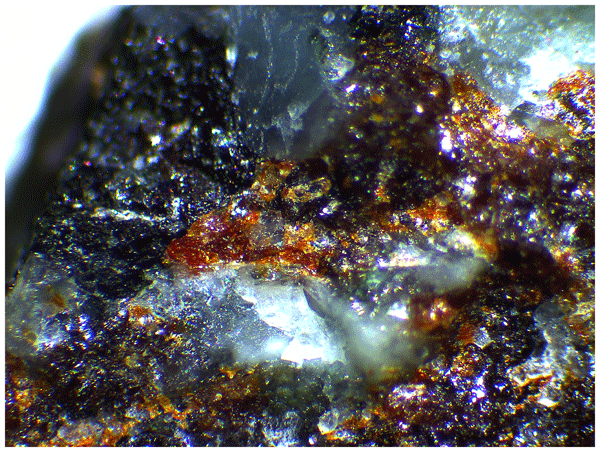
Yttrotungstite-(Nd) is a new mineral species discovered in the Nyakabingo tungsten mine, Kigali, Rwanda. The mineral occurs in the oxidized zones of the deposit, where it forms tiny yellow-orange tabular crystals that reach a length of maximum of 100 µm, and frequently form radiated groups. The dominant form is {010}, and a twinning has been observed parallel to (001). Electron microprobe analyses and structural data, confirming that the species belongs to the yttrotungstite group.
Yttrotungstite-(Nd) is a new mineral species discovered in the Nyakabingo tungsten mine, Kigali,...