Articles | Volume 38, issue 2
https://doi.org/10.5194/ejm-38-209-2026
© Author(s) 2026. This work is distributed under
the Creative Commons Attribution 4.0 License.
https://doi.org/10.5194/ejm-38-209-2026
© Author(s) 2026. This work is distributed under
the Creative Commons Attribution 4.0 License.
Plumbogottlobite, PbMg(VO4)(OH), the Pb analogue of gottlobite and the Mg analogue of descloizite

Mineral Sciences Department, Natural History Museum of Los Angeles County, 900 Exposition Boulevard, Los Angeles, CA 90007, USA
Joy Désor
independent researcher: Im Langenfeld 4, 61350 Bad Homburg, Germany
Division of Geological and Planetary Sciences, California Institute of Technology, Pasadena, CA 91125, USA
Related authors
Ian E. Grey, Christian Rewitzer, Rupert Hochleitner, Anthony R. Kampf, Stephanie Boer, William G. Mumme, Nicholas C. Wilson, and Cameron J. Davidson
Eur. J. Mineral., 37, 169–179, https://doi.org/10.5194/ejm-37-169-2025, https://doi.org/10.5194/ejm-37-169-2025, 2025
Short summary
Short summary
Fluormacraeite is the first type mineral to be described from the Plößberg pegmatite, Upper Palatinate, Bavaria, Germany. The crystal structure of fluormacraeite has been refined using synchrotron data that has resolved a small monoclinic distortion due to ordering of K and H2O. The general crystal–chemical properties of the monoclinic paulkerrite-group minerals are discussed.
Anthony R. Kampf, Joy Désor, and Chi Ma
Eur. J. Mineral., 36, 873–878, https://doi.org/10.5194/ejm-36-873-2024, https://doi.org/10.5194/ejm-36-873-2024, 2024
Short summary
Short summary
Karlseifertite is a new member of the dussertite group of the alunite supergroup from Tsumeb, Namibia. It is the first member of the dussertite group to be described based upon valency-imposed double site occupancy in the octahedrally coordinated cation site. It is also the first member of the alunite supergroup containing essential Ge.
Anthony R. Kampf, Gerhard Möhn, Chi Ma, George R. Rossman, Joy Désor, and Yunbin Guan
Eur. J. Mineral., 36, 605–614, https://doi.org/10.5194/ejm-36-605-2024, https://doi.org/10.5194/ejm-36-605-2024, 2024
Short summary
Short summary
Rotherkopfite is the first member of the neptunite group that does not contain lithium in its chemical formula. It was found at Rother Kopf, Eifel volcanic fields, Germany, where in occurs in cavities in a quartz–sanidine fragment embedded in a volcanic rock. Rotherkopfite occurs as dark brownish-red crystals, up to about 0.2 mm across. The intriguing crystal structure is based on two interwoven three-dimensional frameworks.
Rupert Hochleitner, Ian E. Grey, Anthony R. Kampf, Stephanie Boer, Colin M. MacRae, William G. Mumme, and Nicholas C. Wilson
Eur. J. Mineral., 36, 541–554, https://doi.org/10.5194/ejm-36-541-2024, https://doi.org/10.5194/ejm-36-541-2024, 2024
Short summary
Short summary
The paper describes the characterisation of fluor-rewitzerite, a new mineral species belonging to the paulkerrite group. The crystal structure of fluor-rewitzerite has been refined using microfocus synchrotron diffraction data, which allowed 25 of the possible 30 H atoms to be located, thus establishing key features of the H bonding. Crystallochemical trends are reviewed for seven recently characterised monoclinic paulkerrite-group minerals.
Ian E. Grey, Christian Rewitzer, Rupert Hochleitner, Anthony R. Kampf, Stephanie Boer, William G. Mumme, and Nicholas C. Wilson
Eur. J. Mineral., 36, 267–278, https://doi.org/10.5194/ejm-36-267-2024, https://doi.org/10.5194/ejm-36-267-2024, 2024
Short summary
Short summary
Macraeite is the fourth type mineral to be described from the Mangualde pegmatite, Portugal, and is the first paulkerrite-group mineral to be characterised from the locality. Its crystal structure has been refined using synchrotron diffraction data, and its chemical analysis, Raman spectrum, and optical properties are reported.
Christian Rewitzer, Rupert Hochleitner, Ian E. Grey, Anthony R. Kampf, Stephanie Boer, and Colin M. MacRae
Eur. J. Mineral., 35, 805–812, https://doi.org/10.5194/ejm-35-805-2023, https://doi.org/10.5194/ejm-35-805-2023, 2023
Short summary
Short summary
Regerite is the first new mineral species to be described from the Kreuzberg pegmatite, Pleystein, in the Oberpfalz, Bavaria. It has been characterised using electron microprobe analysis, Raman spectroscopy, optical measurements and a synchrotron-based single-crystal structure refinement. The structure type for regerite has not been previously reported.
Ian E. Grey, Erich Keck, Anthony R. Kampf, Colin M. MacRae, Robert W. Gable, William G. Mumme, Nicholas C. Wilson, Alexander M. Glenn, and Cameron Davidson
Eur. J. Mineral., 35, 635–643, https://doi.org/10.5194/ejm-35-635-2023, https://doi.org/10.5194/ejm-35-635-2023, 2023
Short summary
Short summary
Hochleitnerite is a new member of the paulkerrite group of minerals. Its crystal structure, chemical analyses and Raman spectroscopy are reported, and its crystallochemical properties are discussed in relation to other group members.
Ian E. Grey, Rupert Hochleitner, Anthony R. Kampf, Stephanie Boer, Colin M. MacRae, John D. Cashion, Christian Rewitzer, and William G. Mumme
Eur. J. Mineral., 35, 295–304, https://doi.org/10.5194/ejm-35-295-2023, https://doi.org/10.5194/ejm-35-295-2023, 2023
Short summary
Short summary
Manganrockbridgeite, Mn2+2Fe3+3(PO4)3(OH)4(H2O), a new member of the rockbridgeite group, has been characterised using electron microprobe analyses, Mössbauer spectroscopy, optical properties and single-crystal X-ray diffraction. Whereas other rockbridgeite-group minerals have orthorhombic symmetry with a statistical distribution of 50%Fe3+/50% vacancies in M3-site octahedra, monoclinic manganrockbridgeite has full ordering of Fe3+ and vacancies in alternate M3 sites along the 5.2 Å axis.
Ian E. Grey, Rupert Hochleitner, Christian Rewitzer, Anthony R. Kampf, Colin M. MacRae, Robert W. Gable, William G. Mumme, Erich Keck, and Cameron Davidson
Eur. J. Mineral., 35, 189–197, https://doi.org/10.5194/ejm-35-189-2023, https://doi.org/10.5194/ejm-35-189-2023, 2023
Short summary
Short summary
Pleysteinite has been approved as a new mineral species, and we describe here the characterisation of the mineral and its relationship to related minerals benyacarite, paulkerrite and mantienneite. The characterisation includes the determination and refinement of the crystal structure, electron microprobe analyses, optical properties and interpretation of its Raman spectrum.
Rupert Hochleitner, Christian Rewitzer, Ian E. Grey, William G. Mumme, Colin M. MacRae, Anthony R. Kampf, Erich Keck, Robert W. Gable, and Alexander M. Glenn
Eur. J. Mineral., 35, 95–103, https://doi.org/10.5194/ejm-35-95-2023, https://doi.org/10.5194/ejm-35-95-2023, 2023
Short summary
Short summary
The paper gives a characterisation of the new mineral species, whiteite-(CaMnFe), which has recently been approved as a new mineral (proposal IMA2022-077). The study included a single-crystal structure refinement that, when combined with electron microprobe analyses, confirmed that the mineral was a new member of the whiteite subgroup of the jahnsite group of minerals. Relationships between the crystal structure and the unit-cell parameters for the whiteite-subgroup minerals are discussed.
Peter Elliott, Ian E. Grey, William G. Mumme, Colin M. MacRae, and Anthony R. Kampf
Eur. J. Mineral., 34, 375–383, https://doi.org/10.5194/ejm-34-375-2022, https://doi.org/10.5194/ejm-34-375-2022, 2022
Short summary
Short summary
This paper describes the characterisation of a new mineral from a South Australian phosphate quarry. The characterisation included chemical analyses, infrared spectroscopy, and a determination and refinement of the crystal structure. The results showed that the mineral has a unique crystal chemistry, but it is closely related to the well-known phosphate mineral crandallite.
Ian Edward Grey, Peter Elliott, William Gus Mumme, Colin M. MacRae, Anthony R. Kampf, and Stuart J. Mills
Eur. J. Mineral., 34, 215–221, https://doi.org/10.5194/ejm-34-215-2022, https://doi.org/10.5194/ejm-34-215-2022, 2022
Short summary
Short summary
A reinvestigation of angastonite from the type locality has shown that it is a mixture of crystalline phases and an amorphous phase, with the published formula corresponding to the amorphous phase. A redefinition proposal for angastonite as an amorphous mineral was approved by the IMA CNMNC. Our study showed how the amorphous phase formed and how it progressively recrystallises as new crandallite-related minerals.
Luca Bindi, Jan B. Kihle, Guangming Cheng, Jinping Hu, Nan Yao, Chi Ma, Yunbin Guan, Paul D. Asimow, and Paul J. Steinhardt
Eur. J. Mineral., 37, 783–791, https://doi.org/10.5194/ejm-37-783-2025, https://doi.org/10.5194/ejm-37-783-2025, 2025
Short summary
Short summary
During project STARDUST, over 5500 specimens were recovered. Among them, a micrometeorite from Oslo (NMM/L2) revealed a new Al–Cu alloy with Al₄Cu₉ stoichiometry. This phase was approved as a new mineral named jonlarsenite. The microspherule shows features typical of micrometeorites. Its extraterrestrial origin is confirmed by oxygen isotope composition and chondritic chemistry, similar to previously known Al–Cu meteoritic materials.
Ian E. Grey, Christian Rewitzer, Rupert Hochleitner, Anthony R. Kampf, Stephanie Boer, William G. Mumme, Nicholas C. Wilson, and Cameron J. Davidson
Eur. J. Mineral., 37, 169–179, https://doi.org/10.5194/ejm-37-169-2025, https://doi.org/10.5194/ejm-37-169-2025, 2025
Short summary
Short summary
Fluormacraeite is the first type mineral to be described from the Plößberg pegmatite, Upper Palatinate, Bavaria, Germany. The crystal structure of fluormacraeite has been refined using synchrotron data that has resolved a small monoclinic distortion due to ordering of K and H2O. The general crystal–chemical properties of the monoclinic paulkerrite-group minerals are discussed.
Anthony R. Kampf, Joy Désor, and Chi Ma
Eur. J. Mineral., 36, 873–878, https://doi.org/10.5194/ejm-36-873-2024, https://doi.org/10.5194/ejm-36-873-2024, 2024
Short summary
Short summary
Karlseifertite is a new member of the dussertite group of the alunite supergroup from Tsumeb, Namibia. It is the first member of the dussertite group to be described based upon valency-imposed double site occupancy in the octahedrally coordinated cation site. It is also the first member of the alunite supergroup containing essential Ge.
Anthony R. Kampf, Gerhard Möhn, Chi Ma, George R. Rossman, Joy Désor, and Yunbin Guan
Eur. J. Mineral., 36, 605–614, https://doi.org/10.5194/ejm-36-605-2024, https://doi.org/10.5194/ejm-36-605-2024, 2024
Short summary
Short summary
Rotherkopfite is the first member of the neptunite group that does not contain lithium in its chemical formula. It was found at Rother Kopf, Eifel volcanic fields, Germany, where in occurs in cavities in a quartz–sanidine fragment embedded in a volcanic rock. Rotherkopfite occurs as dark brownish-red crystals, up to about 0.2 mm across. The intriguing crystal structure is based on two interwoven three-dimensional frameworks.
Rupert Hochleitner, Ian E. Grey, Anthony R. Kampf, Stephanie Boer, Colin M. MacRae, William G. Mumme, and Nicholas C. Wilson
Eur. J. Mineral., 36, 541–554, https://doi.org/10.5194/ejm-36-541-2024, https://doi.org/10.5194/ejm-36-541-2024, 2024
Short summary
Short summary
The paper describes the characterisation of fluor-rewitzerite, a new mineral species belonging to the paulkerrite group. The crystal structure of fluor-rewitzerite has been refined using microfocus synchrotron diffraction data, which allowed 25 of the possible 30 H atoms to be located, thus establishing key features of the H bonding. Crystallochemical trends are reviewed for seven recently characterised monoclinic paulkerrite-group minerals.
Ian E. Grey, Christian Rewitzer, Rupert Hochleitner, Anthony R. Kampf, Stephanie Boer, William G. Mumme, and Nicholas C. Wilson
Eur. J. Mineral., 36, 267–278, https://doi.org/10.5194/ejm-36-267-2024, https://doi.org/10.5194/ejm-36-267-2024, 2024
Short summary
Short summary
Macraeite is the fourth type mineral to be described from the Mangualde pegmatite, Portugal, and is the first paulkerrite-group mineral to be characterised from the locality. Its crystal structure has been refined using synchrotron diffraction data, and its chemical analysis, Raman spectrum, and optical properties are reported.
Christian Rewitzer, Rupert Hochleitner, Ian E. Grey, Anthony R. Kampf, Stephanie Boer, and Colin M. MacRae
Eur. J. Mineral., 35, 805–812, https://doi.org/10.5194/ejm-35-805-2023, https://doi.org/10.5194/ejm-35-805-2023, 2023
Short summary
Short summary
Regerite is the first new mineral species to be described from the Kreuzberg pegmatite, Pleystein, in the Oberpfalz, Bavaria. It has been characterised using electron microprobe analysis, Raman spectroscopy, optical measurements and a synchrotron-based single-crystal structure refinement. The structure type for regerite has not been previously reported.
Ian E. Grey, Erich Keck, Anthony R. Kampf, Colin M. MacRae, Robert W. Gable, William G. Mumme, Nicholas C. Wilson, Alexander M. Glenn, and Cameron Davidson
Eur. J. Mineral., 35, 635–643, https://doi.org/10.5194/ejm-35-635-2023, https://doi.org/10.5194/ejm-35-635-2023, 2023
Short summary
Short summary
Hochleitnerite is a new member of the paulkerrite group of minerals. Its crystal structure, chemical analyses and Raman spectroscopy are reported, and its crystallochemical properties are discussed in relation to other group members.
Ian E. Grey, Rupert Hochleitner, Anthony R. Kampf, Stephanie Boer, Colin M. MacRae, John D. Cashion, Christian Rewitzer, and William G. Mumme
Eur. J. Mineral., 35, 295–304, https://doi.org/10.5194/ejm-35-295-2023, https://doi.org/10.5194/ejm-35-295-2023, 2023
Short summary
Short summary
Manganrockbridgeite, Mn2+2Fe3+3(PO4)3(OH)4(H2O), a new member of the rockbridgeite group, has been characterised using electron microprobe analyses, Mössbauer spectroscopy, optical properties and single-crystal X-ray diffraction. Whereas other rockbridgeite-group minerals have orthorhombic symmetry with a statistical distribution of 50%Fe3+/50% vacancies in M3-site octahedra, monoclinic manganrockbridgeite has full ordering of Fe3+ and vacancies in alternate M3 sites along the 5.2 Å axis.
Ian E. Grey, Rupert Hochleitner, Christian Rewitzer, Anthony R. Kampf, Colin M. MacRae, Robert W. Gable, William G. Mumme, Erich Keck, and Cameron Davidson
Eur. J. Mineral., 35, 189–197, https://doi.org/10.5194/ejm-35-189-2023, https://doi.org/10.5194/ejm-35-189-2023, 2023
Short summary
Short summary
Pleysteinite has been approved as a new mineral species, and we describe here the characterisation of the mineral and its relationship to related minerals benyacarite, paulkerrite and mantienneite. The characterisation includes the determination and refinement of the crystal structure, electron microprobe analyses, optical properties and interpretation of its Raman spectrum.
Rupert Hochleitner, Christian Rewitzer, Ian E. Grey, William G. Mumme, Colin M. MacRae, Anthony R. Kampf, Erich Keck, Robert W. Gable, and Alexander M. Glenn
Eur. J. Mineral., 35, 95–103, https://doi.org/10.5194/ejm-35-95-2023, https://doi.org/10.5194/ejm-35-95-2023, 2023
Short summary
Short summary
The paper gives a characterisation of the new mineral species, whiteite-(CaMnFe), which has recently been approved as a new mineral (proposal IMA2022-077). The study included a single-crystal structure refinement that, when combined with electron microprobe analyses, confirmed that the mineral was a new member of the whiteite subgroup of the jahnsite group of minerals. Relationships between the crystal structure and the unit-cell parameters for the whiteite-subgroup minerals are discussed.
Peter Elliott, Ian E. Grey, William G. Mumme, Colin M. MacRae, and Anthony R. Kampf
Eur. J. Mineral., 34, 375–383, https://doi.org/10.5194/ejm-34-375-2022, https://doi.org/10.5194/ejm-34-375-2022, 2022
Short summary
Short summary
This paper describes the characterisation of a new mineral from a South Australian phosphate quarry. The characterisation included chemical analyses, infrared spectroscopy, and a determination and refinement of the crystal structure. The results showed that the mineral has a unique crystal chemistry, but it is closely related to the well-known phosphate mineral crandallite.
Ian Edward Grey, Peter Elliott, William Gus Mumme, Colin M. MacRae, Anthony R. Kampf, and Stuart J. Mills
Eur. J. Mineral., 34, 215–221, https://doi.org/10.5194/ejm-34-215-2022, https://doi.org/10.5194/ejm-34-215-2022, 2022
Short summary
Short summary
A reinvestigation of angastonite from the type locality has shown that it is a mixture of crystalline phases and an amorphous phase, with the published formula corresponding to the amorphous phase. A redefinition proposal for angastonite as an amorphous mineral was approved by the IMA CNMNC. Our study showed how the amorphous phase formed and how it progressively recrystallises as new crandallite-related minerals.
Cited articles
Đorđević, T., Kolitsch, U., and Nasadala, L.: A single-crystal X-ray and Raman spectroscopic study of hydrothermally synthesized arsenates and vanadates with the descloizite and adelite structure types, Am. Mineral., 101, 1135–1149, 2016.
Ferraris, G. and Ivaldi, G.: Bond valence vs bond length in O O hydrogen bonds, Acta Crystallogr., B44, 341–344, 1988.
Frost, R. L., Williams, P. A., Kloprogge, J. T., and Leverett, P.: Raman spectroscopy of descloizite and mottramite at 298 and 77 K, J. Raman Spectrosc., 32, 906–911, 2001.
Gagné, O. C. and Hawthorne, F. C.: Comprehensive derivation of bond-valence parameters for ion pairs involving oxygen, Acta Crystallogr., B71, 562–578, 2015.
Guillemin, C.: Une nouvelle espèce minéral: la vésigniéite, Cu3Ba(VO4)2(OH)2, C. R. Hebd. Séances Acad. Sci., 240, 2331–2333, 1955.
Gunter, M. E., Bandli, B. R., Bloss, F. D., Evans, S. H., Su, S. C., and Weaver, R.: Results from a McCrone spindle stage short course, a new version of EXCALIBR, and how to build a spindle stage, The Microscope, 52, 23–39, 2004.
Hawthorne, F. C. and Faggiani, R.: Refinement of the structure of descloizite, Acta Crystallogr., B35, 717–720, 1979.
Mandarino, J. A.: The Gladstone-Dale relationship: Part IV. The compatibility concept and its application, Can. Mineral., 19, 441–450, 1981.
Martens, W., Frost, R. L., and Williams, P. A.: Molecular structure of the adelite group of minerals – a Raman spectroscopic study, J. Raman Spectrosc., 34, 104–111, 2003.
Rammelsberg, C.: Ueber das Mangankupfererz von Friedrichsrode, Zusatz zu der vorhergehenden Abhandlung, Poggendorffs Annalen der Physik und Chemie, 150, 559–562, 1849.
Scheven, M.: Die Minerale des Fundgebietes am Gottlob bei Friedrichroda im Thüringer Wald, Fundgrube, 26, 7–11, 1990.
Sheldrick, G. M.: SHELXT – Integrated space-group and crystal-structure determination, Acta Crystallogr., A71, 3–8, 2015a.
Sheldrick, G. M.: Crystal Structure refinement with SHELX, Acta Crystallogr., C71, 3–8, 2015b.
Witzke, T., Steins, M., Doering, T., and Kolitsch, U.: Gottlobite, CaMg(VO4,AsO4)(OH), a new mineral from Friedrichroda, Thuringia, Germany, N. Jb. Miner. Mon., 10, 444–454, 2000.
Witzke, T., Kolitsch, U., Warnsloh, J. M., and Göske, J.: Wakefieldite-(La), LaVO4, a new mineral species from the Glücksstern Mine, Friedrichroda, Thuringia, Germany, Eur. J. Mineral., 20, 1135–1139, 2008.
Short summary
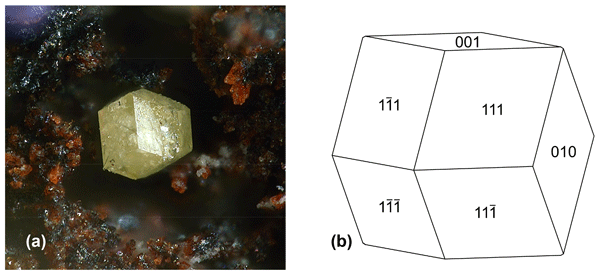
This paper describes the new mineral plumbogottlobite from the Glücksstern mine, Gottlob Hill, Friedrichroda, Gotha District, Thuringia, Germany. It occurs as thick, square, orange-brown, tabular crystals up to about 0.2 mm in diameter. The mineral is the lead (Pb) analogue of the mineral gottlobite, which occurs at the same locality and is identical in appearance. Plumbogottlobite is a late-stage, low-temperature hydrothermal mineral occurring on baryte and hausmannite.
This paper describes the new mineral plumbogottlobite from the Glücksstern mine, Gottlob Hill,...