the Creative Commons Attribution 4.0 License.
the Creative Commons Attribution 4.0 License.
 | 02 Oct 2026
Report of a rare, well-preserved lawsonite eclogite (Elekdağ, Central Pontides, Türkiye)
Katherine F. Fornash

Charles Petty
Erkan Toraman
Gültekin Topuz
Donna L. Whitney
Although lawsonite eclogite is predicted from experimental, thermodynamic, and geophysical methods to be common in cold subduction zones, the defining metamorphic assemblage in metabasite (garnet + omphacite + lawsonite) is rare in exhumed subduction complexes. To date, there are nine well-documented complexes with these phases in apparent textural equilibrium in the matrix. A 10th (Elekdağ, Central Pontides, Türkiye) has previously been interpreted as a lawsonite eclogite based on lawsonite and omphacite inclusions in garnet. We report the first observation of an Elekdağ eclogite that contains abundant matrix lawsonite with omphacite + garnet, allowing determination of near-peak metamorphic conditions. Zr-in-rutile thermometry and phase diagram calculations indicate lawsonite eclogite facies conditions of ∼ 500 °C at P ∼ 2.3 GPa, higher than previous estimates of pressure but similar to other fresh lawsonite eclogites reported worldwide. In most Elekdağ metabasites, lawsonite eclogite was retrogressed to epidote ± lawsonite blueschist. The prevalence of epidote in eclogite and blueschist in this and other subduction complexes indicates exhumation conditions that were warmer than prograde or peak metamorphism. These apparently relatively “warm” conditions should not be extrapolated to characterize the overall thermal state of subduction in the forearc region that is typically represented by subduction complexes.
- Article
(11863 KB) - Full-text XML
-
Supplement
(11219 KB) - BibTeX
- EndNote


Along with protolith composition, the thermal gradient of the subducted lithosphere (i.e., variation of temperature with depth) exerts a fundamental control on mineral assemblages and conditions of dehydration reactions and, subsequently, the location and quantities of fluids released, the rheology of the subduction interface, and the geodynamic behavior of the subducted plate (e.g., Schmidt and Poli, 1998; Kerrick and Connolly, 2001; Peacock, 2003; van Keken et al., 2011; Kim et al., 2013). The thermal state of paleo-subduction zones can be determined from the pressure–temperature (P–T) history of metamorphic rocks and can shed light on the thermal state of the planet over geologic time and the timescales over which subduction – and cold subduction (∼ 5 °C km−1) in particular – has operated. A major challenge of these reconstructions is that the P–T conditions of eclogites and blueschists may not record the maximum P and associated T but instead record lower P and/or higher T encountered during exhumation. Fresh lawsonite eclogites may be an exception to this as they typically record the predicted P–T conditions at the slab–mantle interface for cold subduction zones (Whitney et al., 2020). Lawsonite eclogites are therefore a significant source of information about the geochemistry and geodynamics of subducted slabs prior to exhumation.
The hallmark of cold subduction is the presence of the hydrous Ca–Al silicate lawsonite, which plays an important role in volatile and element cycling in the Earth owing to its high water content (11.5 wt %) and geochemical affinity for a variety of petrogenetically significant minor and trace elements, including U, Th, Sr, the rare earth elements (REEs), and transition metals (Fe, Ti, Cr) (e.g., Tribuzio et al., 1996; Tsujimori et al., 2006; Tsujimori and Ernst, 2014; Martin et al., 2014; Fornash et al., 2019; Kang et al., 2022, 2024). It is therefore of great interest to find and study subduction complexes with preserved lawsonite and to understand the conditions of its formation.
In a global review of eclogites that contain fresh lawsonite (i.e., not inferred or replaced by other minerals), Whitney et al. (2020) identified nine localities with a convincing matrix assemblage of garnet + omphacite + lawsonite in apparent textural equilibrium. An additional seven localities have been reported to contain garnets with lawsonite + omphacite inclusions but no lawsonite (and, in some cases, no omphacite) in the matrix. One of the inclusion-only localities was the Elekdağ area of the Central Pontides, Türkiye (Altherr et al., 2004; Okay et al., 2006; Aygül et al., 2016, 2022). In this report, we describe an Elekdağ eclogite containing abundant fresh matrix lawsonite + garnet + omphacite and thereby add it as a 10th well-documented example of well-preserved lawsonite eclogite localities, along with the Sivrihisar massif (Türkiye), the Alpine Corsica (France), the Samana Metamorphic Complex (Dominican Republic), the South Motagua Fault Zone (Guatemala), the Voltri massif (Western Alps), the Port Macquarie mélange (Australia), rare layers in the Franciscan Complex (California, USA), Pinchi Lake (British Columbia, Canada), and the Garnet Ridge xenolith (Arizona, USA).
In four of these sites, lawsonite eclogite occurs as one or more loose blocks (Samana, Port Macquarie, Pinchi Lake) or xenoliths (Garnet Ridge), leaving only six sites that have more structural and lithologic context. Eclogites with well-preserved, abundant matrix lawsonite and field context (even if in a mélange) are particularly significant for the information they provide about subduction metamorphism conditions and processes. We report mineral compositions and P–T conditions for the Elekdağ lawsonite eclogite and compare these results with a nearby garnet–epidote blueschist in which garnets contain inclusions of lawsonite and rare omphacite and that is interpreted as a retrogressed lawsonite eclogite. The latter records lower P–T conditions than the fresh eclogite and is similar to rocks previously referred to as Elekdağ lawsonite eclogite.
Metabasites in the Elekdağ massif consist of eclogites and blueschists (± garnet) that are exposed within and along the margins of a large (35 km × 2–3 km) metaperidotite (antigorite serpentinite) body in the Central Pontides, Türkiye, as part of a Cretaceous (∼ 105 Ma) subduction complex (Altherr et al., 2004; Okay et al., 2006; Aygül et al., 2016, 2022) (Fig. S1 in the Supplement). Elekdağ metabasite blocks are typically surrounded by chlorite-rich metasomatic zones locally associated with tourmaline. Maximum P–T conditions have been estimated at ∼ 490 °C, ∼ 1.7 GPa (Okay et al., 2006).
Most Elekdağ metabasites contain garnet, Na-amphibole, epidote, chlorite, and phengite, with inclusions in garnet comprising Na-amphibole, epidote, (rare) omphacite, lawsonite, rutile, titanite, ilmenite, chlorite, phengite, and quartz (Altherr et al., 2004; Okay et al., 2006; Aygül et al., 2022; this study). A tourmaline-bearing eclogite has been reported in which lawsonite and omphacite occur as inclusions in garnet, and the matrix omphacite contains inclusions of lawsonite, glaucophane, rutile, and quartz. P–T conditions were estimated at 400–430 °C and > 1.35 GPa (Altherr et al., 2004).
Aygül et al. (2022) analyzed lawsonite inclusions in two retrogressed Elekdağ eclogites and noted that lawsonite inclusions occurred only in the core and mantle of the garnet in one sample and only in the outer core (mantle) in the other. Because lawsonite also occurs in blueschists, lack of coexisting omphacite creates ambiguity as to whether lawsonite inclusions formed during prograde blueschist metamorphism and/or peak eclogite facies conditions.
In this study, we describe a fresh lawsonite eclogite (ELEK23-05b) and compare it with a retrogressed eclogite that contains lawsonite predominantly as inclusions in garnet and texturally late matrix epidote and albite (ELEK23-08a2). Both eclogites occur as meter-scale tectonic blocks along the contact with a large body of serpentinite (Fig. S1).
The matrix of the fresh lawsonite eclogite consists of garnet (∼ 20 %) + omphacite (∼ 35 %) + lawsonite (∼ 20 %) + phengite (∼ 14 %) + chlorite (∼ 9 %) + accessory rutile, and minor secondary glaucophane and titanite (Fig. 1a–c). Some chlorite occurs in garnet pressure shadows, but chlorite also occurs with straight grain boundaries against omphacite, garnet, and lawsonite in the matrix and may be part of the high-pressure assemblage. Quartz occurs as inclusions in garnet and lawsonite but has not been observed in the matrix. Garnets are ∼ 1 mm in diameter, subhedral, and display slight, concentric compositional zoning characterized by distinct core and rim regions (Figs. 1d and S2–3). Cores exhibit a decrease in Mn (spessartine 13 → 2) and Ca (grossular, grs31 → 29) from the center outward (Table S1). The garnet core region is surrounded by a higher Mn and Fe; slightly lower Ca (grs27); mostly euhedral (except for embayments around large inclusions) annulus; a low-Mn, higher-Ca rim region; and a very thin (< 20 µm), discontinuous zone of higher Mn, similar to the highest core values. Garnet cores are low in Mg (pyrope, prp6), with oscillations in Mg (prp7-12) and Ca (grs27-31) outside the low-Ca annulus. At the outermost rim region, a zone of lower Mg is surrounded by a very thin rim of higher Mg (prp13). Rutile first appears in the inner side of the annulus and is present in the Mg-rich rim region (Fig. S4).
Matrix omphacite displays patchy zoning, with the jadeite component varying between jadeite 28–16. Matrix lawsonite is also zoned and displays overall core-to-rim increases in Fe, Ti, and Sr (Fig. 1e), although zoning in some grains appears patchy; minor amounts of Cr were detected in some lawsonite (Table S2). Phengite is part of the eclogite assemblage; it displays patchy zoning, and its Si content varies from 3.34 to 3.49 cations per formula unit (p.f.u) calculated on an 11-oxygen basis (Table S3).
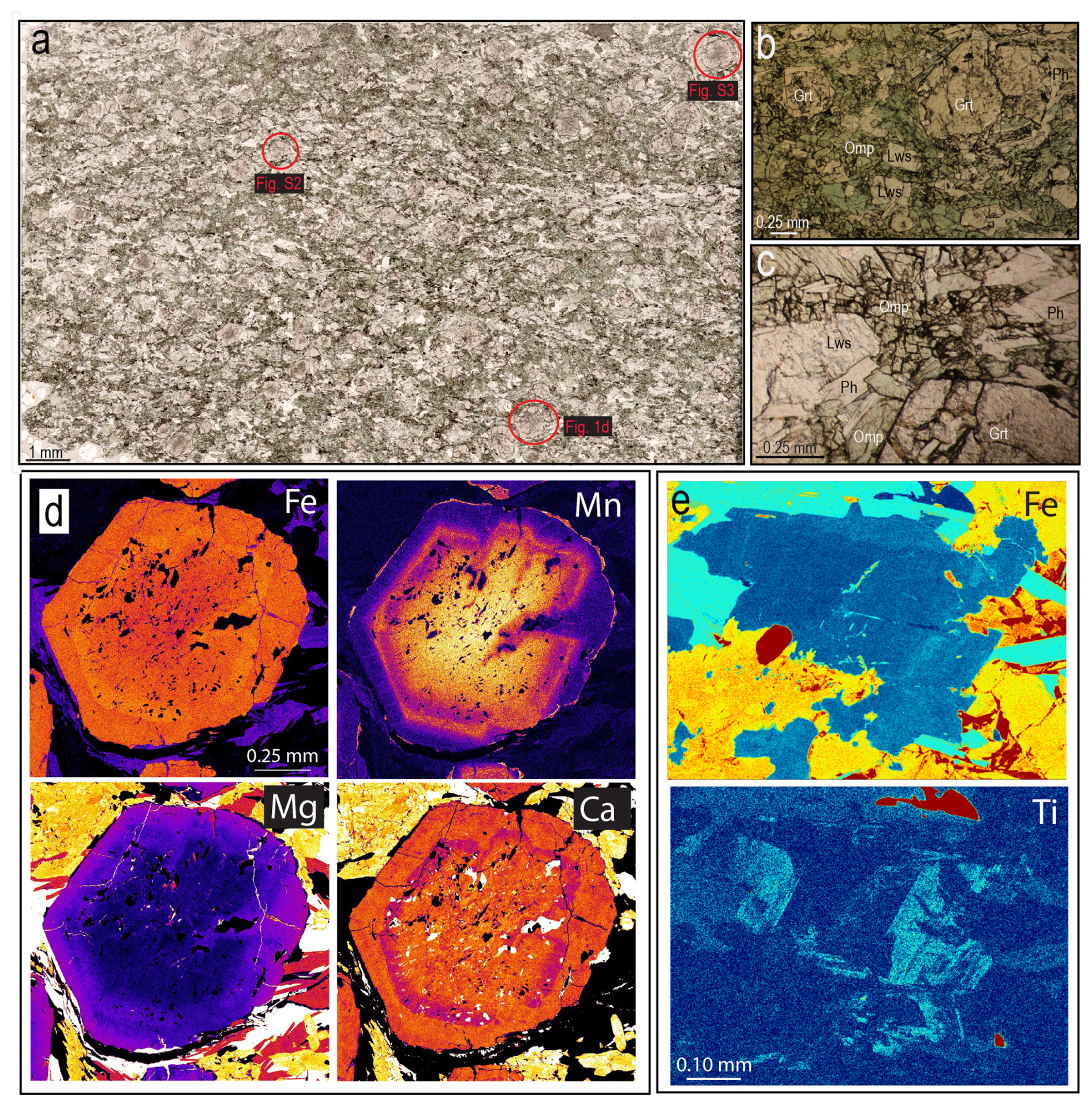
Figure 1Images from fresh eclogite ELEK23-05b. (a) Scan of an entire thin section, showing abundant garnet, omphacite, and lawsonite, with less abundant phengite, chlorite, and rutile. The garnets for which element maps are provided are circled and labeled. (b) Plane-polarized-light (ppl) photo showing garnet, omphacite, lawsonite, and phengite. (c) Higher-magnification ppl photo showing the lawsonite eclogite assemblage, with minor texturally late glaucophane. (d) Element maps of garnet showing distinct core vs. rim compositional zoning that corresponds to a change in inclusion minerals; e.g., the high Ca annulus corresponds to the disappearance of titanite and quartz as inclusions and appearance of rutile, which is also present in the high-Mg rim zone. (e) Fe and Ti maps of a large matrix lawsonite grain.
The retrogressed eclogite (epidote blueschist) consists of large (4–5 mm diameter) subhedral garnets (Fig. 2a) that contain abundant lawsonite inclusions from the garnet core to very near the rim (Fig. 2a–d). Also present are inclusions of glaucophane and epidote (in garnet cores) and rare omphacite (near rims). Quartz inclusions occur from the core to the near-rim region. In the relatively Mn-rich core, ilmenite inclusions containing minor Mn are complexly intergrown with titanite. Rutile inclusions occur in the outer part of the garnet.

Figure 2Images from retrogressed eclogite ELEK23-08a2. (a) Scan of an entire thin section: large garnets are in a matrix of glaucophane, epidote, chlorite, and phengite. (b, c) Plane-polarized-light and crossed-polarized-light photos of a garnet containing abundant lawsonite inclusions (tabular grains with high-order interference colors seen in c). The upper-right (green) arrow points to an omphacite inclusion; the lower-left (blue) arrow points to a glaucophane inclusion. (d) Element maps of garnet showing distinct slightly Mn- and Fe-richer core with Mn-bearing ilmenite inclusions. Mg and Ca increase from core to rim. (e) Cross-polarized-light photo and Fe and Ti element maps of a lawsonite inclusion in garnet. Points 1–4 on the Fe element map indicate the locations of microprobe analyses reported in Table S2.
The large garnets display concentric major element zoning characterized by an overall decrease in Fe from the core towards the rim (almandine 73 → 66). Mn contents are very low (< 1 wt % MnO) but show an overall decrease from the core to rim and a slight increase at the rim (Fig. 2d). Mg and Ca increase from the core to rim (pyrope 7 → 11; grossular 19 → 23) (Fig. 2d; Table S1). Ca displays minor compositional oscillations that are anti-correlated with Fe abundance.
Lawsonite inclusions in garnet contain Fe and Ti; most lack detectable Cr (Table S2). Determining trends in composition with the location of inclusions in garnet is complicated by zoning in lawsonite as apparent zoning will vary with the location of the plane of intersection of the thin-section surface with each lawsonite grain, as well as the crystallographic orientation of the grain for elements that are sector-zoned. Some lawsonite inclusions in garnet exhibit hourglass sector zoning in Ti and concentric zoning in Fe (Fig. 2e).
In addition to garnet, the matrix contains glaucophane, white mica, epidote, albite, chlorite, and minor lawsonite. Matrix epidote occurs as large (4–6 mm long) porphyroblasts that contain glaucophane and lawsonite inclusions (Fig. 2a). Some lawsonite inclusions in epidote have been partially replaced by a rim of lower-Fe epidote (clinozoisite) compared to the host porphyroblast. The lower-Fe region corresponds to the original outline of the lawsonite (i.e., lawsonite “ghosts”; Martin et al., 2014; Whitney et al., 2020). Small, rare lawsonite also occurs as inclusions in albite. White mica is phengitic with a lower Si content (3.20–3.27 Si p.f.u.) than phengite in the fresh eclogite (3.34–3.49 Si p.f.u.) (Table S3). Regardless of textural position (e.g., matrix, inclusion in garnet or epidote), all analyzed Na amphiboles are glaucophane (Table S3).
Previous studies based on variably retrogressed Elekdağ eclogites have determined a range of P–T conditions using calculated metamorphic reactions (∼ 490 °C, 1.7–1.9 GPa; Okay et al., 2006), conventional thermobarometry (400–430 °C, > 1.35 GPa; Altherr et al., 2004), and Zr-in-rutile thermometry (416 ± 13 °C; Zack and Luvizotto, 2006). We used a combination of Zr-in-rutile thermometry and calculation of a bulk-composition-specific phase diagram (pseudosection) to evaluate the P–T conditions of the fresh eclogite and compare results with a retrogressed eclogite similar to that analyzed in previous studies. Attempts to use Ti-in-quartz thermometry on quartz inclusions in garnet were unsuccessful owing to concentrations of Ti in quartz below the detection limits of the electron microprobe.
The Zr-in-rutile thermometer requires the assemblage rutile + zircon + quartz. Quartz only occurs as inclusions in garnet so we applied the thermometer to rutile inclusions that could reasonably be inferred to have been in equilibrium with spatially associated quartz + zircon in inferred eclogite facies garnet domains. In the fresh eclogite, this corresponds to a relatively narrow zone in garnet: quartz (but not rutile) is present in garnet cores, and rutile (but not quartz) is present in the outermost rim zone and matrix. Both quartz and rutile occur with zircon in a very narrow zone in the garnet outer core (Fig. S4). If the garnet rim represents peak eclogite conditions, this zone with quartz + rutile inclusions likely represents late prograde, possibly near-peak conditions.
Rutile in garnet in the fresh eclogite has Zr contents of 30–50 ppm (Table S4). Rutile in garnet in the retrogressed eclogite occurs in the outer core region and has a lower Zr content: 9–12 ppm (Table S4). These values yield temperatures of ∼ 490–540 °C for the fresh eclogite and ∼ 420–450 °C for the retrogressed eclogite over the pressure range evaluated (1.7–2.3 GPa) and using the calibration of Kohn (2020) (Table S4; Fig. 3).
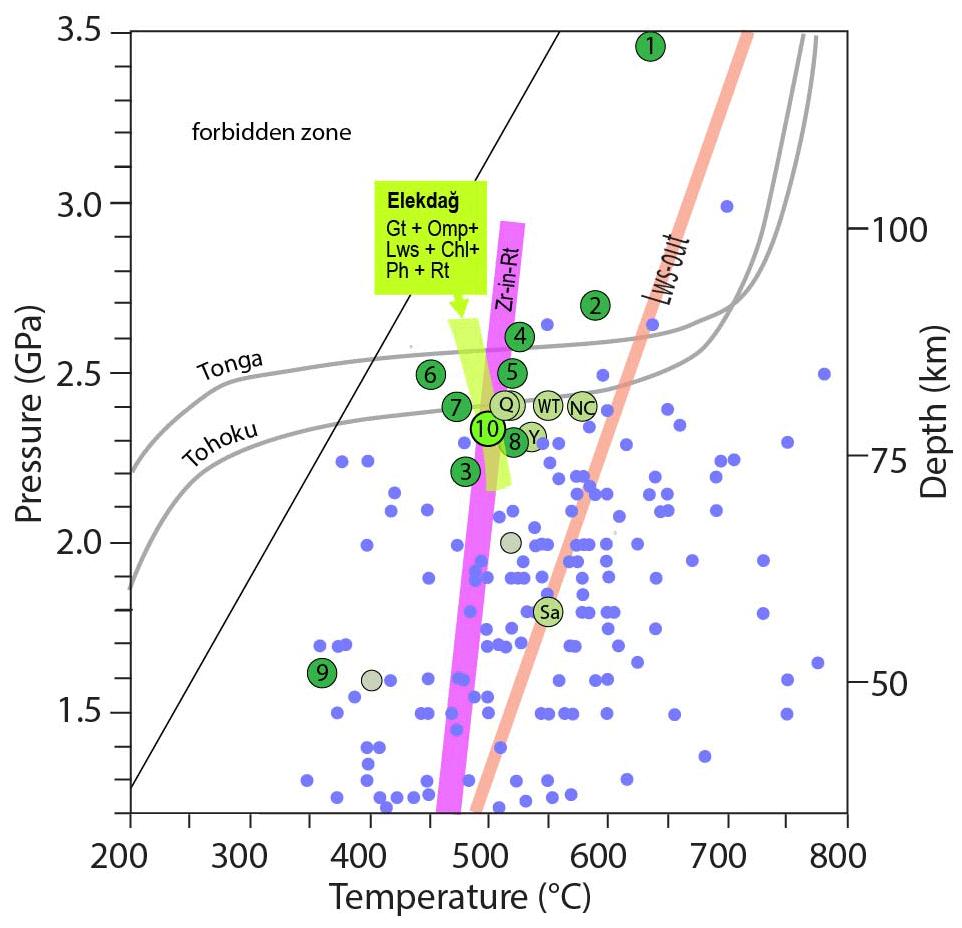
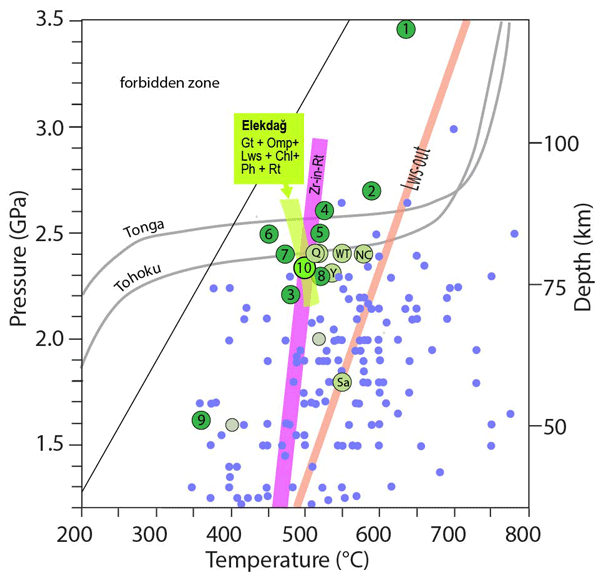
Figure 3P–T conditions of the 10 documented eclogites (worldwide) with fresh matrix lawsonite (large numbered green circles). 1 denotes Garnet Ridge, Arizona, USA (xenolith; Hernández-Uribe and Palin, 2019); 2 denotes Port Macquarie, Australia (mélange; Tamblyn et al., 2020); 3 denotes rare layers in the Franciscan Complex, California, USA (structurally coherent; Tsujimori et al., 2006); 4 denotes Sivrihisar, Türkiye (structurally coherent; Whitney and Davis, 2006; Davis and Whitney, 2006); 5 denotes South Motagua Fault Zone, Guatemala (mélange; Endo et al., 2012); 6 denotes Pinchi Lake, British Columbia, Canada (blocks; Ghent et al., 2009); 7 denotes Voltri massif, Ligurian Alps, Italy (metagabbroic lens hosted in metasediments and serpentinites; Scarsi et al., 2018); 8 denotes Alpine Corsica (structurally coherent; Vitale Brovarone et al., 2011); 9 denotes Samana Peninsula, Dominican Republic (beach pebble; Zack et al., 2004a); and 10 denotes Elekdağ, Türkiye (chain of blocks along contact with serpentinite; this study). Also shown (circles with letters) are localities with lawsonite + omphacite inclusions in garnet but not matrix lawsonite (Whitney et al., 2020): Sa denotes Sanbagawa; NC denotes New Caledonia; Q denotes N Qilian, which overlaps with conditions of eclogite from the SW Tianshan; WT denotes W Tianshan; and Y denotes Yukon Territory, Canada (Faber and Rowe, 2024). The two smaller circles represent the P–T conditions of eclogites in which lawsonite is present but possibly not in equilibrium with both garnet and omphacite (lower T: Spitsbergen, higher T: Sulawesi). Small circles (blue) are representative blueschists from a global dataset; there is a wide scatter of data representing prograde, peak, and retrograde conditions (Whitney et al., 2020). Modeled slab surface conditions for two modern cold subduction zones from van Keken and Wilson (2023).
To construct a pseudosection for the fresh lawsonite eclogite, we calculated an effective bulk composition using mineral modes and compositions and subtracting the garnet core mode/composition: SiO2=46.0 wt %, TiO2=1.6 wt %, Al2O3=15.8 wt %, FeO = 12.1 wt %, MnO = 0.20 wt %, MgO = 6.8 wt %, CaO = 9.7 wt %, Na2O = 3.1 wt %, and K2O = 1.5 wt %. To calculate the phase diagram, we used Perple_X (v. 6.7.7), the thermodynamic database of Holland and Powell (2011), and an assumption of water saturation (owing to the high abundance of hydrous phases). The following solution models were used: clinopyroxene: Omph(HP) (Holland and Powell, 1996); amphibole: GlTrTsPg (Wei and Powell, 2003; White et al., 2003); chlorite: Chl(HP) (Holland et al., 1996); garnet: Gt(WPH) (White et al., 2000); and phengite: Pheng(HP) (Powell and Holland, 1999). Although cation calculations of electron microprobe data for omphacite indicate the presence of some Fe3+ (Table S3), we did not incorporate Fe3+ in the pseudosection calculation; therefore, the results are an approximation of peak metamorphic conditions. In the phase diagram, the quartz-absent assemblage lawsonite + omphacite + garnet + rutile + phengite + chlorite, which corresponds to the matrix assemblage of the fresh eclogite, has a relatively narrow T range of ∼ 470–520 °C at P > 2.1 GPa. Contouring the pseudosection for most mineral compositions and modes results in steep, closely spaced isopleths that do not provide further refinement of pressure, with the exception of Si-in-phengite isopleths (Fig. S5). We have based our estimate of lawsonite eclogite near-peak P–T conditions using the intersection of the eclogite assemblage phase field with the 30–50 ppm isopleths of the Zr-in-rutile thermometer, yielding a result of ∼ 500 °C, 2.3 GPa (Fig. 3), which corresponds well with mineral modes (e.g., garnet, ∼ 20 %) and compositions (e.g., phengite Si ∼ 3.5; prp6−12) (Fig. S5).
These P–T conditions are higher than those previously determined for lawsonite eclogite conditions based on mineral assemblages in retrogressed eclogite. We did not model the retrogressed eclogite in this study because of the difficulty of determining the effective bulk composition of a rock in which the lawsonite eclogite assemblage is represented only by an incomplete set of inclusions in garnet and (to a lesser extent) epidote. The lower P–T conditions determined by other studies (e.g., Okay et al., 2006) and the lower Zr concentration in rutile in this study suggest that peak conditions cannot be easily retrieved from the retrogressed eclogite. In some cases, however, the differences in calculated P–T conditions may reflect the use of different geothermometer calibrations. For example, recalculation of the Zr-in-rutile temperatures obtained by Zack and Luvizotto (2006) using the Zr-in-rutile calibration of Kohn (2020) instead of the Zack et al. (2004b) calibration (which does not take into account the pressure dependence of Zr incorporation in rutile) yields higher temperatures that overlap with those recorded by the eclogites in this study (∼ 446–506 °C at pressures of 1.7–2.3 GPa).
High-pressure/low-temperature (HP/LT) metabasites occur in bands along contacts with a large metaperidotite body in the Elekdağ massif (Fig. S1). Although the metabasites typically occur as blocks and lenses, the complex is not a chaotic mélange: it is likely that all or most of the exhumed rocks experienced similar peak conditions and were subsequently deformed and variably retrogressed under lawsonite- to epidote-stable conditions during exhumation. Retrogression was assisted by deformation and fluids, which also promoted metasomatism that produced chlorite-rich domains along contacts between metabasite and serpentinite. The disruption of garnet zoning, such as seen around large inclusions of epidote, chlorite, and phengite (Fig. S2), may be evidence for fluid-driven reaction under conditions sufficient to modify garnet.
The rare fresh lawsonite eclogite (Fig. 1) is a fortuitously preserved relic that provides information about the peak to near-peak conditions of the exhumed part of the subducted slab (Fig. 3). As with other fresh lawsonite eclogites exhumed from oceanic subduction complexes, it records conditions that correspond to those modeled for relatively cold subduction (Fig. 3), reaffirming the importance of lawsonite eclogites for studying the conditions and processes occurring in modern subduction zones (e.g., Tsujimori et al., 2006; Tsujimori and Ernst, 2014). In contrast, retrogressed lawsonite eclogites typically record lower pressures and a range of temperatures (Fig. 3) and are not reliable indicators of peak conditions. Widespread development of epidote group minerals occurred during retrograde metamorphism as metabasites near the top of the subducting oceanic crust were detached from the slab and exhumed.
Although the existence of lawsonite eclogite conditions was previously inferred from inclusions in garnet in Elekdağ retrogressed eclogites, the discovery of an eclogite with abundant, fresh matrix lawsonite provided the opportunity to determine (near-) peak P–T conditions, which correspond to modeled conditions for the slab surface in modern cold subduction zones (e.g., the active Tonga and Tohoku subduction zones; Fig. 3). The vast majority of high-pressure metabasites in the Elekdağ subduction complex record lower pressures and a wide range of temperatures and therefore give an incomplete and inaccurate indication of subduction thermal conditions.
Microprobe analyses and supporting images are available in the Supplement.
The supplement related to this article is available online at https://doi.org/10.5194/ejm-38-567-2026-supplement.
The field work was conducted by KFF, ET, and DLW, with essential logistical support by GT. Petrographic and electron microprobe analyses, with subsequent thermobarometric calculations and creation of illustrations, were performed by CP, DLW, and KFF, in consultation with GT. All of the authors contributed to the interpretations and writing and editing.
The contact author has declared that none of the authors has any competing interests.
Publisher's note: Copernicus Publications remains neutral with regard to jurisdictional claims made in the text, published maps, institutional affiliations, or any other geographical representation in this paper. The authors bear the ultimate responsibility for providing appropriate place names. Views expressed in the text are those of the authors and do not necessarily reflect the views of the publisher.
This research was supported in part by NSF grant nos. EAR-1949895 and EAR-2342604 to Donna L. Whitney and an American Association of University Women (AAUW) Research Publication Grant in Engineering, Medicine, and Science to Katherine F. Fornash. We thank Jennifer Mitchell (UMN) for the support with the electron microprobe analyses. The University of Minnesota electron microprobe is in the Characterization Facility, which receives partial support from the US NSF through the MRSEC (award no. DMR-2011401) and the NNCI (award no. ECCS-2025124) programs.
This research has been supported by the National Science Foundation, Directorate for Geosciences (grant nos. EAR-1949895 and EAR-2342604) and a Research Publication Grant in Engineering, Medicine, and Science from the American Association of University Women (AAUW).
This paper was edited by Chiara Groppo and reviewed by Tatsuki Tsujimori and Stefano Ghignone.
Altherr, R., Topuz, G., Marschall, H., Zack, T., and Ludwig, T.: Evolution of a tourmaline-bearing lawsonite eclogite from the Elekdag area (Central Pontides, N Turkey): evidence for infiltration of slab-derived B-rich fluids during exhumation, Contrib. Mineral. Petrol., 148, 409–425, https://doi.org/10.1007/s00410-004-0611-1, 2004.
Aygül, M., Okay, A. I., Oberhansli, R., and Sudo, M.: Pre-collisional accretionary growth of the southern Laurasian active margin, Central Pontides, Turkey, Tectonophysics, 671, 218–234, https://doi.org/10.1016/j.tecto.2016.01.010, 2016.
Aygül, M., Okay, A. I., Hacker, B. R., and Kylander-Clark, A. R. C.: REE behavior in warm and cold subducting oceanic crust, Int. J. Earth Sci., 111, 905–918, https://doi.org/10.1007/s00531-021-02156-z, 2022.
Davis, P. B. and Whitney, D. L.: Petrogenesis of lawsonite and epidote eclogite and blueschist, Sivrihisar Massif, Turkey, J. Metamorph. Geol., 823–849, https://doi.org/10.1111/j.1525-1314.2006.00671.x, 2006.
Endo, S., Wallis, S. R., Tsuboi, M., Torres de León, R., and Solari, L. A.: Metamorphic evolution of lawsonite eclogites from the southern Motagua fault zone, Guatemala: insights from phase equilibria and Raman spectroscopy, J. Metamorph. Geol., 143–164, https://doi.org/10.1111/j.1525-1314.2011.00960.x, 2012.
Faber, C. and Rowe, C. D.: Lawsonite eclogite records subduction rheology and slab detachment, Faro, Yukon-Tanana Terrane, Yukon Territory, Canada, Geol. Soc. Am. Bull., 137, 932–959, https://doi.org/10.1130/B37540.1, 2024.
Fornash, K. F., Whitney, D. L., and Seaton, N. C. A.: Lawsonite composition and zoning as an archive of metamorphic processes in subduction zones, Geosphere, 15, 24–46, https://doi.org/10.1130/GES01455.1, 2019.
Ghent, E., Tinkham, D., and Marr, R.: Lawsonite eclogites from the Pinchi Lake area, British Columbia – new P–T estimates and interpretation, Lithos, 109, 248–253, https://doi.org/10.1016/j.lithos.2008.06.018, 2009.
Hernández-Uribe, D. and Palin, R. M.: Catastrophic shear-removal of subcontinental lithospheric mantle beneath the Colorado Plateau by the subducted Farallon slab, Sci. Rep., 9, 8153, https://doi.org/10.1038/s41598-019-44628-y, 2019.
Holland, T. and Powell, R.: Thermodynamics of order-disorder in minerals, 2. Symmetric formalism applied to solid solutions, Am. Mineral., 81, 1425–1437, https://doi.org/10.2138/am-1996-11-1215, 1996.
Holland, T., Baker, J., and Powell, R.: Mixing properties and activity-composition relationships of chlorites in the system MgO-FeO-Al2O3-SiO2-H2O, Eur. J. Mineral., 10, 395–406, https://doi.org/10.1127/ejm/10/3/0395, 1998.
Holland, T. J. B. and Powell, R.: An improved and extended internally consistent thermodynamic dataset for phases of petrologic interest, involving a new equation of state for solids, J. Metamorph. Geol., 29, 333–383, https://doi.org/10.1111/j.1525-1314.2010.00923.x, 2011.
Kang, P., Whitney, D. L., Martin, L. A. J., and Fornash, K. F.: Trace and Rare Earth Element compositions of lawsonite as a chemical tracer of metamorphic processes in subduction zones, J. Petrol., 63, https://doi.org/10.1093/petrology/egac065, 2022.
Kang, P., Martin, L. A. J., Vitale Brovarone, A., and Whitney, D. L.: Lawsonite and garnet oxygen isotope record of fluid-rock Interaction during subduction, Geochem. Geophy. Geosy., 25, e2023GC011389, https://doi.org/10.1029/2023GC011389, 2024.
Kerrick, D. M. and Connolly, J. A. D.: Metamorphic devolatilization of subducted oceanic metabasalts: implications for seismicity, arc magmatism, and volatile recycling, Earth Planet. Sc. Lett., 189, 19–29, https://doi.org/10.1016/S0012-821X(01)00347-8, 2001.
Kim, D., Katayama, I., Michibayashi, K., and Tsujimori, T.: Deformation fabrics of natural blueschists and implications for seismic anisotropy of subducting oceanic crust, Phys. Earth Planet. Int., 222, 8–21, https://doi.org/10.1016/j.pepi.2013.06.011, 2013.
Kohn, M. J.: A refined zirconium-in-rutile thermometer, Am. Mineral., 105, 963–971, https://doi.org/10.2138/am-2020-7091, 2020.
Martin, L. A. J., Hermann, J., Gauthiez-Putallaz, L., Whitney, D. L., Vitale Brovarone, A., Fornash, K. F., and Evans, N. J.: Lawsonite geochemistry and stability-implication for trace element and water cycles in subduction zones, J. Metamorph. Geol., 32, 455–478, https://doi.org/10.1111/jmg.12093, 2014.
Okay, A. I., Tuysuz, O., Satir, M., Ozkan-Altiner, S., Altiner, D., Sherlock, S., and Eren, R. H.: Cretaceous and Triassic subduction-accretion, high-pressure-low-temperature metamorphism, and continental growth in the Central Pontides, Turkey, Geol. Sci. Am. Bull., 118, 1247–1269, https://doi.org/10.1130/B25938.1, 2006.
Peacock, S. M.: Thermal structure and metamorphic evolution of subducting slabs, Inside the Subduction Factory, Geophys. Monogr. Ser., 138, 7–22, https://doi.org/10.1029/138GM02, 2003.
Powell, R. and Holland, T.: Relating formulations of the thermodynamics of mineral solid solutions: Activity modeling of pyroxenes, amphiboles, and micas, Am. Mineral., 84, 1–14, https://doi.org/10.2138/am-1999-1-201, 1999.
Scarsi, M., Malatesta, C., and Fornasaro, S.: Lawsonite-bearing eclogite from a tectonic mélange in the Ligurian Alps: new constraints for the subduction plate-interface evolution, Geol. Mag., 155, 280–297, https://doi.org/10.1017/S0016756817000395, 2018.
Schmidt, M. W. and Poli, S.: Experimentally based water budgets for dehydrating slabs and consequences for arc magma generation, Earth Planet. Sc. Lett., 163, 361–379, https://doi.org/10.1016/S0012-821X(98)00142-3, 1998.
Tamblyn, R., Hand, M., Kelsey, D., Anczkiewicz, R., and Och, D.: Subduction and accumulation of lawsonite eclogite and garnet blueschist in eastern Australia, J. Metamorph. Geol., 157–182, https://doi.org/10.1111/jmg.12516, 2020.
Tribuzio, R., Messiga, B., Vannuchi, R., and Bottazzi, P.: Rare earth element redistribution during high-pressure-low-temperature metamorphism in ophiolitic Fe-gabbros (Liguria, northwestern Italy): Implications for light REE mobility in subduction zones, Geology, 24, 711–714, https://doi.org/10.1130/0091-7613(1996)024<0711:REERDH>2.3.CO;2, 1996.
Tsujimori, T., Sisson, V. B., Liou, J. G., Harlow, G. E., and Sorensen, S. S.: Very-low-temperature record of the subduction process: A review of worldwide lawsonite eclogites, Lithos, 92, 609–624, https://doi.org/10.1016/j.lithos.2006.03.054, 2006.
Tsujimori, T. and Ernst, W. G.: Lawsonite blueschists and lawsonite eclogites as proxies for palaeo-subduction zone processes: a review, J. Metamorph. Geol., 32, 437–454, https://doi.org/10.1111/jmg.12057, 2014.
van Keken, P. E. and Wilson, C. R.: An introductory review of the thermal structure of subduction zones: III – Comparison between models and observation, Progr. Earth Planet. Sc., 10, 57, https://doi.org/10.1186/s40645-023-00589-5, 2023.
van Keken, P. E., Hacker, B. R., Syracuse, E. M., and Abers, G. A.: Subduction factory: 4. Depth-dependent flux of H2O from subducting slabs worldwide, J. Geophys. Res.-Sol. Ea., 116, https://doi.org/10.1029/2010JB007922, 2011.
Vitale Brovarone, A., Groppo, C., Hetényi, G., Compagnoni, R., and Malavieille, J.: Coexistence of lawsonite-bearing eclogite and blueschist: phase equilibria modelling of Alpine Corsica metabasalts and petrological evolution of subducting slabs, J. Metamorph. Geol., 29, 583–600, https://doi.org/10.1111/j.1525-1314.2011.00931.x, 2011.
Wei C. J. and Powell, R.: Phase relations in high-pressure metapelites in the system KFMASH (K2O-FeO-MgO-Al2O3-SiO2-H2O) with application to natural rocks, Contrib. Mineral. Petrol., 145, 301–15, https://doi.org/10.1007/s00410-003-0454-1, 2003.
White, R. W., Powell, R., Holland, T. J. B., and Worley, B. A.: The effect of TiO2 and Fe2O3 on metapelitic assemblages at greenschist and amphibolite facies conditions: mineral equilibria calculations in the system K2O-FeO-MgO-Al2O3-SiO2-H2O-TiO2-Fe2O3, J. Metamorph. Geol., 18, 497–511, https://doi.org/10.1046/j.1525-1314.2000.00269.x, 2000.
White, R. W., Powell, R., and Phillips, G. N.: A mineral equilibria study of the hydrothermal alteration in mafic greenschist facies rocks at Kalgoorlie, Western Australia, J. Metamorph. Geol., 21, 455–68, https://doi.org/10.1046/j.1525-1314.2003.00454.x, 2003.
Whitney, D. L. and Davis, P. B.: Why is lawsonite eclogite so rare?: Metamorphism and preservation of lawsonite eclogite, Sivrihisar, Turkey, Geology, 34, 473–476, https://doi.org/10.1130/G22259.1, 2006.
Whitney, D. L., Fornash, K. F., Kang, P., Ghent, E. D., Martin, L., Okay, A. I., and Vitale Brovarone, A.: Lawsonite composition and zoning as tracers of subduction processes: A global review, Lithos, 370–371, 2020.
Zack, T., Rivers, T., Brumm, R., and Kronz, A.: Cold subduction of oceanic crust: Implications from a lawsonite eclogite from the Dominican Republic, Eur. J. Mineral., 16, 909–916, https://doi.org/10.1127/0935-1221/2004/0016-0909, 2004a.
Zack, T., Moraes, R., and Kronz, A.: Temperature dependence of Zr in rutile: empirical calibration of a rutile thermometer, Contrib. Mineral. Petrol., 148, 471–488, https://doi.org/10.1007/s00410-004-0617-8, 2004b.
Zack, T. and Luvizotto, G. L.: Application of rutile thermometry to eclogites, Miner. Petrol., 88, 69–85, https://doi.org/10.1007/s00710-006-0145-5, 2006.
- Abstract
- Introduction
- Overview of the petrology and tectonic setting of the Elekdağ eclogite
- Petrography and petrology of Elekdağ lawsonite eclogite
- P–T conditions
- Implications
- Data availability
- Author contributions
- Competing interests
- Disclaimer
- Acknowledgements
- Financial support
- Review statement
- References
- Supplement
- Abstract
- Introduction
- Overview of the petrology and tectonic setting of the Elekdağ eclogite
- Petrography and petrology of Elekdağ lawsonite eclogite
- P–T conditions
- Implications
- Data availability
- Author contributions
- Competing interests
- Disclaimer
- Acknowledgements
- Financial support
- Review statement
- References
- Supplement